

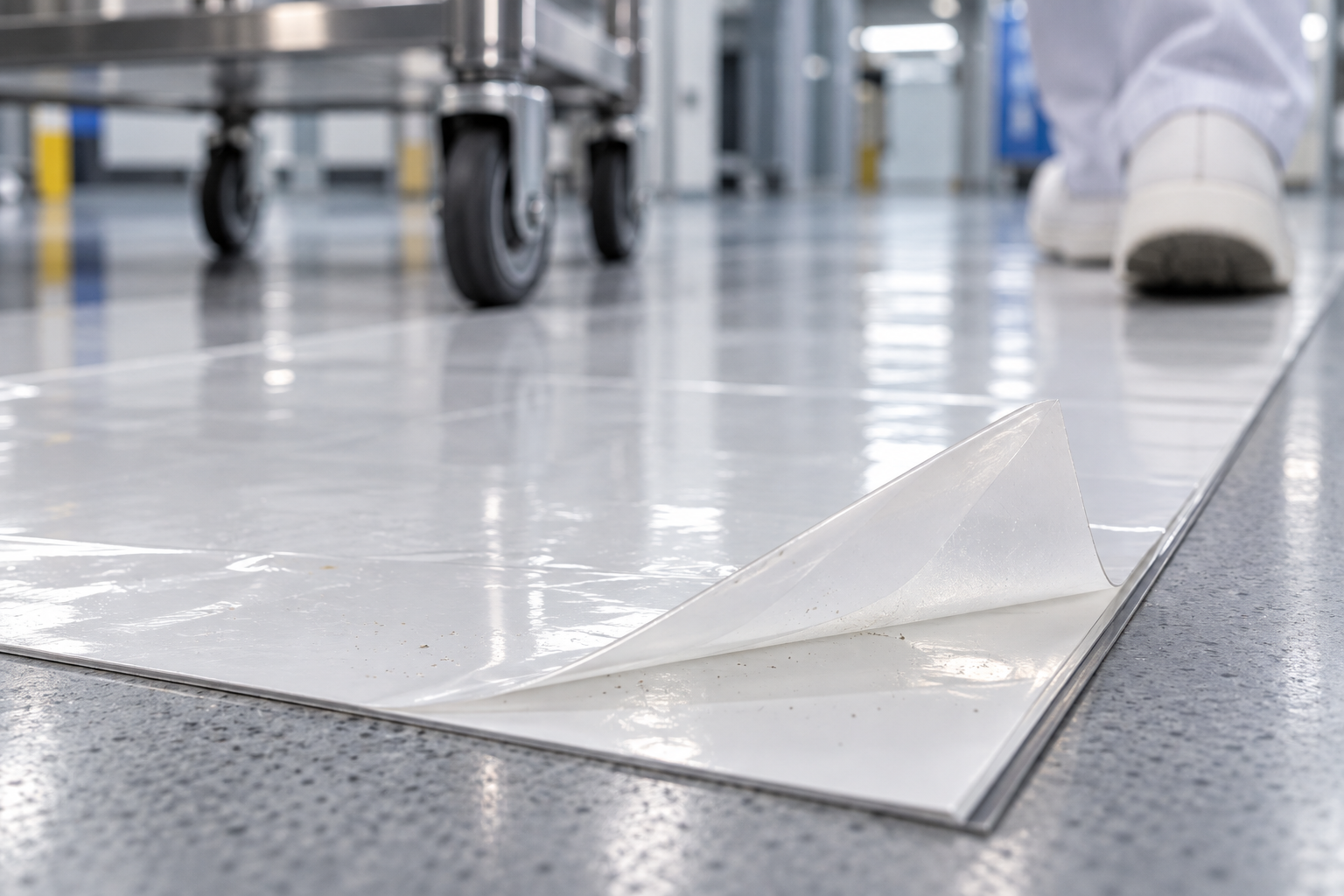
In busy controlled environments, entrances and transition points can experience a constant flow of people, trolleys, carts and wheeled equipment. While traditional peel-off sticky mats can provide a simple method of contamination control, high levels of traffic can quickly expose their limitations.
They can become saturated quickly
Peel-off mats rely on an exposed adhesive sheet to collect contamination from footwear and, in some cases, wheels. With every person or piece of equipment that crosses the mat, more dirt, dust and particles accumulate on the surface.
In a high-traffic area, the exposed sheet can become saturated relatively quickly. As contamination builds up, less clean adhesive surface is available to make effective contact with the next shoe or wheel.
This makes performance highly dependent on monitoring. Sheets need to be identified as saturated and peeled away at the right time, potentially several times throughout a busy shift.
Wheeled traffic can cause additional problems
Peel-off mats can also be challenging where there is frequent movement of trolleys, carts or other wheeled equipment.
The combination of wheel weight, movement and contact with an adhesive surface can place greater stress on the sheet. Depending on the mat and traffic involved, sheets can lift, wrinkle, tear or become caught around wheels, potentially disrupting movement through the area.
If a mat is damaged, it may then require immediate attention or replacement, adding another intervention in an already busy environment.
Peeling can disturb collected contamination
There is also the question of what happens to contamination once it has been collected.
A heavily saturated sheet contains the particles and debris picked up from repeated traffic. When that sheet is peeled away, handling and movement of the contaminated material creates an opportunity for some of that contamination to be disturbed or redistributed into the surrounding environment, particularly if sheets have been allowed to become heavily loaded before removal.
The contaminated sheet then needs to be handled and disposed of appropriately before a fresh adhesive layer can be exposed.
More traffic means more maintenance and waste
In high-traffic areas, this cycle can happen repeatedly: the surface becomes loaded, someone needs to identify when it requires changing, peel away the used sheet, dispose of it and expose a fresh layer.
As traffic increases, so can the frequency of these interventions, resulting in greater maintenance demands and more single-use plastic waste. More frequent sheet replacement can also increase ongoing costs, as peel-off mats need to be replenished more regularly to keep pace with demand.
Performance also relies heavily on staff recognising when a sheet has become saturated and replacing it at the right time. If this process is delayed or inconsistent, the mat may remain in use beyond its most effective point.
A different approach to high-traffic contamination control
Rather than relying on disposable adhesive sheets, Dycem contamination control mats have a naturally tacky polymeric surface to attract, capture and retain contamination from shoes and wheels.
The surface is designed to withstand repeated pedestrian and wheeled traffic without layers that need to be peeled away. Contamination is removed through regular cleaning, which restores the tacky surface ready for continued use.
Dycem can capture up to 99.9% of shoe- and wheel-borne contamination, making it suitable for busy entrances, transition points and areas where both people and wheeled equipment regularly move between environments.
Installed CleanZone and WorkZone solutions can also remain in place for approximately 3–5 years when correctly maintained, replacing the continual cycle of using and disposing of individual adhesive sheets.
For high-traffic controlled environments, the difference is simple: rather than relying on a disposable surface that becomes progressively saturated and needs to be removed, Dycem provides a reusable contamination control surface designed for continuous use.
If you’d like to try a free sample, click here.