

In a data center, air is constantly moving.
It can be pushed through raised floors, pulled through server intakes, redirected through hot aisles and cold aisles, and returned through cooling systems. While liquid cooling is also part of the cooling equation, this airflow is essential. Without it, servers and their environments cannot maintain the temperatures needed to operate reliably.
But there is an important distinction that is often overlooked.
Data center airflow is designed to move heat. In these mission critical environments, it is not designed to control contamination in the same way airflow is managed in a cleanroom.
That difference matters.
Cleanroom Airflow vs. Data Center Airflow
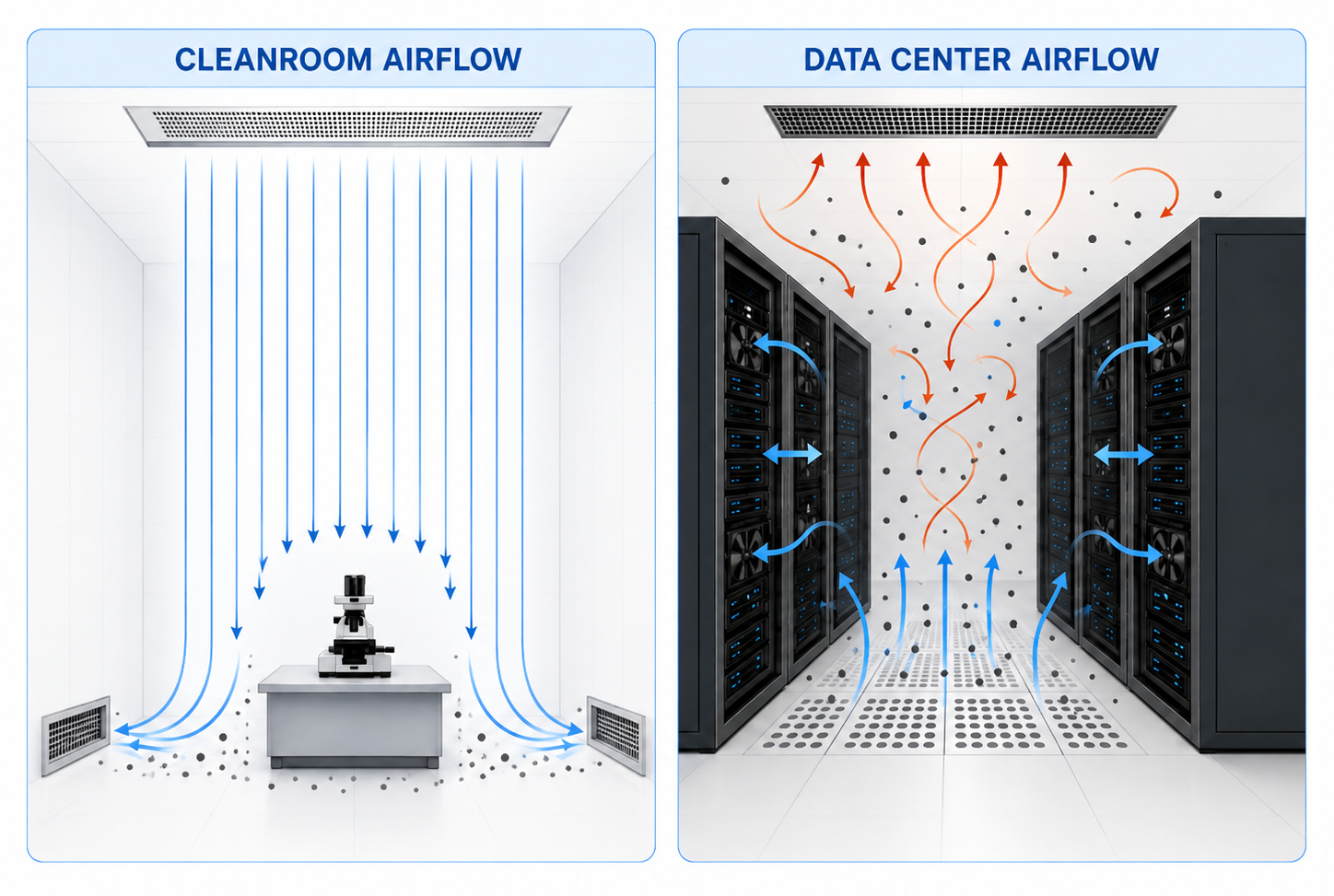
In cleanrooms, airflow is often a key part of the contamination control strategy. Depending on the classification and process requirements, cleanrooms may use unidirectional, non-unidirectional, or mixed airflow patterns to help control how particles move through the controlled space.
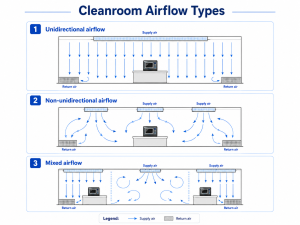
Unidirectional airflow, also referred to as laminar flow, is designed to move air in a consistent direction. In many cleanroom applications, HEPA-filtered air is pushed down from the ceiling and exits through low-level returns. This downward movement helps drive particulate away from the critical process area and toward the floor or return path, reducing the risk of particles remaining suspended or recirculating through the protected zone.
In a data center, airflow serves a different purpose. It is designed to deliver cool air to equipment and remove heat. This often means air moves upward, across aisles, and through server racks, creating more opportunity for floor-level particulate to become airborne, recirculate with rising warm air, and travel toward ceiling-level intakes or return pathways.
That means dust, fibers, and debris introduced at floor level may not stay on the floor. Once disturbed by foot traffic, wheels, fans, or pressure changes, particles can become part of the airflow moving through the data hall.
Data halls generally fall closest to mixed or non-unidirectional airflow. They are engineered environments, but they are not designed to behave like cleanrooms. The airflow is high-volume, forceful, and often turbulent.
Data Center Airflow Is Built for Cooling
The primary goal of airflow in a data center is thermal management.
Cool air must reach the equipment. Server fans pull that air through the racks, across internal components, and out into hot aisles or return pathways. Cooling systems then remove heat from the environment and recirculate conditioned air back into the space.
This airflow is critical to uptime and performance, but it also creates a unique contamination challenge.
The same air that cools equipment can also carry particulate contamination. Because data center airflow is constantly being pushed, pulled, lifted, and recirculated, particles do not always remain where they enter. Dust, fibers, debris, and other contaminants can be lifted from floors, disturbed by foot and wheel traffic, and carried into the moving air.
Once airborne, these particles can travel through aisles, cooling pathways, and equipment intakes. Beinng pushed into servers and other equipment is the biggest concern around maintaining this critical (and expensive) equipment for longevity and efficiency of these units.
How Particulate Moves Through a Data Hall
Particulate contamination can enter a data center in many ways:
- Shoes and wheels
- Carts and equipment
- Packaging materials
- Construction or maintenance activity
- Loading areas
- Outdoor dust and debris
- Raised floor access points
Once these contaminants enter the data hall, the airflow environment will move them far beyond the original entry point.
This means particles introduced at floor level can become part of the cooling process. They may be pulled toward server intakes, carried into rack rows, or redistributed throughout the space by turbulent air movement.
Why This Matters for Server Performance
Servers depend on airflow to operate efficiently. When particulate accumulates on equipment, filters, fans, vents, or internal components, it can and will interfere with the movement of air.
Over time, contamination may contribute to:
- Reduced cooling efficiency
- Increased fan demand
- Higher operating temperatures
- Greater maintenance requirements
- Potential reliability concerns
- Shortened equipment lifespan
Even small particles can become a larger issue when they build up over time or settle in sensitive areas.
For facilities focused on uptime, energy efficiency, and long-term equipment protection, contamination control should be part of the broader environmental strategy.
Controlling Contamination Before It Enters the Airflow
Cleaning and filtration remain important, but they are not the only line of defense. By the time particles are airborne, they may already be moving through critical cooling pathways.
A more proactive approach starts at the point of entry.
Dycem contamination control solutions are designed to capture and retain contamination from shoes and wheels before it can be tracked into critical areas. Installed at entrances, transition zones, loading areas, and access points, Dycem helps reduce the amount of particulate entering the controlled environment in the first place.
For data centers, this is especially important because floor-level contamination does not always stay on the floor. In a high-volume airflow environment, particles can quickly become part of the air your servers are breathing.
By reducing particulate at the source, data centers can help protect the air moving through their equipment, support cooling efficiency, and reduce unnecessary contamination-related risk.
Your servers are breathing the air around them every second of every day.
The cleaner that air is, the better protected your critical infrastructure becomes.
Reduce Risk with Dycem
Dycem helps data centers control contamination before it enters critical spaces. Contact our team to learn how contamination control zones can support cleaner airflow, equipment protection, and long-term performance.
Sources
- YouTube: Data Center Airflow Management
- AKCP: Airflow Management Plan for Data Centers
- RackSolutions: A Beginner’s Guide to Data Center Airflow Management
- Enconnex: Data Center Airflow Principles, Benefits, and Tips
- Lawrence Berkeley National Laboratory: Data Center Airflow Management Retrofit
- Volico: Data Center Airflow Management Best Practices
- DataSpan: Tips for Data Center Airflow Management