

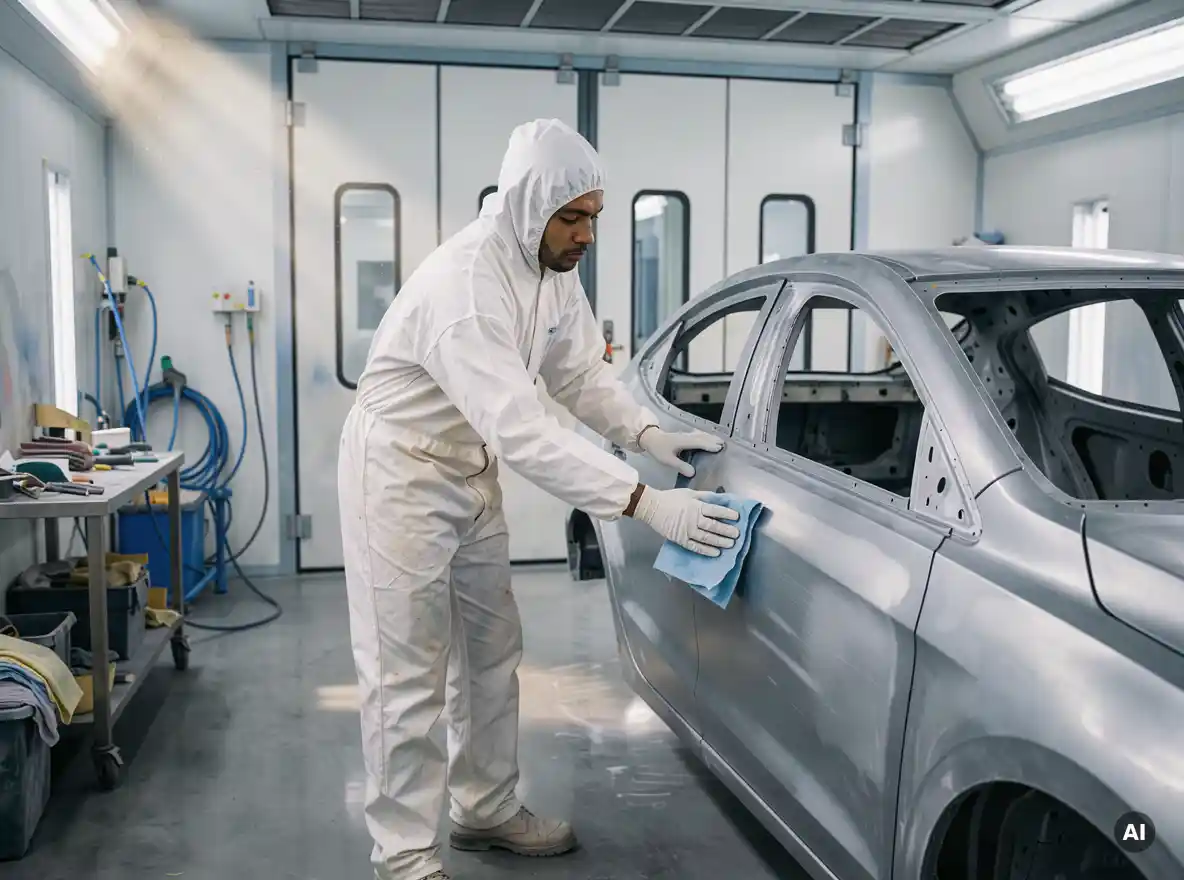
Automotive paint shops prevent dust contamination before the paint booth by layering controls: restricting and cleaning entry points, capturing particles from shoes and wheels at floor level, managing airflow and pressure in prep areas, and following disciplined cleaning routines. Each layer is then verified through inspection and defect tracking. No single measure is enough, because dust reaches the vehicle body from several directions at once. The sections below cover the sources, controls, and verification methods that matter most for dust control ahead of the booth.
Where does pre-booth dust in paint shops come from?
Pre-booth dust in paint shops comes mainly from people, wheeled equipment, incoming vehicle bodies, and the surrounding plant. Footwear, trolley wheels, garments, abrasive prep work, and open doors all introduce particles that can settle on a body and appear later as dirt defects in the paint finish.
Dycem’s contamination control experience points to the floor as a dominant route: Dycem estimates that roughly 80% of contaminants entering a controlled environment arrive at floor level, carried on shoes and wheels and then redistributed by foot traffic and air movement. The proportion will vary by facility. In a paint shop, the main sources typically include:
- Footwear and wheels: soil, grit, and fibres tracked in from loading areas, walkways, and adjoining production zones.
- Personnel: lint and fibres from clothing, hair, and gloves, plus particles shed during movement.
- Vehicle bodies and parts: dust and debris carried on bodies, fixtures, and skids from upstream processes.
- Prep activity: sanding, masking, and sealing generate particulate close to the booth entrance.
- Plant environment: dust drawn in through doors, material transfer points, and uncontrolled openings.
Understanding which of these dominate in a given facility determines where controls will have the greatest effect.
How do entry controls stop contaminants from reaching the booth?
Entry controls stop contaminants by creating a defined transition between the general plant and the paint preparation zone, so particles are removed before people and equipment move deeper into the process. Effective entry control combines restricted access, garment and footwear practices suited to the finish quality required, and floor-level capture at every threshold.
A practical approach uses zoning, with progressively cleaner areas separated by clear boundaries. Common elements include:
- Limiting access to trained personnel with a genuine need to enter.
- Providing a changing point where street clothing is replaced with lint-controlled garments.
- Using dedicated or cleaned footwear for the prep area.
- Controlling material and equipment transfer so carts, tools, and fixtures are cleaned or swapped at the boundary.
- Installing particle capture flooring at each entry and transition point.
Automotive finishing does not follow pharmaceutical or food regulations, but the underlying principle is the same: stop contamination at the boundary rather than chase it afterwards. The exact level of control should reflect the finish quality targets and defect data of the individual facility.
What flooring solutions capture dust from shoes and wheels?
Contamination control flooring captures dust from shoes and wheels by holding particles in place so they are not carried further into the prep area. Options include disposable sticky mats and reusable polymeric mats. Reusable mats can be washed and returned to service, while disposable sheets need frequent peeling and replacement.
Dycem polymeric mats are designed to attract, capture, and retain particles from footwear and wheels. Dycem reports capture of up to 99.9% of shoe and wheel contaminants under its own testing conditions; results in a working facility will depend on traffic, mat placement, and cleaning routines. Because the surface is washable, performance is restored by cleaning rather than by discarding layers, which also reduces single-use plastic waste. For a comparison of approaches, see Dycem’s overview of sticky mats and their limitations.
Choosing between mat types by traffic
The right product depends on what crosses the floor. Dycem CleanZone is built for pedestrian and light-wheeled traffic, which suits personnel entrances, changing areas, and corridors leading to prep zones. Where forklifts, pallet trucks, or heavy carts operate, Dycem WorkZone is designed for heavy-duty wheeled traffic. Matching the product to the traffic type helps prevent premature wear and maintain capture performance.
Placement matters as much as product
Mats work best when particles cannot bypass them. Position them across the full width of the doorway or corridor so every step and wheel rotation makes contact. Size them to allow several footsteps on the surface, and avoid gaps at the edges where traffic can skirt around. Mats complement, rather than replace, filtration, garment control, and a documented cleaning programme.
How should airflow and pressure be managed outside the booth?
Airflow and pressure outside the booth should be managed so that air does not draw dust in from the plant towards vehicle bodies. In practice this means filtered supply air to the prep area, a pressure strategy suited to the facility layout, and minimal turbulence near vehicle bodies.
Key considerations include:
- Filtered make-up air: supply air passing through appropriate filtration reduces airborne particulate entering the prep zone.
- Pressure relationships: many facilities keep the prep area at slight positive pressure relative to dustier surrounding areas to limit inward leakage, but the right strategy depends on the layout, fume and overspray control needs, and the paint system design. The booth itself is typically controlled according to its own design.
- Door and opening discipline: doors left open or opened frequently undermine pressure differentials, so interlocks, vestibules, or fast-acting doors can help.
- Air patterns: avoid fans, open vents, or layouts that stir settled dust and blow it across vehicle bodies.
Pressure and airflow design should be validated against the paint system manufacturer’s requirements, applicable health and safety rules, and the facility’s own engineering standards. Floor-level contamination control supports this work by reducing the dust load that air handling would otherwise have to manage, since particles held in a mat are not available to be lifted back into the air.
What cleaning routines keep prep areas dust-free?
Prep areas stay dust-free through scheduled, documented cleaning that removes settled particulate without redistributing it. Effective routines clean from the cleanest point outward and from top to bottom, using methods such as damp wiping or vacuuming with suitable filtration instead of dry sweeping or compressed air.
A workable routine often includes the following, with frequencies adjusted to the facility rather than treated as fixed rules:
- Per shift: wipe high-touch surfaces, fixtures, and carts; check entry mats for visible build-up.
- Daily: clean floors using vacuum or damp methods, and clean tack rails, benches, and tooling.
- Weekly or as needed: deep clean walls, ceilings, light fittings, and ledges where dust accumulates.
- Review: adjust frequency according to defect data and visible dust load.
Reusable mats need their own cleaning schedule. Cleaning restores their capture surface, so follow the manufacturer’s guidance, including Dycem’s instructions on cleaning Dycem mats, for the approved method. Antimicrobial properties in a mat support hygiene but do not replace cleaning, disinfection, or monitoring.
How can paint shops tell if contamination controls are working?
Paint shops can tell whether contamination controls are working by tracking dirt-related paint defects alongside direct measurements of particulate in the prep area and on surfaces. A sustained reduction in dirt defects, together with stable or falling particle counts, indicates the controls are effective.
Useful verification methods include:
- Defect tracking: record dirt and inclusion defects by location, shift, and vehicle position to link problems to specific sources.
- Air and surface sampling: airborne particle counters measure particles in the air, while tape lift and wipe tests assess what has settled on surfaces. These measure different things and are most useful when used together to compare conditions over time.
- Visual inspection: check mats and thresholds for build-up and bypassed paths.
- Pressure checks: confirm differentials and door behaviour remain as designed.
- Audit of routines: verify that cleaning and entry procedures are actually followed.
Establish a baseline before making changes so improvements can be attributed to the right measure. Where reusable mats are already installed, Dycem’s particle collection efficiency testing can show whether they are still performing as intended and help guide maintenance or replacement decisions.
Preventing dust before the paint booth is a matter of closing off each pathway in turn, starting at the floor where much of the contamination enters. Facilities that combine entry discipline, suitable flooring, controlled airflow, consistent cleaning, and data-led verification are best placed to reduce rework and protect finish quality. For a tailored view of where dust is entering a specific facility, arrange a complimentary site survey with a Dycem contamination control specialist.
Frequently Asked Questions
Where should I start if my paint shop has a high dirt defect rate but limited budget?
Begin by establishing a baseline: log dirt and inclusion defects by location, shift, and vehicle position for a few weeks. Use that data to identify the dominant source, which is often floor-level traffic at entry points and transitions. Then tackle the highest-impact, lowest-cost fixes first, such as installing contamination control mats across the full width of key entrances, enforcing door discipline, and replacing dry sweeping or compressed air with damp wiping or filtered vacuuming.
What are the most common mistakes that undermine pre-booth dust control?
Typical mistakes include mats that are too small or leave gaps so traffic can bypass them, using compressed air or dry sweeping that redistributes dust, propping doors open and breaking pressure differentials, and letting carts and fixtures move from dirty areas into prep zones without cleaning or swapping. Another frequent error is relying on a single measure, such as filtration alone, instead of layering controls at the floor, the doors, the air, and the cleaning routine.
What if forklifts or heavy carts need to cross the entry point to the prep area?
Choose flooring rated for the traffic it will carry. Pedestrian and light-wheeled traffic suits a product like Dycem CleanZone, but forklifts, pallet trucks, and heavy carts call for a heavy-duty option such as Dycem WorkZone. Where possible, also swap or clean wheeled equipment at the boundary, and use dedicated carts inside the prep zone so fewer contaminated wheels cross the threshold.