

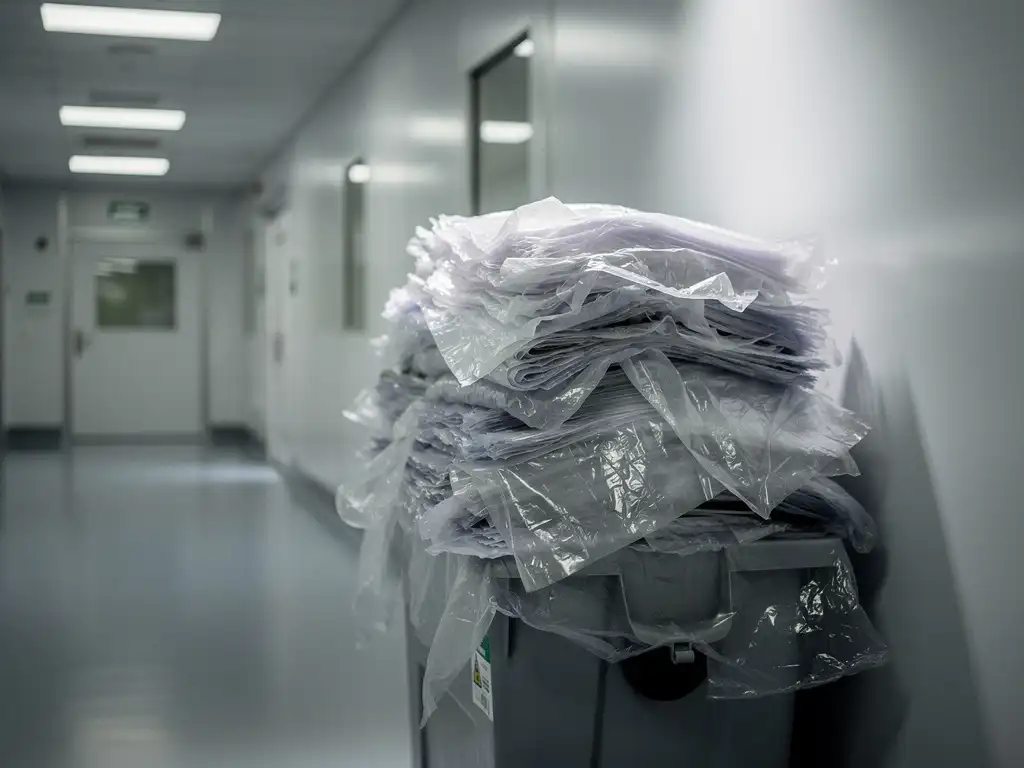
Reusable floor mats reduce industrial plastic waste by replacing single-use disposable sticky mats with long-lasting polymeric alternatives that perform for three to five years before requiring replacement. Where a disposable mat is discarded after a set number of peel-off layers, a reusable contamination control mat is cleaned, maintained, and returned to service, eliminating the continuous cycle of plastic waste that regulated facilities generate at every entry point. The sections below address the most common questions facilities managers raise when evaluating the switch.
How much plastic waste do disposable sticky mats generate?
Disposable sticky mats generate a significant and continuous volume of plastic waste because each mat consists of multiple laminated polyethylene layers that are peeled away and discarded as they become saturated with contaminants. A single high-traffic entry point can consume dozens of mat layers per week, adding up to hundreds of discarded plastic sheets per year at just one location in a facility with multiple controlled zones.
The waste accumulation compounds quickly in larger operations. A pharmaceutical manufacturer with ten cleanroom entry points, for example, may discard thousands of individual plastic layers annually. Each layer is typically non-recyclable due to the adhesive coating and the contaminants it has captured, meaning the material goes directly to landfill. For facilities with strong ESG commitments or regulatory expectations around environmental responsibility, this volume of single-use plastic waste has become increasingly difficult to justify.
Beyond the volume of material discarded, the procurement cycle itself creates additional packaging waste. Disposable mats are shipped in bulk, wrapped in plastic, and replaced on a rolling basis, compounding the environmental footprint of a solution that was never designed with the end of its life in mind.
How do reusable contamination control mats work?
Reusable contamination control mats work by using a high-tack polymeric surface to attract, capture, and retain particulates from shoes and wheels as personnel and equipment pass over them. Unlike adhesive peel-off mats that trap contamination in disposable layers, reusable mats are cleaned on a regular schedule and returned to full performance, making them a permanent fixture rather than a consumable product.
The mechanism relies on the physical and electrostatic properties of the mat’s polymer surface. As foot traffic or wheeled equipment crosses the mat, contaminants including dust, fibres, and microparticles transfer from soles and tyres onto the mat surface. Dycem’s contamination control mats are engineered to capture up to 99.9% of floor-level particulates at the point of entry, preventing them from migrating into controlled environments.
Built-in Biomaster silver-ion antimicrobial technology adds a further layer of protection by inhibiting microbial growth on the mat surface by up to 99.9%. This is particularly relevant in pharmaceutical, medical device, and food production environments where microbial contamination carries compliance and product safety implications. The mat is cleaned using standard cleaning protocols, which restore the surface’s capture performance without degrading the material, and the process repeats across a three-to-five year operational lifespan.
What is the environmental impact of switching from disposable to reusable mats?
Switching from disposable sticky mats to reusable contamination control mats substantially reduces the volume of single-use plastic a facility sends to landfill each year. Because a reusable mat operates for three to five years without replacement, it eliminates the ongoing production, packaging, shipping, and disposal cycle that disposable mats require, lowering the facility’s material consumption and associated carbon footprint across its entire service life.
The environmental benefit scales with the size of the facility and the number of entry points in use. A site that previously cycled through hundreds of disposable mat layers per month replaces that consumption with a fixed installation that requires only water and cleaning agents to maintain. This reduction in material throughput directly supports ESG reporting targets and aligns with corporate sustainability commitments that procurement and operations leaders are increasingly required to evidence.
Reusable mats also reduce the indirect environmental costs associated with disposable alternatives. Frequent deliveries of replacement stock, the energy used in manufacturing single-use layers, and the logistics of waste disposal all contribute to a disposable mat’s total environmental footprint. Removing those inputs from the equation makes reusable contamination control a measurably more sustainable choice for facilities operating under environmental management frameworks such as ISO 14001.
Are reusable floor mats as effective as disposable sticky mats at controlling contamination?
Reusable floor mats are at least as effective as disposable sticky mats at controlling contamination, and in several measurable respects they outperform them. Dycem’s polymeric mats capture up to 99.9% of floor-level particulates, a performance level that disposable mats can only sustain when their top layer is fresh. As a sticky mat layer fills with contaminants, its capture efficiency declines until the layer is peeled away, creating variable performance between changes.
Reusable mats maintain consistent performance across their lifespan because cleaning restores the surface rather than removing it. There is no degradation curve between cleaning cycles that is comparable to the saturation problem inherent in adhesive layers. This consistency is important in regulated environments where contamination control must be demonstrable and repeatable, not dependent on how recently a disposable layer was changed.
The antimicrobial protection built into reusable mats also has no equivalent in standard disposable sticky mats. Silver-ion technology inhibits microbial growth continuously, rather than simply trapping particles until the layer is discarded. For cleanrooms, gowning areas, and pharmaceutical manufacturing environments where microbial contamination is a specific compliance risk, this represents a meaningful performance advantage over disposable alternatives.
Which industries are making the switch to reusable contamination mats?
Industries where contamination control is a regulatory requirement rather than an operational preference are leading the transition from disposable sticky mats to reusable alternatives. Pharmaceutical manufacturing, medical device production, food and beverage processing, electronics, aerospace, and automotive sectors are among the most active in adopting reusable contamination control mats, driven by a combination of compliance pressure, cost efficiency, and sustainability commitments.
In pharmaceutical and medical device facilities, GMP compliance and FDA audit readiness make consistent, validated contamination control essential. Reusable mats with documented performance data and ISO-certified manufacturing provide the evidence base that quality managers need to justify their contamination control programme. Global organisations including GSK, Abbott, and Pfizer have adopted Dycem’s solutions for exactly this reason.
In electronics and aerospace, where particulate contamination can compromise product integrity at a microscopic level, the consistency of reusable mats offers a reliability advantage over disposable alternatives. Companies such as Intel, Sony, Airbus, and Lockheed Martin operate in environments where contamination failure has significant downstream consequences, making long-term performance and traceability important factors in supplier selection.
Food and beverage manufacturers are increasingly replacing disposable mats in response to both hygiene standards and internal sustainability targets. The combination of antimicrobial protection, cleanability, and reduced single-use plastic waste makes reusable contamination control mats a strong fit for food-safe environments where both product integrity and environmental responsibility are under scrutiny.
What should facilities consider when replacing disposable mats with reusable ones?
When replacing disposable sticky mats with reusable contamination control mats, facilities should evaluate traffic volume, zone classification, mat placement, cleaning protocols, and total cost of ownership. These factors determine which mat format is appropriate for each entry point and how the transition should be structured to maintain contamination control performance without operational disruption during the changeover.
- Traffic type and volume: Pedestrian-only areas and light-wheeled traffic zones have different requirements from heavy industrial routes used by forklifts and pallet trucks. Mat selection should reflect the actual load and frequency at each entry point.
- Zone classification: Cleanroom entrances, gowning rooms, airlocks, and critical corridors each carry different contamination risk levels. Mat placement should be mapped against the facility’s zone plan to ensure coverage at the highest-risk transition points.
- Cleaning integration: Reusable mats require a defined cleaning schedule to maintain performance. Facilities should confirm that their existing cleaning protocols or service arrangements can accommodate the mat maintenance requirements before installation.
- Size and configuration: Entry points vary in width, layout, and foot traffic pattern. Reusable mats can be sized and configured to match specific facility layouts, including multi-mat arrangements for wider corridors or high-volume zones.
- Total cost of ownership: The upfront investment in reusable mats is higher than a box of disposable alternatives, but the three-to-five year lifespan and elimination of recurring replacement costs typically result in a lower total cost over time. Procurement teams should model this comparison across a realistic operational period.
- Regulatory documentation: For facilities subject to GMP, ISO, or FDA requirements, it is worth confirming that the chosen mat solution comes with the quality documentation and compliance credentials needed to satisfy auditors.
A site survey conducted before installation helps match the right solution to each location, reducing the risk of under-specifying in high-traffic areas or over-engineering in lower-risk zones.
How Dycem helps reduce industrial plastic waste through reusable contamination control
Dycem’s range of reusable contamination control mats is engineered to replace disposable sticky mats with a long-term, high-performance alternative that reduces plastic waste, lowers total cost of ownership, and supports compliance in regulated environments. Key benefits include:
- Capture of up to 99.9% of floor-level particulates at facility entry points
- Built-in Biomaster silver-ion antimicrobial protection inhibiting microbial growth by up to 99.9%
- A three-to-five year operational lifespan that eliminates the recurring cycle of disposable mat replacement
- ISO-certified manufacturing meeting EN ISO 9001 and 14001 standards, California Proposition 65, and EU REACH compliance
- A product range covering pedestrian zones, heavy-wheeled traffic areas, and flexible or temporary installations
- Significant reduction in single-use plastic waste to support ESG goals and sustainability reporting
Dycem’s contamination control specialists are available to assess your facility, identify the right solution for each entry point, and provide a free site survey. Contact Dycem today to start the conversation.