

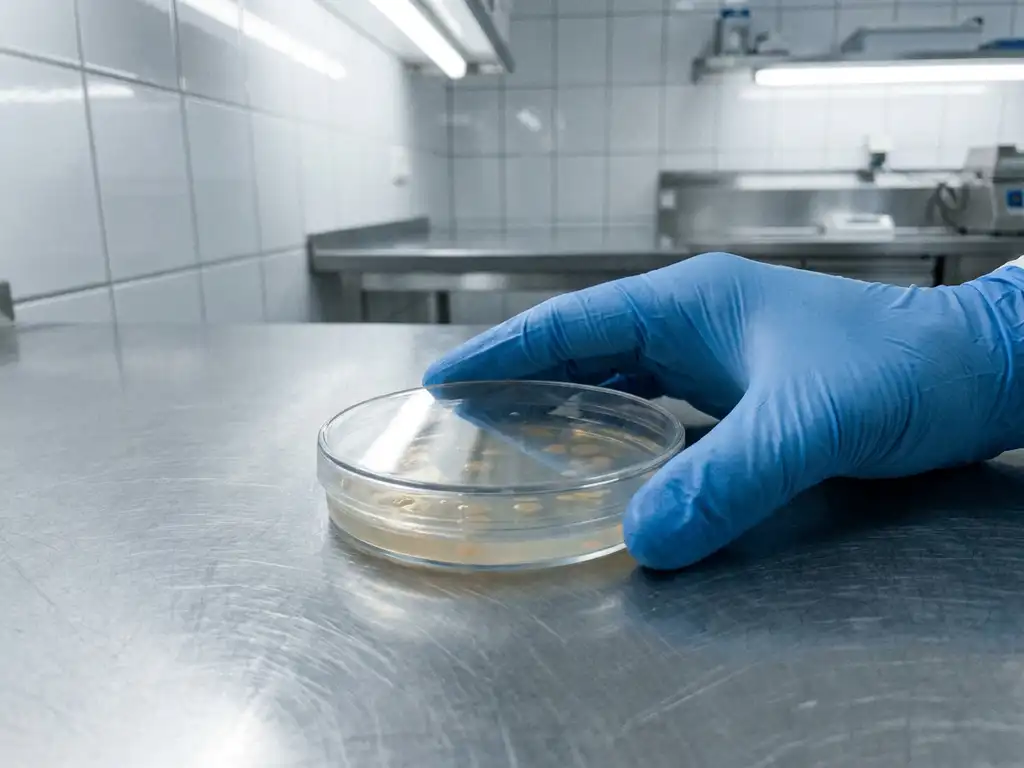
Surface materials in food facilities directly affect bacterial growth by influencing how easily microorganisms can attach, survive, and multiply. Porous, rough, or damaged surfaces provide physical refuges where bacteria accumulate and form biofilms that are resistant to standard cleaning protocols. For food production environments, the choice of surface material is not an aesthetic decision; it is a hygiene and compliance decision with direct consequences for product safety.
Different materials carry very different contamination risk profiles, and understanding those differences helps Quality, EHS, and Facilities Managers make better decisions about surfaces, flooring, and entry-point controls. The sections below address the most common questions around surface materials, bacterial behaviour, and contamination management in food manufacturing environments.
Which surface materials harbour the most bacteria in food facilities?
Porous and rough surface materials harbour the most bacteria in food facilities. Wood, concrete, grout lines, and corroded or scratched stainless steel all create physical spaces where bacteria can lodge, survive, and form biofilms that resist cleaning. Smooth, non-porous materials such as sealed stainless steel, food-grade polymers, and coated epoxy flooring are significantly easier to decontaminate.
Untreated concrete is one of the highest-risk materials in food production environments. Its open pore structure absorbs moisture and organic material, creating conditions where bacteria such as Listeria monocytogenes and Salmonella can persist even after routine cleaning. Cracked or degraded concrete compounds this risk by creating recesses that are physically inaccessible to mops, scrubbers, and disinfectants.
Stainless steel is widely used in food processing precisely because it is non-porous and corrosion-resistant, but surface damage changes this entirely. Scratches from abrasive cleaning tools create microscopic grooves where bacteria adhere and multiply. Once biofilm establishes in these grooves, standard sanitation may not be sufficient to eliminate it.
Wood is largely prohibited in regulated food manufacturing zones for this reason. Its natural porosity and tendency to absorb moisture make it impossible to reliably sanitise, and it represents an unacceptable contamination risk in any area where food contact or proximity is involved.
How does surface texture affect bacterial adhesion and biofilm formation?
Surface texture directly affects bacterial adhesion because rougher surfaces offer more contact points and physical protection for microbial cells. Bacteria are more likely to adhere to irregular surfaces, and once attached, they produce extracellular polymeric substances that form a biofilm, a structured community that is significantly harder to remove than free-floating bacteria.
Biofilm formation is a staged process. Initial attachment occurs within minutes of bacterial contact with a surface. If the surface texture allows cells to settle into grooves or pits, mechanical cleaning becomes less effective because the biofilm is partially shielded from the physical action of scrubbing and the chemical action of disinfectants.
Surface roughness is typically measured using Ra values (arithmetic mean roughness). Food industry guidance and standards generally recommend surfaces with Ra values below 0.8 micrometres for food contact areas, as smoother surfaces reduce adhesion sites and make cleaning more effective. Surfaces that exceed this threshold, whether by design or through wear and damage, present an elevated risk of persistent bacterial contamination.
Regular surface inspection is therefore as important as regular cleaning. A surface that was compliant at installation may develop roughness over time through use, abrasive cleaning, or chemical degradation. Facilities should incorporate surface condition assessments into their hygiene management programmes to catch deterioration before it becomes a contamination liability.
What role do floors and floor-level surfaces play in food facility contamination?
Floors and floor-level surfaces play a central role in food facility contamination because they are the primary pathway through which external contaminants enter controlled production zones. Foot traffic and wheeled equipment continuously transfer particulates, moisture, and microorganisms from lower-hygiene areas into higher-hygiene zones, making floor-level contamination management a critical control point.
Research into contamination pathways consistently identifies the floor as the dominant entry route for particulates in controlled environments. Contaminants tracked in on footwear and equipment wheels can become airborne through foot movement and equipment vibration, spreading beyond the immediate floor surface and reaching product contact areas, open packaging, and processing equipment.
Floor drains, floor joints, and the junctions between floors and walls are particularly high-risk zones. These areas trap organic material, retain moisture, and are often difficult to clean thoroughly. Listeria is known to colonise floor drains in food processing facilities and can persist for extended periods if drainage design and cleaning protocols are inadequate.
Floor material selection matters significantly. Epoxy coatings and polyurethane systems designed for food environments offer seamless, impervious surfaces that eliminate grout lines and joints. However, even these materials require proper installation, maintenance, and the management of entry points to prevent external contamination from being carried in before floor-level controls can act.
Are antimicrobial surfaces effective at reducing bacterial growth in food production?
Antimicrobial surfaces are effective at reducing bacterial growth in food production when used as part of a broader hygiene strategy. They work by incorporating agents, most commonly silver ions, copper compounds, or specific polymers, that inhibit microbial attachment and proliferation. However, antimicrobial surfaces are not a standalone solution and should complement, not replace, validated cleaning and sanitation programmes.
Silver-ion technology is among the most widely validated antimicrobial mechanisms for food-adjacent environments. Silver ions disrupt bacterial cell membranes and interfere with metabolic processes, inhibiting the growth of a broad spectrum of microorganisms. This technology is durable, does not leach harmful chemicals, and maintains activity over extended periods, making it well suited to surfaces and equipment that require long-term protection.
The effectiveness of any antimicrobial surface depends on its condition. A surface that has been scratched, chemically degraded, or physically damaged will lose both its antimicrobial properties and its cleanability. Facilities should therefore select antimicrobial materials rated for the cleaning chemicals and physical demands of their specific environment.
It is also important to distinguish between antimicrobial surfaces that inhibit growth and those that claim to eliminate bacteria entirely. Inhibition reduces the rate at which bacteria multiply between cleaning cycles, lowering overall microbial load and the risk of cross-contamination. Elimination requires validated disinfection processes. Both are necessary components of a robust food facility hygiene programme.
How do entry-point surfaces contribute to cross-contamination between zones?
Entry-point surfaces contribute to cross-contamination between zones by acting as transfer points where contaminants from lower-hygiene areas are carried into higher-hygiene production environments. Every time a person or piece of equipment crosses a zone boundary, the surfaces at that transition point, floors, mats, walls, door frames, influence whether contamination is captured or allowed to progress.
Zone segregation is a fundamental principle in food facility design, but physical barriers alone do not prevent microbial transfer. Footwear is one of the most significant vectors: soles collect contaminants from external areas, loading bays, and lower-hygiene zones, and then deposit those contaminants directly onto production floor surfaces. Wheeled equipment such as trolleys, pallet trucks, and forklifts follow the same principle at a larger scale, with wheels capable of carrying substantial particulate and microbial loads across zone boundaries.
Entry-point surface management therefore requires active contamination capture, not just passive separation. Smooth, cleanable surfaces at transition points reduce the likelihood of contamination accumulating, but they do not capture particles already attached to footwear or wheels. Purpose-designed contamination control mats placed at zone entry points provide a physical capture mechanism, removing particulates from shoes and wheels before they cross into controlled areas.
The design and maintenance of entry-point surfaces also matters. Recessed or damaged flooring at doorways and transition points creates areas where contamination accumulates and is difficult to remove. Facilities should treat entry points as dedicated control zones with their own cleaning frequency, surface condition monitoring, and contamination capture measures.
What surface and flooring standards apply to food manufacturing facilities?
Food manufacturing facilities must comply with a range of surface and flooring standards that govern material selection, finish, and maintenance. Key frameworks include the EU Food Hygiene Regulation (EC) No 852/2004, FDA Food Safety Modernization Act (FSMA) requirements, and BRCGS Global Standard for Food Safety, all of which specify that surfaces in food production areas must be smooth, durable, impervious, and easy to clean and disinfect.
These standards share common principles regardless of geography. Surfaces that contact or are adjacent to food must be non-toxic, non-absorbent, and resistant to the cleaning chemicals used in the facility. Flooring must be resistant to cracking and damage from operational loads, and must not create standing water or drainage issues that could support bacterial growth.
ISO standards also apply in many food manufacturing contexts, particularly where facilities operate cleanroom or controlled environment areas. ISO 14644 governs cleanroom classification and surface cleanliness, while ISO 22000 provides a food safety management system framework that encompasses environmental hygiene requirements including surfaces and flooring.
Facilities pursuing BRCGS, SQF, or IFS certification will be assessed against detailed requirements for surface condition, cleanability, and the management of entry and transition points. Auditors will look for evidence that surface materials were selected with hygiene in mind, that surfaces are maintained in good condition, and that cleaning validation demonstrates effective decontamination of all surfaces in the facility.
How Dycem helps with contamination control in food facilities
Dycem’s reusable contamination control mats are engineered to address one of the most persistent hygiene challenges in food manufacturing: contaminants entering controlled zones via foot traffic and wheeled equipment. Key benefits include:
- Up to 99.9% particulate capture from footwear and equipment wheels at zone entry points, reducing the microbial load carried into production areas
- Built-in Biomaster silver-ion antimicrobial technology that inhibits microbial growth by up to 99.9%, providing continuous protection between cleaning cycles
- Reusable polymer construction with a 3 to 5 year lifespan, eliminating the recurring cost and waste of disposable sticky mats
- ISO-certified manufacturing in compliance with EN ISO 9001 and 14001, California Proposition 65, and EU REACH regulations, supporting audit readiness and regulatory compliance
- Tailored configurations to suit complex facility layouts, traffic flows, and zone transition requirements, including the Dycem CleanZone for pedestrian areas and the Dycem WorkZone for heavy-wheeled traffic
For food facilities looking to strengthen their entry-point hygiene controls and reduce cross-contamination risk, Dycem offers a free site survey and consultation with a contamination control specialist. Contact Dycem today to discuss your facility’s requirements and find the right solution.