

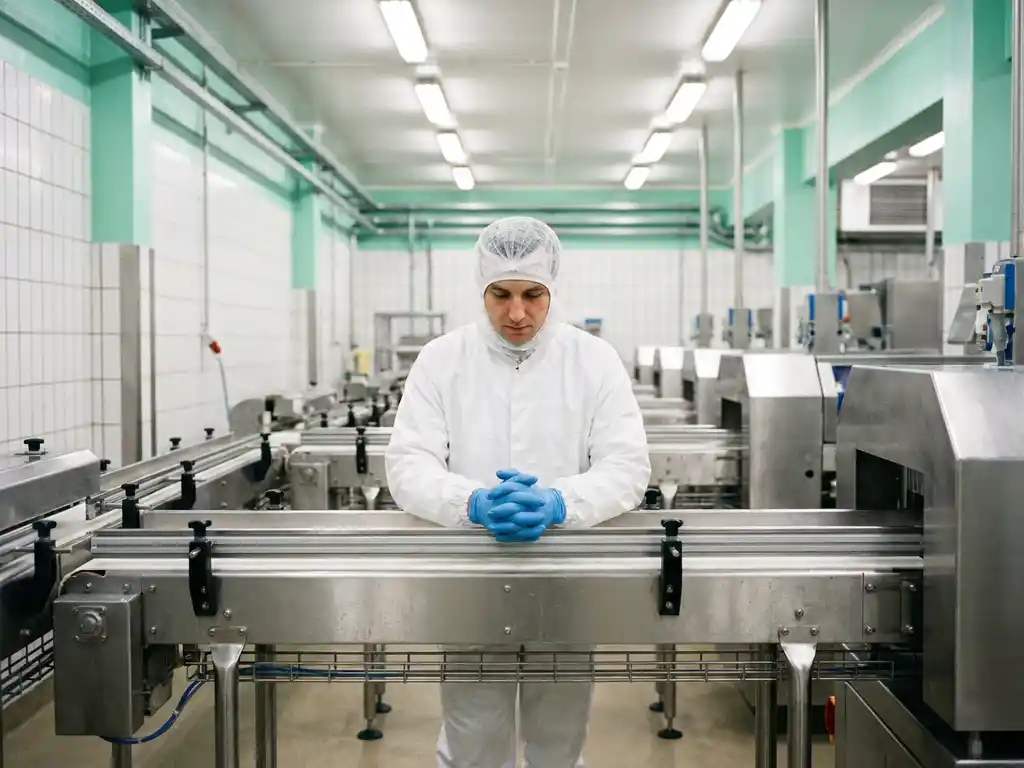
Controlling contamination risk in open-process food production areas requires a layered approach that addresses the primary entry points for contaminants: personnel movement, wheeled equipment, and airborne particles. Because food is exposed directly to the production environment in open-process settings, the margin for error is narrow and the consequences of contamination are significant. The sections below address the most common questions facilities face when building or reviewing their contamination control strategy.
What are the biggest sources of contamination in open-process food areas?
The biggest sources of contamination in open-process food production areas are personnel, equipment, and the surrounding facility environment. People moving through production zones carry microorganisms, dust, and debris on their footwear and clothing. Wheeled equipment such as trolleys, pallet trucks, and forklifts transfer particulates from loading bays and storage areas directly into production spaces. Airborne particles, condensation, and cross-contamination between raw and finished product zones also present consistent risks.
In open-process environments, food is not enclosed in packaging or sealed equipment during production, which means it is directly exposed to whatever enters the room. Unlike closed-process lines, there is no physical barrier between the product and the air, surfaces, or personnel nearby. This makes contamination prevention at the point of entry especially critical.
Common contaminants found in food production facilities include:
- Soil, dust, and biological debris carried in on footwear
- Microorganisms including bacteria, moulds, and yeasts
- Particulates transferred by wheeled traffic from non-production zones
- Allergens tracked between production areas handling different ingredients
- Lubricants, packaging fibres, and other facility-level materials
Understanding these sources is the foundation of any effective food facility contamination control programme. Each entry point requires a targeted, validated measure rather than a single generalised solution.
How does contamination enter food production facilities at the floor level?
Contamination enters food production facilities at the floor level primarily through footwear and wheeled equipment. Studies in contamination control consistently show that up to 80% of particulates entering controlled environments are tracked in at floor level. Every step a worker takes from a car park, loading bay, or corridor brings a fresh load of contaminants to the production floor, and every wheel turn from a trolley or forklift compounds that transfer.
Floor-level contamination is particularly problematic because it is largely invisible during routine operations. Particles accumulate gradually, and by the time a contamination event is detected through product testing or an audit, the source may be difficult to trace. In open-process food areas, where product contact surfaces and exposed ingredients are close to floor height, this pathway presents a direct hygiene risk.
The challenge is compounded in larger facilities where personnel and equipment move frequently between zones with different cleanliness requirements. A worker moving from a raw ingredient handling area into a ready-to-eat production zone, or a pallet truck crossing from a loading dock into a processing room, can transfer contamination with each transition unless robust controls are in place at those boundaries.
What contamination control measures are required in open-process food environments?
Open-process food environments typically require a combination of zoning, personnel hygiene protocols, equipment controls, and physical barrier solutions at entry points. Regulatory frameworks including HACCP, BRC Global Standards, and SQF set clear expectations for contamination prevention, and facilities operating under these standards must demonstrate that risks at every entry point are identified and mitigated.
Core contamination control measures for open-process food production include:
- Defined hygiene zones: Clearly separated areas with controlled access, particularly between raw and ready-to-eat production
- Gowning and PPE requirements: Dedicated footwear, protective clothing, and hair covering for personnel entering production areas
- Entry point controls: Physical solutions at doorways and transition points to prevent floor-level particulate transfer
- Cleaning and sanitation schedules: Validated cleaning regimes for floors, equipment, and surfaces
- Allergen management protocols: Segregation and control of allergen-containing ingredients to prevent cross-contact
- Pest control measures: Structural and procedural controls to prevent ingress from external environments
Entry point controls are often the weakest link in food facility contamination management. Personnel may follow gowning protocols diligently, but if footwear is not decontaminated before entering a production zone, the risk remains. Physical contamination control measures at doorways and transitions are an essential complement to procedural controls.
How do reusable contamination control mats compare to disposable sticky mats in food facilities?
Reusable contamination control mats offer significantly better long-term performance, cost efficiency, and sustainability compared to disposable sticky mats in food production environments. Disposable peel-off mats lose effectiveness as layers become saturated, require frequent replacement, and generate considerable single-use plastic waste. Reusable polymer mats maintain consistent contamination capture performance over a lifespan of three to five years and can be cleaned in place to restore full effectiveness.
In food facility environments, consistency of performance is a compliance requirement, not just an operational preference. Disposable sticky mats degrade with each use, and in high-traffic areas they can become ineffective within hours of being placed. A mat that is no longer capturing contaminants but remains in position gives a false sense of security and provides no auditable evidence of ongoing protection.
Reusable mats also address the operational frustrations that quality and facilities managers commonly face with disposable alternatives:
- No need for frequent restocking or layer-peeling during production hours
- Consistent performance validated over the mat’s full lifespan
- Reduced single-use plastic waste, supporting ESG and sustainability commitments
- Lower total cost of ownership over a three-to-five-year period compared to recurring disposable mat purchases
- Built-in antimicrobial protection to inhibit microbial growth between cleaning cycles
For food facilities operating under BRC, SQF, or FSSC 22000 certification, the ability to demonstrate a validated, consistently performing contamination control solution at entry points is a meaningful audit advantage over disposable alternatives.
Where should contamination control mats be placed in a food production facility?
Contamination control mats should be placed at every transition point between zones of different cleanliness levels in a food production facility. The most critical locations are entrances to open-process production areas, gowning room exits, doorways between raw and ready-to-eat zones, and access points from loading bays or external environments into the facility.
Effective placement follows the contamination pathway. Because most particulates enter at floor level via footwear and wheels, mats should intercept that pathway before contaminants reach the production environment. Placing a mat only at the main facility entrance is insufficient if personnel and equipment then travel through multiple internal zones before reaching the production floor.
Key placement locations to consider include:
- Main facility entrances: First point of contact for all personnel entering from external areas
- Gowning room exits: The transition point where personnel move from changing areas into production zones
- Production area doorways: Entry points directly into open-process production rooms
- Zone boundaries: Transitions between raw ingredient handling and finished product areas
- Loading bay access points: Where wheeled equipment moves from external or storage areas into the facility
- Maintenance access routes: Entry points used by engineers or contractors who may carry additional contamination risk
Facilities with complex layouts or high traffic volumes benefit from a structured site assessment to map contamination pathways and identify the highest-risk transition points. A contamination control site survey can provide evidence-based placement recommendations tailored to a facility’s specific layout and operational flow.
How do you maintain contamination control mats to meet food safety standards?
Contamination control mats in food production facilities should be cleaned regularly using approved cleaning agents, with frequency determined by traffic volume and the contamination risk level of the zone. Maintenance records should be kept as part of the facility’s documented hygiene programme to support audit readiness and demonstrate ongoing compliance with food safety standards.
Reusable polymer mats are designed to be cleaned in place without specialist equipment. Standard cleaning procedures typically involve:
- Removing loose debris using a vacuum or dry sweep
- Applying an approved cleaning solution compatible with the mat material and the facility’s hygiene protocols
- Scrubbing or mopping the mat surface to lift embedded particulates
- Rinsing thoroughly to remove cleaning agent residue
- Allowing the mat to dry before returning it to service, or using it wet where protocols permit
In food environments, the choice of cleaning agent matters. Mats should be compatible with the disinfectants and sanitisers already in use at the facility to avoid introducing new chemical risks. Dycem’s reusable mats incorporate Biomaster silver-ion antimicrobial technology, which inhibits microbial growth by up to 99.9% between cleaning cycles, providing an additional layer of protection in high-risk food production settings.
Maintenance frequency should increase during high-production periods, following any spillage events, or when visual inspection indicates reduced surface tackiness. Documenting each cleaning event creates a traceable hygiene record that supports BRC, SQF, and FSSC 22000 audits and demonstrates that contamination controls are actively managed rather than passively relied upon.
How Dycem helps with contamination control in food production
Dycem’s reusable contamination control mats are purpose-built for the demands of food production environments, providing validated, long-lasting particulate capture at every critical entry point. Key benefits for food facilities include:
- Up to 99.9% particulate capture at floor level, intercepting contaminants before they reach open-process areas
- Biomaster antimicrobial protection built into every mat, inhibiting microbial growth by up to 99.9% between cleaning cycles
- Three-to-five-year product lifespan, reducing the cost and waste associated with disposable sticky mat programmes
- ISO-certified manufacturing compliant with EN ISO 9001 and 14001, California Proposition 65, and EU REACH regulations
- Customisable formats including CleanZone, WorkZone, and Floating Mats to suit pedestrian zones, heavy wheeled traffic, and flexible or temporary layouts
- A more sustainable alternative to single-use peel-off mats, supporting ESG commitments and reducing single-use plastic waste
Dycem’s contamination control specialists work with food facilities to assess entry points, map contamination pathways, and recommend the right solution for each zone. To arrange a free site survey and discuss your facility’s requirements, contact Dycem today.