

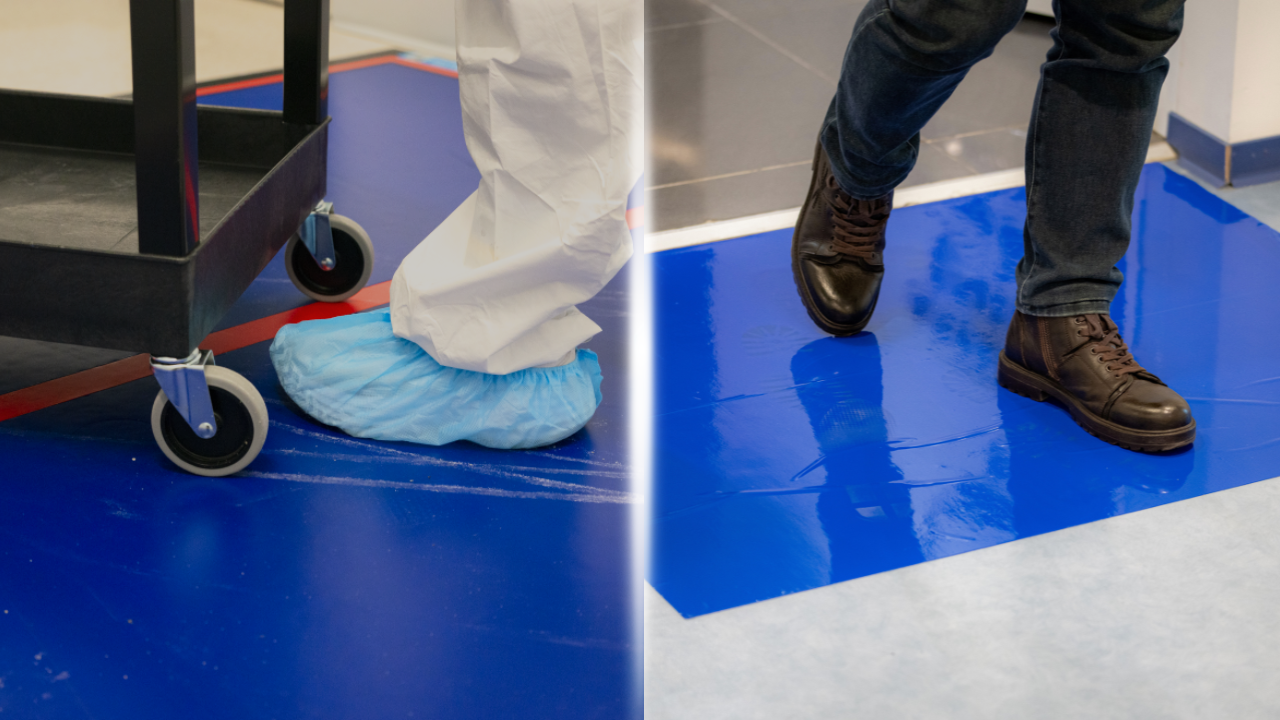
The Shift Towards Smarter Contamination Control
Contamination control remains a critical priority across pharmaceutical manufacturing, medical device production, electronics manufacturing, food processing, healthcare, and other controlled environments. As facilities face increasing pressure to improve operational efficiency, reduce waste, and meet stringent cleanliness standards, many are reassessing traditional contamination control methods.
One of the most significant changes in recent years has been the move away from single-use adhesive mats, often referred to as peel-off or sticky mats, towards reusable contamination control mats. This shift is being driven by performance, sustainability, cost-effectiveness, and the growing demand for long-term contamination control solutions.
The Limitations of Single-Use Adhesive ‘Sticky’ Mats
For decades, adhesive ‘sticky’ mats were considered the standard solution for controlling contamination at entrances and transition points. These mats rely on disposable adhesive layers that capture dirt and debris from footwear and wheels.
However, many facilities are discovering that adhesive mats come with several limitations:
- Continuous Consumable Costs: Every contaminated layer must be peeled away and discarded. Over time, this creates significant ongoing costs for replacement mats and labour.
- Increased Waste Generation: Thousands of adhesive sheets can be discarded annually by a single facility. For organisations pursuing sustainability initiatives and ESG targets, this level of waste is increasingly difficult to justify.
- Operational Disruption: Staff must regularly monitor mat condition, remove contaminated layers, and replace depleted mats. This maintenance requirement adds unnecessary workload and increases the potential for human error.
- Limited Performance with Wheeled Traffic: Many modern facilities rely heavily on carts, trolleys, pallet jacks, and other wheeled equipment. Adhesive mats can become damaged under wheeled traffic, reducing their effectiveness and lifespan.
- Potential Safety Concerns: As adhesive layers become worn or begin to lift, they may create trip hazards or interfere with wheeled equipment movement.
Why Facilities Are Choosing Reusable Contamination Control Mats
Reusable contamination control mats offer a fundamentally different approach to contamination prevention.
Rather than relying on disposable adhesive layers, advanced polymeric contamination control mats use a permanently tacky surface to attract, capture, and retain contaminants from shoes, wheels, and equipment. Captured contaminants remain securely held until the mat is cleaned.
This technology provides several key advantages.
1. Superior Long-Term Value
While reusable contamination control mats may require a higher initial investment, they typically deliver years of performance rather than days or weeks.
Many high-performance polymeric mats provide an average lifespan of 3 to 5 years, significantly reducing the total cost of ownership compared to disposable alternatives.
Instead of repeatedly purchasing replacement mats, facilities can focus their budgets on long-term contamination control performance.
2. Reduced Environmental Impact
Sustainability has become a major consideration across all industries.
Replacing thousands of disposable adhesive sheets with a reusable solution can dramatically reduce plastic waste, packaging waste, and disposal requirements.
For organisations working towards environmental targets, reusable contamination control mats offer a practical way to improve sustainability without compromising cleanliness standards.
3. Improved Contamination Control Performance
Modern reusable contamination control mats are specifically designed to address floor-level contamination, one of the most significant contamination sources in controlled environments.
Independent testing has demonstrated that advanced polymeric mats can capture and retain up to 99.9% of contaminants carried on shoes and wheels. By reducing contaminants at the point of entry, facilities can help protect critical processes, products, equipment, and personnel.
Many reusable contamination control mats also contribute to reductions in airborne particulate levels by preventing contaminants from becoming reintroduced into the environment.
4. Designed for Real-World Traffic
Unlike disposable adhesive mats, reusable contamination control mats are designed to withstand both pedestrian and wheeled traffic.
This makes them particularly suitable for:
- Pharmaceutical manufacturing facilities
- Medical device manufacturing environments
- Semiconductor and electronics production
- Data centers
- Food and beverage processing plants
- Research laboratories
- Healthcare facilities
Whether personnel are walking across the surface or transporting materials on carts and trolleys, reusable mats continue to provide effective contamination control. Read Dycem’s success stories.

5. Easy Integration into Existing Cleaning Procedures
One common misconception is that reusable contamination control mats require complex maintenance.
Although maintenance is key with reusable mats, in reality, they are designed to integrate seamlessly into existing cleaning SOPs. Routine cleaning restores the mat’s contamination capture capability without requiring replacement or special handling procedures.
This simplifies maintenance while ensuring consistent performance throughout the product’s lifespan.
6. Supporting Regulatory Compliance and Quality Standards
Controlled environments are becoming increasingly regulated, particularly within pharmaceutical, biotechnology, medical device, and food manufacturing sectors.
A robust contamination control strategy must address contamination risks at every stage of the process, including facility entrances, gowning areas, airlocks, material transfer points, and production zones.
Reusable contamination control mats support these objectives by helping facilities:
- Reduce contamination entering critical areas
- Improve environmental cleanliness
- Support contamination control strategies (CCS)
- Strengthen audit readiness
- Protect product quality and yield
- Enhance operational consistency
As regulatory expectations continue to evolve, organisations are seeking contamination control solutions that deliver measurable, long-term performance.
The Future of Contamination Control
The move towards reusable contamination control mats reflects a broader trend within controlled environments: replacing short-term fixes with sustainable, evidence-based solutions.
Facilities today are under pressure to reduce waste, improve efficiency, strengthen contamination control programmes, and maximise return on investment. Reusable contamination control mats align with all of these objectives.
By providing long-term contamination control, reducing environmental impact, and eliminating the ongoing costs associated with disposable alternatives, reusable contamination control mats are rapidly becoming the preferred choice for organisations seeking a smarter approach to contamination prevention.
Conclusion
As contamination control requirements become more demanding, organisations can no longer rely solely on traditional single-use solutions.
Reusable contamination control mats offer a more sustainable, cost-effective, and performance-driven alternative to adhesive peel-off mats. By capturing contaminants at the point of entry, supporting regulatory compliance, and reducing operational waste, they help facilities maintain cleaner, safer, and more efficient controlled environments.
For organisations looking to strengthen their contamination control strategy while reducing long-term costs, reusable contamination control mats represent a proven investment in both cleanliness and sustainability.