

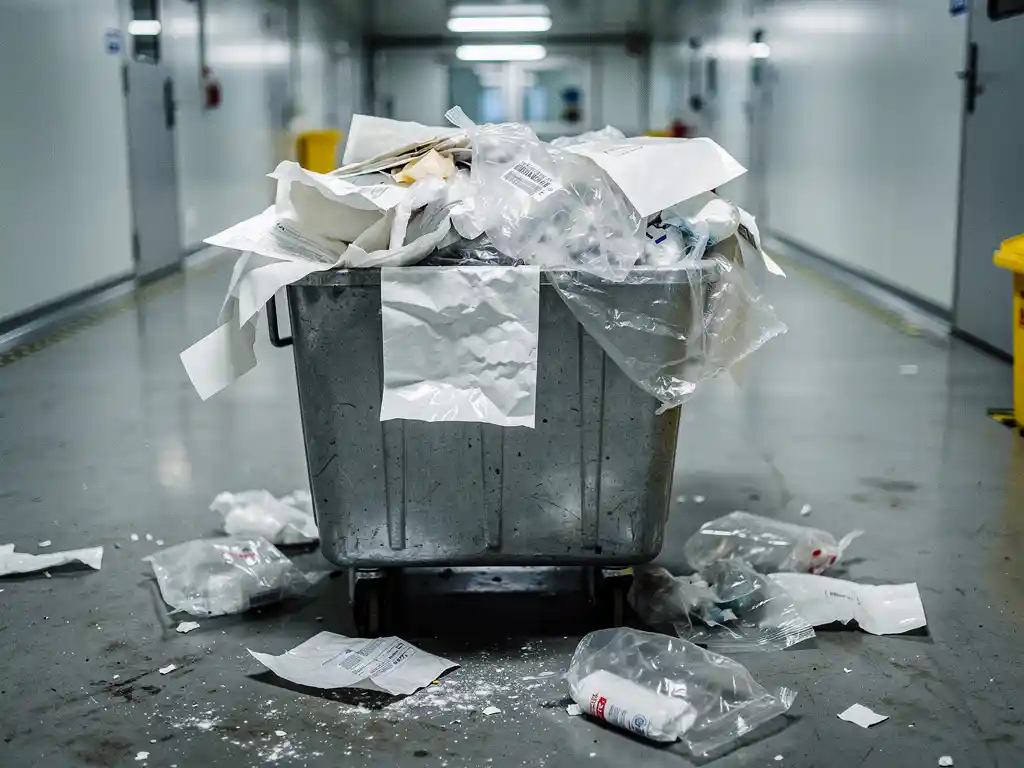
Single-use contamination products generate substantial volumes of plastic and polymer waste, contributing meaningfully to landfill accumulation across regulated industries. Facilities that rely on disposable sticky mats, peel-off sheets, and single-use shoe covers discard these materials continuously, often daily, creating a persistent waste stream that compounds over time. For quality and facilities managers operating under increasing ESG scrutiny, the environmental cost of these products is no longer easy to ignore. The sections below address the most common questions surrounding this issue, from the materials involved to the regulations taking shape and the practical steps facilities can take to reduce their impact.
How much waste do single-use contamination products generate?
Single-use contamination products generate significant volumes of non-recyclable waste, typically measured in tonnes per facility per year. A single disposable sticky mat pad contains dozens of peel-off layers, each discarded after a short period of use. Across a facility running multiple entry points, this volume accumulates rapidly into a substantial and recurring waste stream.
To put this into perspective, a mid-sized pharmaceutical or electronics facility may use hundreds of sticky mat pads annually. Each pad is composed of layered polymer sheets that are peeled away and disposed of, often several times a day per entry point. When multiplied across shift patterns, headcount, and wheeled traffic, the total weight of discarded material across a year becomes considerable. Unlike general office waste, this material is difficult to segregate for recycling and typically ends up in landfill.
The waste burden extends beyond the mats themselves. Disposable shoe covers, single-use overshoes, and related consumables add further volume to the total. For facilities with sustainability reporting obligations or corporate net-zero commitments, this ongoing output represents a measurable liability that is increasingly difficult to justify.
What types of materials make up disposable contamination mats?
Disposable contamination mats, commonly known as sticky mats or tacky mats, are made from layered sheets of polyethylene film coated with a pressure-sensitive adhesive. The adhesive layer captures particulates from shoe soles and wheels, and the contaminated sheet is peeled away to reveal a fresh layer beneath. Both the film and the adhesive are petroleum-derived plastics.
The polyethylene film used in these mats is typically low-density, which makes it lightweight and flexible but also difficult to recycle in standard municipal or industrial waste streams. The adhesive coating further complicates recyclability, as bonded materials generally cannot be separated economically at scale. Once a layer is peeled off, it is contaminated with particulates, dust, and potentially biological matter, which often disqualifies it from recycling programmes entirely.
Some disposable mat products also incorporate additional backing layers or release liners made from silicone-coated paper or film, adding further mixed-material complexity to disposal. In cleanroom environments where contamination control is critical, the used layers cannot be reprocessed on-site and must be treated as controlled waste, adding cost and logistical burden to their disposal.
Are single-use cleanroom products recyclable or biodegradable?
The vast majority of single-use cleanroom products, including sticky mats, disposable shoe covers, and peel-off floor sheets, are neither practically recyclable nor biodegradable in any meaningful timeframe. They are manufactured from synthetic polymers designed for durability, not decomposition, and their contaminated state at point of disposal typically excludes them from standard recycling infrastructure.
Polyethylene films are technically recyclable in controlled conditions, but the combination of adhesive coatings and particulate contamination means that used sticky mat layers rarely qualify for recycling streams. Facilities operating in regulated environments such as pharmaceuticals or medical devices are often required to treat used mats as controlled or hazardous waste, which means incineration or specialist disposal rather than recycling.
Biodegradability is equally limited. Standard polyethylene does not biodegrade; it photodegrades slowly into microplastics over many decades. Compostable or bio-based alternatives exist in some consumer product categories, but they have not been widely adopted in cleanroom-grade contamination control, where material integrity and validated performance are non-negotiable. The result is that most single-use cleanroom waste follows a linear path from manufacture to landfill or incineration, with little opportunity for recovery.
How do reusable contamination mats compare environmentally to disposable alternatives?
Reusable contamination mats offer a substantially lower environmental footprint than disposable alternatives over their operational lifespan. A reusable polymeric mat designed to last three to five years replaces thousands of individual disposable layers, reducing both the volume of plastic waste generated and the frequency of procurement, packaging, and transportation associated with continuous consumable replenishment.
The comparison becomes clearer when viewed across a full lifecycle. A disposable sticky mat pad may contain 30 to 60 peel-off layers and require replacement every few weeks depending on traffic volume. A reusable mat serving the same entry point for three to five years generates a fraction of the material waste, requires no adhesive coatings, and can be cleaned and maintained without producing contaminated single-use by-products.
Reusable mats also support ESG reporting more directly. Because they are durable, washable, and designed for long-term performance, they contribute to measurable reductions in single-use plastic consumption, which is increasingly a tracked metric within corporate sustainability frameworks. For organisations with supplier sustainability requirements or net-zero targets, the shift from disposable to reusable contamination control represents a practical and documentable improvement.
It is worth noting that the environmental benefit of reusable mats depends on proper maintenance and full utilisation of their lifespan. A mat that is replaced prematurely or improperly maintained reduces the lifecycle advantage. When used as intended, however, the difference in waste generation between reusable and disposable options is significant.
What regulations apply to single-use plastic waste in cleanroom environments?
Regulations governing single-use plastic waste in cleanroom environments vary by region, but the direction of policy is consistent: single-use plastics face increasing restriction, reporting requirements, and in some cases outright bans. Facilities operating in the EU, UK, and North America should be aware of how existing and emerging legislation may affect their contamination control procurement decisions.
European Union and UK regulations
The EU Single-Use Plastics Directive, which came into force in 2021, targets a broad range of disposable plastic products and places obligations on producers and users to reduce reliance on single-use formats. While cleanroom-specific consumables are not always explicitly named, the broader regulatory intent is clear, and facilities subject to EU environmental compliance frameworks should assess whether their disposable contamination products fall within scope. Extended producer responsibility schemes are also expanding, placing greater accountability on organisations that generate plastic waste as part of their operations. The UK has introduced its own single-use plastics legislation following departure from the EU, with similar intent and growing scope.
North American and global standards
In North America, regulations vary by state and province, but California’s Proposition 65 and extended producer responsibility frameworks in several states signal a tightening environment for single-use plastic users. Globally, the UN Environment Programme has been advancing a binding international plastics treaty, the details of which are still being negotiated but which could have significant implications for industrial plastic waste in regulated sectors. Facilities with global operations should monitor developments closely and consider whether their current contamination control approach positions them well for compliance in the near term.
What should facilities consider when switching to sustainable contamination control?
When switching from disposable to sustainable contamination control, facilities should evaluate performance equivalence, facility layout, traffic type, cleaning protocols, and total cost of ownership. The goal is not simply to replace one product with another, but to implement a solution that maintains or improves contamination capture while reducing the ongoing waste and cost burden associated with single-use alternatives.
Key considerations include:
- Traffic type and volume: Entry points serving pedestrian traffic have different requirements from those handling heavy wheeled equipment such as forklifts or pallet trucks. Reusable mat solutions should be matched to the specific demands of each zone.
- Cleaning and maintenance protocols: Reusable mats require a defined cleaning regimen to maintain performance. Facilities should confirm that their cleaning processes are compatible with the mat material and that staff are trained accordingly.
- Regulatory validation: In highly regulated environments such as pharmaceutical manufacturing, any change to contamination control methodology may require validation or documentation. Facilities should confirm that replacement products meet the standards required by their quality management system.
- Total cost of ownership: The upfront cost of reusable mats is higher than a single box of sticky mat pads, but the comparison should be made over the full lifespan. When procurement, disposal, and labour costs are factored in across three to five years, reusable solutions typically represent a lower total expenditure.
- ESG documentation: Facilities with sustainability reporting obligations should ensure that any switch to reusable products is documented in a way that supports ESG disclosures, including quantified reductions in single-use plastic waste.
- Site-specific layout: Entry configurations, gowning room arrangements, and corridor dimensions vary between facilities. A reusable mat solution should be assessed for fit across all relevant entry points before full implementation.
Taking a phased approach, starting with the highest-traffic entry points and expanding from there, allows facilities to demonstrate performance and build internal confidence before committing to a full-site transition.
How Dycem helps reduce the environmental impact of contamination control
Dycem’s reusable contamination control mats are engineered to address both the performance and sustainability challenges that disposable products create. Key benefits include:
- 3 to 5 year product lifespan, dramatically reducing the volume of plastic waste generated compared to continuously replaced sticky mat pads
- Capture of up to 99.9% of shoe and wheel contaminants, maintaining cleanroom performance without the need for single-use layers
- Built-in Biomaster silver-ion antimicrobial technology, inhibiting microbial growth by up to 99.9% without additional chemical treatment
- ISO-certified manufacturing compliant with EN ISO 9001 and 14001, California Proposition 65, and EU REACH regulations
- Support for ESG goals, enabling facilities to quantify and report reductions in single-use plastic consumption
- Customisable formats including CleanZone for pedestrian and light-wheeled traffic, WorkZone for heavy industrial use, and Floating Mats for flexible or temporary zones
Dycem’s contamination control specialists provide consultative support from initial assessment through to implementation, including a free site survey to identify the right solution for each facility’s layout and requirements. To find out how Dycem can help your facility reduce waste without compromising contamination control performance, contact our team today.