

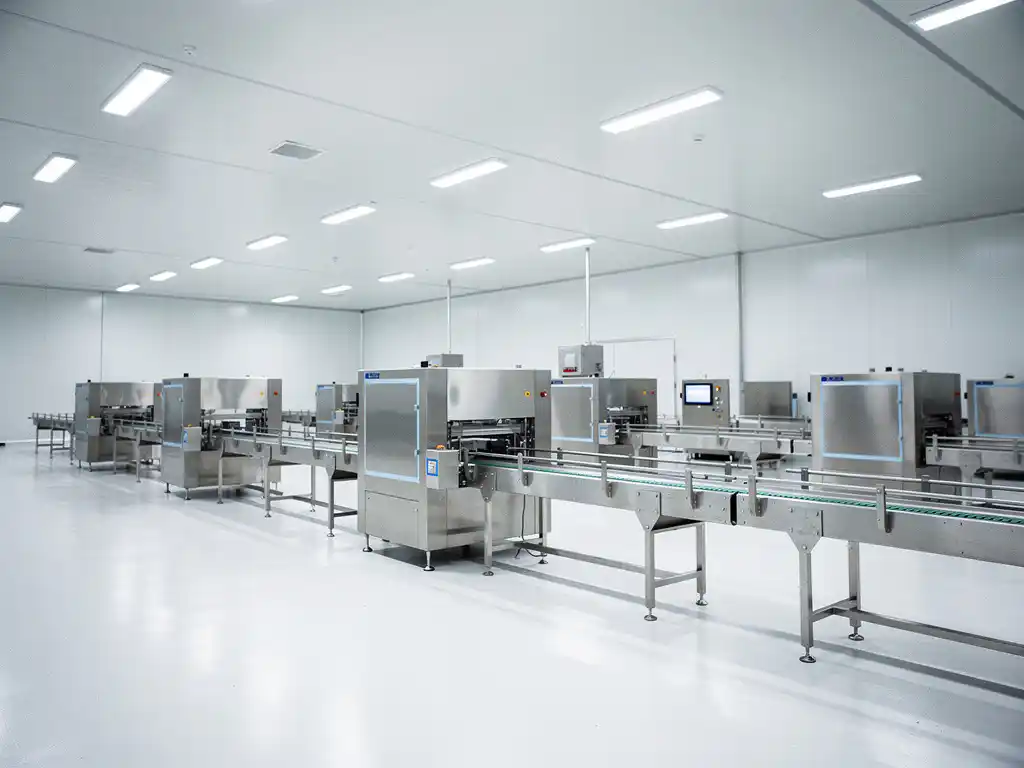
Antimicrobial protection plays a critical role in food-grade facility design by actively inhibiting the growth and spread of harmful microorganisms on surfaces that come into contact with food, personnel, and equipment. In regulated food manufacturing environments, microbial contamination is one of the most significant threats to product safety, audit compliance, and operational continuity. The questions below address the specific mechanisms, surfaces, regulations, and decision points that quality and facilities managers need to understand.
How does antimicrobial protection prevent contamination in food facilities?
Antimicrobial protection prevents contamination in food facilities by inhibiting the growth of bacteria, mould, and other microorganisms on high-contact surfaces before they can spread into production zones. Rather than simply removing visible dirt, antimicrobial treatments create an ongoing hostile environment for microbial activity, reducing the risk of cross-contamination between personnel, equipment, and product areas.
In food manufacturing, contamination rarely arrives in large, visible quantities. It enters incrementally through foot traffic, wheeled equipment, airborne particles, and contact surfaces that are touched repeatedly throughout a shift. Without antimicrobial protection at these critical points, microorganisms can accumulate undetected and migrate deep into controlled zones before any visible sign of a problem emerges.
Effective antimicrobial protection works at the material level. Technologies such as silver-ion treatment are embedded directly into flooring and surface materials, continuously disrupting microbial cell function rather than relying solely on scheduled cleaning cycles. This means protection is maintained between cleans, not just immediately after them. In a food facility operating multiple shifts with high personnel throughput, that continuous action is not a luxury but a functional necessity.
What are the main contamination entry points in a food-grade facility?
The main contamination entry points in a food-grade facility are personnel access routes, wheeled equipment pathways, raw material intake areas, and transition zones between lower and higher cleanliness classifications. Research consistently shows that the majority of contaminants enter controlled environments at floor level, carried in on footwear and wheels from external or lower-grade areas.
Understanding where contamination enters is the foundation of effective facility design. The most significant entry points include:
- Personnel entry points: Gowning rooms, airlocks, and corridor transitions where staff move between general and controlled areas
- Wheeled traffic routes: Pathways used by pallet trucks, trolleys, and forklifts moving raw materials or finished goods between zones
- Raw material intake zones: Loading bays and staging areas where external packaging introduces outside contaminants
- Maintenance access points: Areas where engineers or contractors enter production zones, often without the same gowning discipline as production staff
- Transition corridors: High-traffic passageways connecting zones of different cleanliness classification
Each of these points represents a moment where the contamination boundary between the outside world and the controlled environment is crossed. A robust food-grade facility design treats every one of these transitions as a critical control point, not a secondary consideration.
What surfaces in a food facility require antimicrobial treatment?
In a food facility, the surfaces that require antimicrobial treatment are those with the highest frequency of contact or the greatest proximity to exposed product. This includes flooring at entry and transition points, wall cladding in processing areas, work surfaces, drainage channels, door handles, and equipment contact surfaces.
Flooring is often underestimated as a contamination vector. Because it is in constant contact with footwear and wheeled equipment, it accumulates and redistributes particulates and microorganisms throughout the facility with every movement. Antimicrobial flooring at key entry points captures and retains contaminants rather than allowing them to be tracked further into production areas.
Beyond the floor, the following surfaces warrant antimicrobial consideration in food-grade facility design:
- Processing work surfaces: Direct contact with food or food packaging demands materials that resist microbial colonisation between cleaning cycles
- Wall panels and cladding: Splash zones and areas near open product are particularly vulnerable to biofilm formation
- Drainage and channel systems: Standing moisture creates conditions where microbial growth accelerates rapidly
- Door furniture and push plates: Repeatedly touched by multiple personnel, these surfaces transfer microorganisms efficiently between individuals
- Equipment handles and controls: Shared equipment in production zones presents a consistent cross-contamination risk
A layered approach, treating multiple surface types rather than relying on a single intervention, provides the most reliable antimicrobial protection across the facility.
How does antimicrobial flooring compare to disposable sticky mats?
Antimicrobial flooring outperforms disposable sticky mats in durability, ongoing microbial inhibition, total cost of ownership, and environmental impact. Sticky mats capture particulates on their adhesive surface but offer no antimicrobial action, lose effectiveness rapidly as layers are peeled away, and generate significant volumes of single-use plastic waste over time.
The practical limitations of sticky mats are well understood by quality managers who rely on them. Each layer has a finite capacity, and in high-traffic environments, that capacity is exhausted quickly. Once saturated, a sticky mat that has not been changed becomes a contamination surface in its own right, redistributing what it has already captured.
Antimicrobial reusable flooring addresses these limitations in several ways:
- Continuous protection: Embedded antimicrobial technology remains active between cleaning cycles, not just immediately after a layer is changed
- Consistent performance: A well-maintained reusable mat maintains its contamination capture properties throughout its lifespan, rather than degrading with each use
- Lower long-term cost: A product designed to perform for three to five years eliminates the recurring procurement and disposal costs associated with disposable alternatives
- Reduced waste: Reusable mats significantly reduce single-use plastic consumption, supporting ESG commitments and reducing landfill contribution
- Validated performance data: Reusable antimicrobial mats can be tested and validated as part of a contamination control programme, providing documented evidence for audit purposes
For facilities under GMP or food safety audit pressure, the ability to document a consistent, validated contamination control solution is a material advantage over a consumable that varies in performance depending on when it was last changed.
Which food industry regulations require antimicrobial contamination control?
Food industry regulations that require or strongly support antimicrobial contamination control include the FDA Food Safety Modernization Act (FSMA), the EU General Food Law Regulation, BRC Global Standards for Food Safety, SQF (Safe Quality Food) certification requirements, and ISO 22000 food safety management standards. GMP guidelines applicable to food-grade environments also specify contamination prevention as a core compliance requirement.
These frameworks do not always prescribe specific materials or technologies, but they consistently require facilities to demonstrate that contamination risks have been identified, assessed, and controlled. Antimicrobial surface treatments and flooring contribute directly to satisfying that requirement by providing a documented, active layer of protection.
Key regulatory touchpoints where antimicrobial contamination control is relevant include:
- FSMA Preventive Controls: Requires hazard analysis and preventive controls for food safety, including environmental monitoring and contamination prevention at facility entry points
- BRC Global Standard Issue 9: Specifies requirements for site standards, including floor construction, maintenance, and contamination control at zone boundaries
- SQF Code: Mandates documented food safety plans that address facility design and contamination risk, including personnel and equipment movement between zones
- ISO 22000: Requires a systematic approach to food safety hazards, with prerequisite programmes covering facility hygiene and contamination control infrastructure
- EU Food Hygiene Regulations (852/2004): Requires food business operators to maintain clean and disinfectable surfaces in food handling areas
Facilities preparing for BRC, SQF, or FDA audits benefit from contamination control solutions that generate documented evidence of performance, not just physical protection.
When should a food facility upgrade its contamination control system?
A food facility should upgrade its contamination control system when current measures are failing audit requirements, generating excessive waste and cost, producing inconsistent results, or are no longer proportionate to the facility’s operational scale or cleanliness classification. Any of these indicators signals that the existing approach is a liability rather than a safeguard.
Specific triggers that indicate an upgrade is overdue include:
- Recurring non-conformances or observations during internal or third-party food safety audits related to contamination control
- Environmental monitoring results showing persistent microbial presence in controlled zones
- Significant growth in personnel numbers or wheeled traffic volumes that has outpaced the capacity of the current system
- Facility expansion or zone reclassification that introduces new contamination boundaries requiring active management
- Rising procurement and disposal costs from disposable mat consumption that are no longer justifiable against performance outcomes
- Sustainability commitments that require a reduction in single-use plastic waste across the facility
In 2026, food manufacturers face increasing scrutiny from both regulators and retail customers on contamination control standards. Facilities that continue to rely on legacy solutions, particularly disposable sticky mats or inconsistently applied footbath protocols, are increasingly exposed to audit risk and reputational consequences. An upgrade is not simply a capital decision; it is a risk management decision.
How Dycem helps with food-grade facility contamination control
Dycem’s reusable antimicrobial contamination control mats are purpose-built to address the specific challenges food-grade facilities face at every entry and transition point. Key benefits include:
- Up to 99.9% particulate capture at floor level, stopping contaminants before they reach production zones
- Biomaster silver-ion antimicrobial technology embedded into every mat, inhibiting microbial growth by up to 99.9% between cleaning cycles
- A 3 to 5 year product lifespan, replacing the recurring cost and waste of disposable sticky mats with a validated, long-term solution
- ISO-certified manufacturing meeting EN ISO 9001 and 14001 standards, California Proposition 65, and EU REACH compliance
- Customisable formats for pedestrian zones, heavy wheeled traffic areas, and flexible or temporary layouts across complex facility designs
Whether you are preparing for a BRC audit, replacing an underperforming sticky mat programme, or designing contamination control into a new facility, Dycem’s contamination control products provide the performance data and regulatory alignment your quality team needs. Contact Dycem today to arrange a free site survey and speak with a contamination control specialist.