

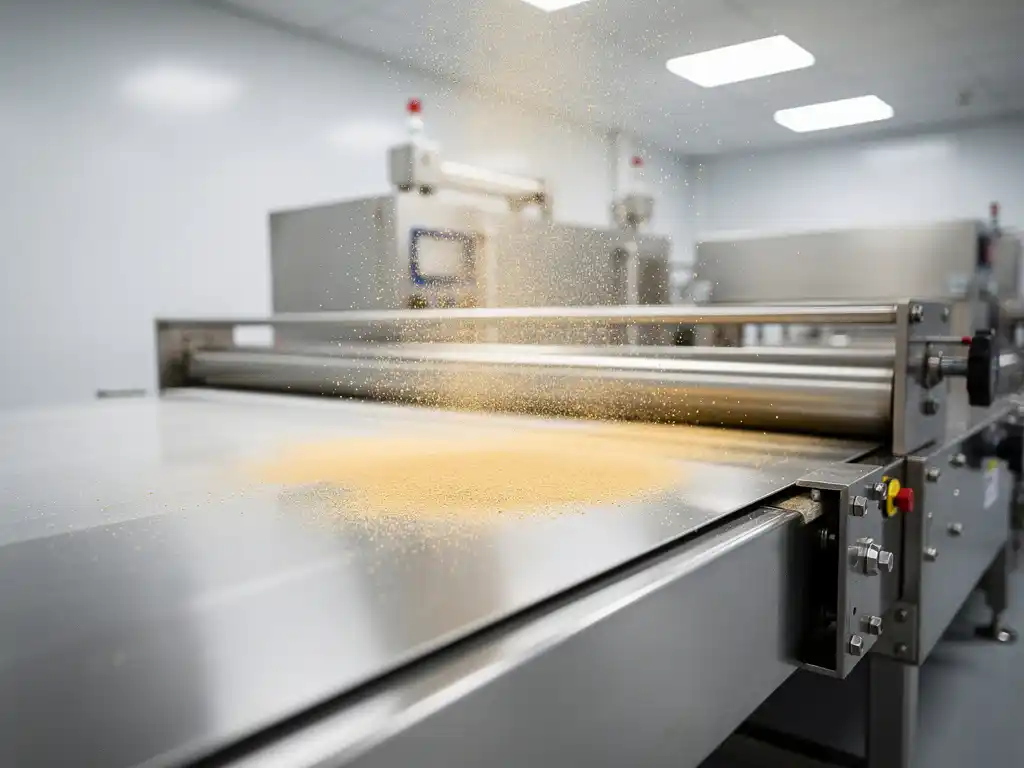
Yes, airborne particles can contaminate food production lines. Dust, microorganisms, and other particulates suspended in facility air can settle directly onto exposed ingredients, packaging, and equipment surfaces, introducing biological, chemical, or physical hazards that compromise product safety and regulatory compliance. The risk is especially significant in facilities where high-traffic entry points, poor airflow management, or inadequate contamination control allow particles to travel freely through production zones. The sections below address the most important questions surrounding airborne contamination in food manufacturing.
How do airborne particles reach food production lines?
Airborne particles reach food production lines through a combination of human movement, air circulation, equipment operation, and inadequate entry control. When people, vehicles, or materials move through a facility, they disturb settled particles and carry contaminants from uncontrolled areas into production zones. Once suspended in air, particles can travel considerable distances before settling on exposed food surfaces or equipment.
The most common pathways include:
- Foot and wheel traffic — personnel and vehicles tracked in from external or lower-grade areas disturb floor-level particles, launching them into the air
- HVAC and ventilation systems — inadequate filtration or poorly maintained ductwork can distribute particles throughout a facility rather than removing them
- Raw material handling — opening packaging, transferring ingredients, and operating processing equipment all generate particulate matter
- Personnel activity — skin cells, hair, clothing fibres, and respiratory droplets are continuously shed by workers and become airborne during normal movement
Understanding these entry routes is the first step in designing a contamination control strategy that addresses the problem at its source rather than reacting after contamination has occurred.
What types of particles pose the greatest risk in food manufacturing?
In food manufacturing, the particles that pose the greatest risk fall into three categories: biological contaminants such as bacteria, moulds, and yeasts; physical contaminants including dust, fibres, and foreign material; and chemical contaminants such as cleaning agent residues or particulate matter from processing equipment. Each category carries distinct food safety implications and regulatory consequences.
Biological contaminants
Microbial particles are among the most serious threats in food production environments. Pathogens such as Listeria monocytogenes, Salmonella, and Aspergillus moulds can become airborne and settle onto product contact surfaces. Even low levels of microbial contamination can trigger product recalls, regulatory action, and significant reputational damage. Facilities producing ready-to-eat or minimally processed foods are particularly vulnerable.
Physical and chemical contaminants
Dust, fibres from clothing or packaging materials, and particulates shed from machinery surfaces represent persistent physical contamination risks. These particles are often invisible to the naked eye yet detectable during quality audits or consumer complaints. Chemical particulates, while less common, can arise from aerosol cleaning agents or material degradation and are equally capable of triggering compliance failures under food safety regulations.
How does foot traffic stir up particles that contaminate food lines?
Foot traffic is one of the primary mechanisms by which floor-level particles become airborne and reach food production lines. Each footstep compresses and releases contaminated floor surfaces, creating a micro-disturbance that lifts settled particulates into the lower air column. From there, normal air movement and human activity carry those particles further into controlled production zones.
Research in contamination control consistently identifies the floor as the single largest reservoir of particulates in any controlled environment. Industry data suggests that up to 80% of contaminants entering controlled environments do so at floor level, carried in on shoes and wheels. When that floor-level contamination is disturbed by walking, wheeled traffic, or equipment movement, it becomes an airborne risk.
This is why entry points are so critical. Contaminants introduced at a facility entrance can migrate progressively deeper into production areas with each person who walks through. Without effective capture at the point of entry, the contamination load inside the facility increases over time, raising the probability that airborne particles will reach exposed food or food contact surfaces.
What regulations govern airborne particle limits in food production?
Airborne particle limits in food production are governed by a combination of international food safety standards, national regulatory frameworks, and sector-specific guidelines. While food manufacturing does not always apply the same strict particle count classifications used in pharmaceutical cleanrooms, regulated food environments are still expected to demonstrate active contamination control as part of their food safety management systems.
The key regulatory frameworks include:
- HACCP (Hazard Analysis and Critical Control Points) — the internationally recognised framework requiring food businesses to identify, assess, and control contamination hazards, including airborne particulates
- BRC Global Standard for Food Safety — widely adopted by food manufacturers supplying major retailers, with explicit requirements for environmental monitoring and contamination prevention in high-care and high-risk zones
- FDA Food Safety Modernization Act (FSMA) — requires US food facilities to implement preventive controls for environmental hazards, including those introduced through personnel and traffic movement
- ISO 22000 — an international food safety management standard integrating HACCP principles with broader management system requirements, including facility hygiene and contamination control
- EU Regulation (EC) No 852/2004 — sets hygiene requirements for food businesses operating in the European Union, including premises design and operational hygiene controls
In higher-risk food manufacturing settings such as infant formula, ready-to-eat products, or sterile food packaging, facilities may voluntarily adopt cleanroom-style environmental standards to reduce contamination risk and demonstrate due diligence during regulatory audits.
How can contamination control mats reduce airborne particle risk?
Contamination control mats reduce airborne particle risk by capturing and retaining floor-level particulates at the point of entry, preventing them from being tracked deeper into the facility where foot and wheel traffic could disturb and aerosolise them. By removing contaminants from shoe soles and wheeled equipment before they enter production zones, mats directly reduce the reservoir of particles available to become airborne.
This approach addresses contamination at its most efficient intervention point. Rather than attempting to filter or capture particles once they are already suspended in air, effective entry-point matting stops the contamination cycle before it begins. Dycem’s contamination control mats are engineered with a polymeric surface that actively attracts, captures, and retains particulates rather than simply scraping them from footwear. The distinction matters: conventional barrier mats can dislodge particles and redistribute them, whereas Dycem’s technology binds them to the mat surface.
For food manufacturing facilities, this capability is particularly valuable at transitions between zones of different hygiene status, such as the boundary between a general production area and a high-care or high-risk zone. Placing mats at these critical thresholds creates a consistent, passive contamination barrier that operates with every person or vehicle that passes through.
What other measures work alongside contamination control matting?
Contamination control matting works most effectively as part of a layered contamination control strategy. No single measure eliminates airborne particle risk entirely, and food manufacturers achieving the highest hygiene standards typically combine physical barriers with environmental monitoring, personnel hygiene protocols, and facility design principles.
Complementary measures that work alongside entry-point matting include:
- HVAC filtration and positive pressure zoning — maintaining positive air pressure in higher-care areas prevents unfiltered air from flowing in from lower-grade zones; HEPA filtration removes fine airborne particles from recirculated air
- Gowning and personnel hygiene protocols — dedicated protective clothing, hair covers, and gloves reduce the volume of biological particles shed by workers into the production environment
- Environmental monitoring programmes — regular surface and air sampling allows facilities to track contamination trends, identify problem areas, and demonstrate compliance during audits
- Facility zoning and traffic management — clearly defined production zones with controlled access routes minimise the movement of personnel and equipment between areas of different hygiene status
- Cleaning and disinfection schedules — structured cleaning programmes targeting floors, walls, and equipment surfaces reduce the settled particulate load available to become airborne
- Equipment and material controls — inspecting incoming materials, controlling packaging operations, and maintaining processing equipment reduces the generation of particles within the production environment itself
When these measures are implemented consistently and reviewed as part of a documented food safety management system, they create a facility environment where airborne contamination risk is managed proactively rather than addressed reactively.
How Dycem helps with airborne contamination in food production
Dycem provides food manufacturers with a proven, reusable contamination control solution that tackles particulate risk at the point of entry, before contaminants can be tracked into production zones and disturbed into the air. Key benefits include:
- Captures up to 99.9% of floor-level and airborne particulates at entry points
- Biomaster silver-ion antimicrobial technology inhibits microbial growth by up to 99.9%, reducing biological contamination risk
- Engineered for 3 to 5 years of performance, reducing the cost and waste associated with disposable sticky mat alternatives
- ISO-certified manufacturing meeting EN ISO 9001 and 14001 standards, California Proposition 65, and EU REACH compliance
- Customisable to suit complex facility layouts, zone transitions, and traffic flow requirements
- Supports audit readiness and compliance with BRC, HACCP, FSMA, and ISO 22000 requirements
Dycem’s CleanZone mats are particularly suited to food manufacturing environments, delivering robust particulate capture at gowning room entrances, high-care zone thresholds, and critical corridors where contamination control is non-negotiable. To find out how Dycem can support your facility’s contamination control programme, speak to a contamination control specialist today.