

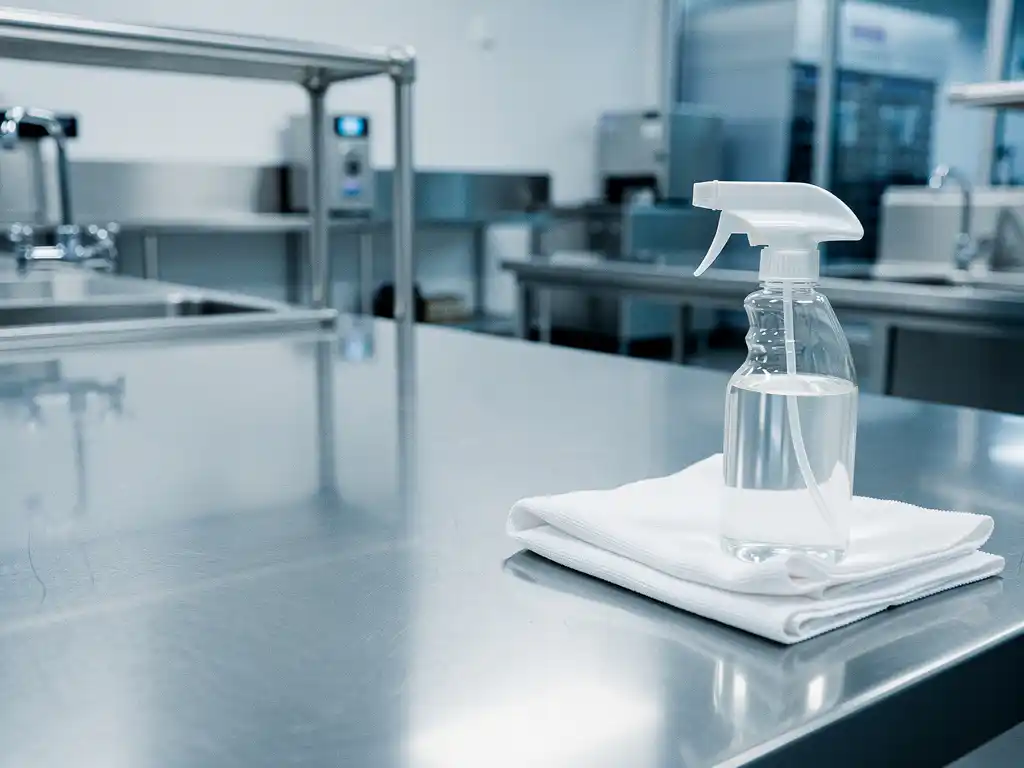
Cleaning, sanitizing, and disinfecting are three distinct processes that must be performed in sequence to effectively manage hygiene in a food facility. Cleaning removes visible dirt and organic matter, sanitizing reduces microbial populations to safe levels, and disinfecting eliminates a broader spectrum of pathogens. Each step builds on the last, and skipping or combining them compromises the effectiveness of the entire process. The following sections address the most common questions food facility managers face when building or auditing their hygiene programs.
What happens if you skip steps in the cleaning, sanitizing, and disinfecting sequence?
Skipping steps in the cleaning, sanitizing, and disinfecting sequence significantly reduces the effectiveness of each subsequent step. Organic residue left behind from inadequate cleaning physically shields microorganisms from sanitizers and disinfectants, rendering chemical treatments far less effective. In food facilities, this can lead to persistent microbial contamination, failed audits, and product safety failures.
The sequence matters because each step depends on the previous one. Sanitizers and disinfectants are formulated to work on clean surfaces. When grease, food particles, or biofilm remain, the active ingredients are consumed by organic matter rather than targeting pathogens. This is not a minor reduction in efficacy; in many cases, the treatment becomes functionally ineffective.
From a regulatory standpoint, GMP guidelines and food safety standards such as HACCP require documented cleaning and disinfection procedures that follow a defined sequence. Facilities that cannot demonstrate procedural compliance risk nonconformances during inspections. Beyond compliance, the practical consequence is elevated risk of cross-contamination, product recalls, and reputational damage.
What is the difference between a sanitizer and a disinfectant in food settings?
In food settings, a sanitizer reduces microbial contamination to levels considered safe for public health, while a disinfectant destroys or irreversibly inactivates a broader range of microorganisms, including those not targeted by standard sanitizers. The key distinction is the level of microbial reduction required and the regulatory category under which each product is approved.
Sanitizers are typically used on food-contact surfaces because they are formulated to reduce bacterial populations without leaving harmful chemical residues. They are validated to achieve a specified log reduction in target organisms under defined conditions. Disinfectants, by contrast, are used on non-food-contact surfaces and in higher-risk areas where a more comprehensive kill is required, such as drains, floors, and processing equipment exteriors.
The choice between the two depends on the surface type, the level of contamination risk, and the regulatory framework governing the facility. In food manufacturing, using a disinfectant where only a sanitizer is required can introduce unnecessary chemical risk, while using a sanitizer where a disinfectant is warranted may leave dangerous pathogens in place. Understanding the distinction is fundamental to building a compliant and effective hygiene program.
How does contamination enter food facilities beyond surfaces?
Contamination enters food facilities through multiple vectors beyond surface contact, including foot traffic, wheeled equipment, airborne particles, personnel, raw materials, and water. Floor-level entry points are among the most significant and most overlooked, with research consistently identifying foot and wheel traffic as primary contamination pathways into controlled production areas.
Each time a person or piece of equipment moves from an uncontrolled area into a production zone, it carries the potential to transfer particulates, microorganisms, and chemical residues. Shoes and wheels pick up contaminants from floors, loading docks, and outdoor environments, then deposit them directly into food preparation and processing areas. Without effective capture at entry points, these contaminants spread rapidly across the facility floor and can be tracked onto equipment, work surfaces, and products.
Airborne contamination is another significant factor, particularly in facilities with poor air pressure management or inadequate filtration. Dust, mold spores, and microbial aerosols can settle on open products, packaging materials, and processing equipment. Personnel represent a further vector through skin, hair, clothing, and respiratory droplets, which is why gowning protocols and hygiene training remain essential components of food safety management systems.
Raw materials and packaging can also introduce contamination if not properly inspected and managed at intake. Water used in cleaning or processing, if not treated to the appropriate standard, can harbor pathogens and distribute them throughout the facility. An effective contamination control program must account for all of these entry routes, not only surface hygiene.
What cleaning and disinfection standards apply to food manufacturing facilities?
Food manufacturing facilities are subject to a range of cleaning and disinfection standards depending on their location, product type, and market. The most widely applicable frameworks include HACCP principles, GMP requirements under FDA 21 CFR Part 117 or EU Regulation 852/2004, and retailer-led standards such as BRC Global Standard for Food Safety and SQF. Each requires documented, validated cleaning and disinfection procedures.
HACCP-based programs require facilities to identify critical control points where contamination is most likely and to implement verified controls at each point. Cleaning and disinfection procedures must be written, monitored, and reviewed regularly. Records must demonstrate that procedures are being followed and that they are achieving the required outcomes, typically verified through environmental monitoring and surface testing.
GMP regulations set baseline requirements for facility design, equipment maintenance, and personnel hygiene, all of which intersect with cleaning and disinfection practices. Facilities supplying major retailers or operating under BRC or SQF certification face additional requirements, including defined cleaning frequencies, approved chemical lists, and third-party verification. ISO 22000, the international standard for food safety management systems, integrates these requirements within a broader risk-based framework and is increasingly adopted by global food manufacturers seeking to align with international best practice.
Should food facilities use disposable or reusable contamination control solutions at entry points?
Reusable contamination control solutions are the more effective and sustainable option for food facility entry points. Disposable sticky mats lose adhesion quickly under heavy traffic, require frequent replacement, and generate significant single-use plastic waste. Reusable polymeric mats designed for contamination capture maintain consistent performance over years of use and are washable, which supports ongoing hygiene management.
The limitations of disposable sticky mats are well established in regulated environments. As each layer saturates with particulates, its ability to capture additional contamination drops sharply. In high-traffic food facilities, mats may need to be replaced multiple times per day to maintain any meaningful level of effectiveness, creating both operational disruption and escalating consumable costs. The total cost of ownership over a three-to-five-year period is substantially higher than for a reusable alternative.
Reusable mats also support food facility compliance more reliably. They can be cleaned and sanitized as part of the facility’s standard hygiene program, maintaining validated performance without the variability introduced by inconsistent mat replacement schedules. From an ESG perspective, eliminating single-use plastic waste from contamination control aligns with the sustainability commitments increasingly required by retailers, auditors, and corporate procurement policies.
How do you build an effective contamination control program for a food facility?
An effective contamination control program for a food facility is built on a risk-based assessment of all contamination entry points, followed by layered controls that address personnel, equipment, materials, and environmental factors. The program must be documented, validated, and reviewed regularly to remain effective as facility operations evolve.
Start by mapping the facility’s contamination risk zones, identifying where uncontrolled areas interface with production and processing environments. Entry points for personnel and wheeled equipment are typically the highest-risk locations and require the most robust controls. Gowning rooms, airlocks, loading bays, and corridor transitions should all be assessed for their contamination transfer potential.
From there, a structured program typically includes the following elements:
- Entry point controls: Physical barriers and contamination capture solutions at all transitions between uncontrolled and controlled zones
- Gowning and personnel hygiene protocols: Standardized procedures for hand washing, protective clothing, and footwear, enforced consistently across all shifts
- Cleaning and disinfection schedules: Written, frequency-defined procedures for all surfaces, equipment, and floor areas, validated against microbial targets
- Environmental monitoring: Regular surface and air sampling to verify that controls are achieving the required outcomes and to detect emerging contamination risks early
- Supplier and intake controls: Inspection and quarantine procedures for raw materials and packaging to prevent external contamination from entering the facility
- Training and competency verification: Ongoing staff training in hygiene procedures, with documented evidence of competency
The program should be reviewed at defined intervals and whenever significant changes occur, such as new product lines, facility expansions, or changes in personnel. Audit readiness depends on the quality of documentation as much as the effectiveness of the controls themselves.
How Dycem helps with contamination control in food facilities
Dycem’s reusable contamination control mats provide food facilities with a validated, long-lasting solution to one of the most persistent contamination entry points: foot and wheel traffic at facility transitions. Key benefits include:
- Capture of up to 99.9% of floor-level particulates at entry points, preventing contaminants from spreading into production areas
- Built-in Biomaster silver-ion antimicrobial technology, which inhibits microbial growth by up to 99.9% on the mat surface
- Washable, reusable construction with a lifespan of three to five years, eliminating the recurring cost and waste of disposable sticky mats
- ISO-certified manufacturing meeting EN ISO 9001 and 14001 standards, California Proposition 65, and EU REACH compliance
- Customizable sizes, formats, and configurations to suit complex facility layouts, traffic flows, and zone requirements
Dycem’s contamination control products are used by leading food and beverage manufacturers worldwide, supporting GMP compliance, audit readiness, and sustainability goals. To find out how Dycem can support your facility’s hygiene program, speak to a contamination control specialist today.