


7 Contamination Control Zones Every Data Center Should Have
Data centers are designed to control temperature, humidity, and airflow. What they are not designed to do is control contamination.
Every day, dust, fibers, packaging debris, and other particles enter facilities on shoes, wheels, equipment, and materials. Once inside, these contaminants can become part of the airflow moving through the data hall. Unlike cleanrooms, where airflow is often designed to help remove particles from critical areas, data center airflow is designed to move heat. That means contaminants introduced at floor level can be lifted, recirculated, and carried toward sensitive equipment.
As AI workloads, rack densities, and cooling demands continue to increase, maintaining a clean environment is becoming an increasingly important part of protecting uptime, cooling efficiency, and equipment reliability.
One of the most effective ways to reduce contamination risk in data centers is to establish contamination control zones throughout the facility. These designated areas help capture and contain particles before they can spread into critical environments.
1. Building Entrances
The first contamination control zone begins before personnel ever reach the data hall.
Dust, dirt, pollen, and outdoor debris are constantly tracked into facilities through foot and wheel traffic. Establishing contamination control at building entrances helps reduce the volume of particulate entering the facility and limits how much contamination can migrate further into the building.
2. Security Checkpoints and Access Control Areas
Personnel often pause, queue, and move equipment through security checkpoints before entering operational spaces.
These transition areas create opportunities for contamination to accumulate and spread. Installing contamination control flooring at access control points helps intercept particles before personnel move deeper into the facility.
3. Access Hallways and Corridors
Corridors connect nearly every area of a data center and experience constant traffic from personnel, carts, tools, and equipment.
Because these pathways act as contamination highways, they are ideal locations for contamination control measures that help prevent particles from being carried between spaces.
4. Data Hall Entrances
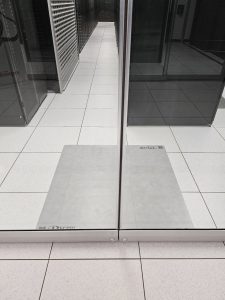
The entrance to the data hall is one of the most important contamination control zones in the facility.
Any contamination that reaches this point has a direct path to critical equipment. Capturing particles before they enter the white space helps reduce the amount of contamination available to circulate throughout the environment.
5. Raised Floor Access Points
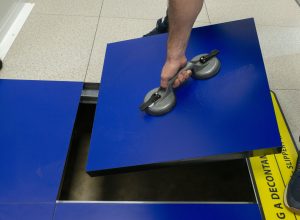
Raised floor systems can accumulate dust and debris over time, particularly during maintenance activities.
When floor panels are opened, contaminants can be disturbed and introduced into the airflow environment. Integrating contamination control directly into raised floor access areas helps reduce this risk while maintaining accessibility and airflow performance.
6. Receiving, Staging, and Storage Areas
Packaging materials, pallets, cardboard, and shipping containers are significant sources of particulate contamination.
Establishing dedicated contamination control zones in receiving and staging areas helps prevent contaminants from migrating from logistics spaces into operational environments.
7. Maintenance and Service Areas
Tools, replacement parts, packaging materials, and maintenance activities can all introduce contamination into the facility.
Implementing contamination control procedures and flooring systems in maintenance areas helps reduce the transfer of particles into critical spaces during routine service activities.
Why Contamination Control Zones Matter
Data centers rely on airflow to cool equipment, but that same airflow can also move contamination throughout the facility.
The most effective contamination control strategy is not to remove particles after they become airborne. It is to prevent them from entering the environment in the first place.
By establishing contamination control zones at key transfer points, data centers can reduce particulate ingress, support cooling efficiency, and help protect critical infrastructure from contamination-related risks.
Supporting Contamination Control with Dycem
Dycem contamination control solutions are designed to capture and retain contamination from shoes and wheels before it can enter critical environments.
From building entrances and access corridors to data hall entrances and raised floor access points, Dycem helps facilities create contamination control zones that support cleaner environments, improved operational efficiency, and long-term equipment protection.
Because data center airflow is designed to move heat rather than control contamination, particles that enter the facility can become part of the airflow moving through the data hall. Learn more about the relationship between contamination and airflow in our article, Data Center Airflow: Moving Heat, Not Contamination.