

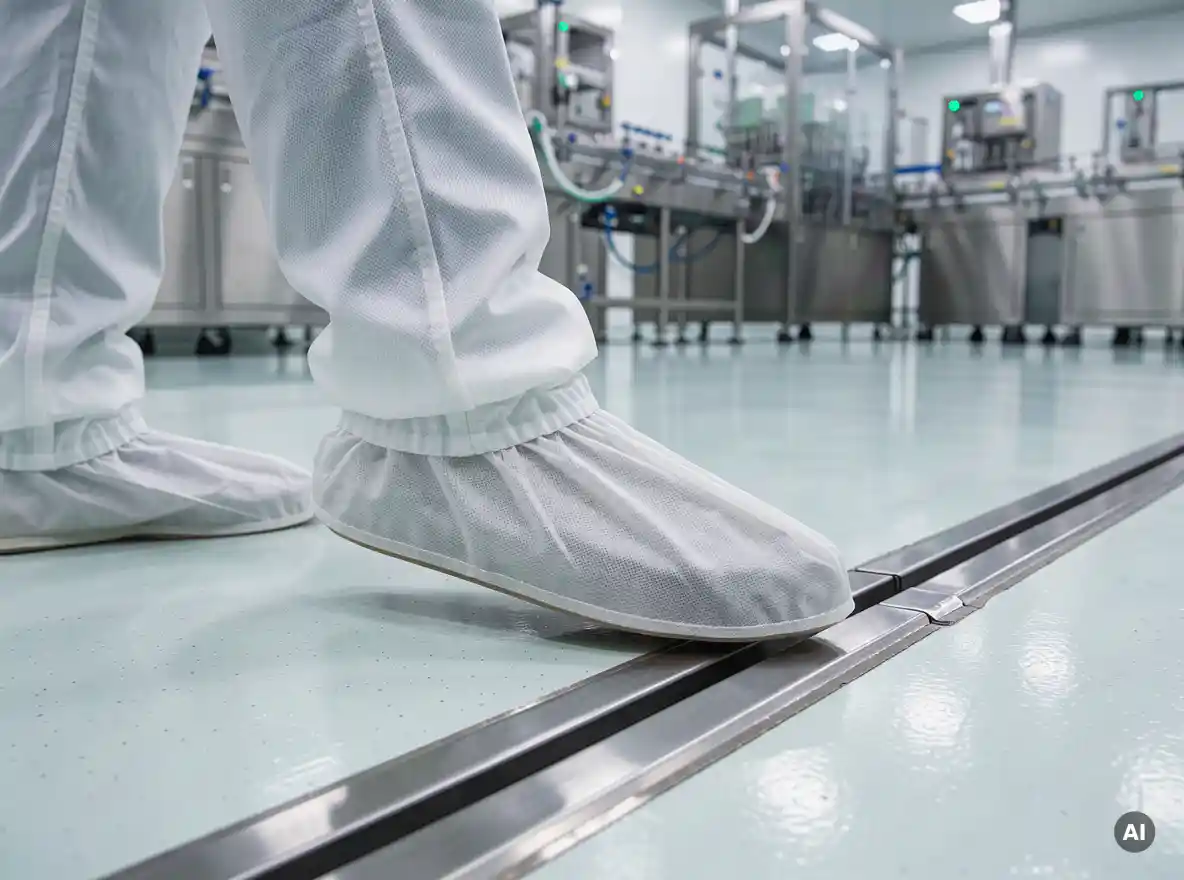
Floor-level contamination control belongs in an EU GMP Annex 1 strategy as a documented, risk-based control within the Contamination Control Strategy (CCS). Facilities identify footwear and wheeled traffic as contamination pathways, place controls at grade transitions, and support them with defined cleaning, monitoring and review. Floor protection reduces particulate transfer but never replaces gowning, cleaning or disinfection.
Annex 1 applies to sterile medicinal product manufacture and expects contamination risks to be identified, controlled and periodically reviewed. Floors are a persistent route for contamination, so the sections below cover how to assess, place, select, validate and maintain floor controls.
Where does floor contamination fit in a CCS risk assessment?
Floor contamination fits in a CCS risk assessment as a personnel and material flow pathway. Footwear, trolley wheels and carts carry particulates and microorganisms between areas, so the floor should be assessed wherever people or equipment move from lower to higher cleanliness zones.
Annex 1 asks manufacturers to consider contamination sources across the whole process, including facility design, personnel, utilities, equipment and material transfer. For floor contamination, the assessment should map:
- Sources: outdoor soil, corridor dust, packaging debris and residues carried on soles and wheels.
- Pathways: pedestrian routes, trolley and cart movements, material transfer points and changing rooms.
- Consequences: impact on particle counts, microbial recovery, cleaning burden and product risk.
- Existing controls: cleaning regimes, gowning procedures, footwear changes and pressure cascades.
Document why floor controls are or are not needed at each transition. A contamination control strategy under EU GMP Annex 1 is only credible when each control is traceable to an identified risk.
How do floor controls reduce particulate and microbial transfer?
Floor controls reduce transfer by capturing contaminants from shoe soles and wheels at the point of entry, before they travel into a cleaner area. Effective systems hold captured particles rather than releasing them, so they are not redistributed by the next footstep or wheel pass.
Reusable polymeric contamination control mats, such as Dycem products, work by attracting and retaining particles on a tacky surface. Dycem reports capture of up to 99.9% of footwear and wheel contaminants under its own test conditions, and the mats incorporate Biomaster silver-ion technology that inhibits microbial growth on the mat surface. These figures are manufacturer-reported and reflect specific test conditions, so they should be confirmed for your own traffic and contamination profile through the particle collection efficiency testing service.
Two points matter for a regulated site. Antimicrobial properties limit growth on the mat itself; they do not replace cleaning, disinfection or environmental monitoring. And floor controls complement, rather than substitute for, gowning discipline, airflow design and pressure differentials.
Which Annex 1 grade transitions need floor-level controls?
Floor-level controls are most justified wherever traffic moves between areas of different cleanliness, particularly into higher-grade zones. Annex 1 defines Grades A to D, so priority transitions are those where footwear or wheels cross a boundary that the CCS identifies as a contamination risk.
Typical candidates include:
- Entry from uncontrolled corridors into Grade D areas.
- Gowning room and changing room thresholds leading to Grade C and Grade B.
- Airlocks and pass-through areas where trolleys and carts transfer between grades.
- Critical corridors that connect production, storage and support areas.
Remember that Grades A to D are EU GMP classifications and are not directly interchangeable with ISO 14644-1 cleanroom classes. Understanding the difference between Grade A and Grade B environments helps you set sensible control points. Grade A and critical processing zones are governed by strict gowning, flow and aseptic controls, so floor mat placement there should follow your own risk assessment rather than a default rule.
How should mats be chosen for different traffic types?
Mats should be chosen by matching the product to the heaviest traffic that crosses it. Pedestrian and light-wheeled areas suit semi-permanent flooring such as Dycem CleanZone, while forklifts and pallet trucks need heavy-duty options. Layout, cleaning access and area changes also influence selection.
- Pedestrian and light wheels: Dycem CleanZone is designed for gowning rooms, cleanroom entrances, critical corridors and airlocks.
- Heavy wheeled traffic: Dycem WorkZone is intended for forklifts, pallet trucks and large carts.
- Flexible or temporary layouts: Floating Mats sit on top of existing flooring and can be moved or extended as space requirements change.
Other selection criteria include compatibility with the facility’s cleaning agents, slip and safety needs, and the footprint required so that every foot and wheel makes contact. Specifications, installation methods and lifespan differ by product, so confirm them before approving a design. For sterile manufacturing specifically, see how Dycem supports pharmaceutical manufacturing.
How can floor contamination controls be validated and documented?
Floor contamination controls are validated by showing they perform their stated purpose in your facility and by recording the evidence within your quality system. This combines a documented rationale, defined acceptance criteria, performance data and routine monitoring trends that confirm continued effectiveness.
A practical approach includes:
- Record the rationale in the CCS and risk assessment, linking each mat location to an identified pathway.
- Define acceptance criteria such as footprint coverage, cleaning frequency and replacement or inspection triggers.
- Gather performance evidence from supplier data and, where appropriate, site-specific efficiency testing.
- Use environmental monitoring trends to confirm there is no adverse signal at monitored transitions, including viable and non-viable data. Floor mats are not a substitute for these programmes, and airborne particle counts, viable monitoring and surface measurements each answer different questions. The article on viable and non-viable particle monitoring explains the distinction.
- Control changes through change control and review the effectiveness during periodic CCS reviews.
No single product guarantees Annex 1 compliance. Compliance rests on the overall system, its documentation and how the site demonstrates control.
What maintenance keeps floor-level controls effective over time?
Floor-level controls stay effective through scheduled cleaning, routine inspection and defined review intervals. A mat that is soiled, damaged or poorly cleaned loses capture performance, so maintenance needs written procedures, trained operators and records that align with the facility’s cleaning programme.
Key practices include:
- Following the manufacturer’s cleaning method for the specific product, and using compatible cleaning and disinfecting agents. Dycem publishes guidance on cleaning Dycem mats.
- Setting cleaning frequency from traffic volume and visible soiling, then adjusting using monitoring data.
- Inspecting for edge lifting, wear, tears and residue build-up, and logging findings.
- Training cleaning staff and documenting the procedure within the quality system.
- Reassessing placement whenever layouts, workflows or traffic patterns change.
Reusable mats avoid the repeated disposal associated with peel-off sticky mats, which can make them a more sustainable option, but only when the cleaning routine is followed consistently.
Next step for your Annex 1 floor strategy
Floor-level controls earn their place in an Annex 1 strategy when they are tied to assessed pathways, placed at the right transitions, matched to traffic, and supported by validation and maintenance records. To identify where your own facility needs them, arrange a complimentary site survey with a Dycem contamination control specialist.
Frequently Asked Questions
What if my environmental monitoring data shows no problem at a transition? Do I still need floor controls there?
Not necessarily. Annex 1 expects controls to be justified by risk, not applied by default, so a clean monitoring history can support a documented decision that a floor control is not required. Record the rationale in the CCS and revisit it during periodic reviews, because changes in traffic volume, layout or product risk can alter the conclusion.
What are the most common mistakes when installing contamination control mats?
The most frequent errors are undersized mats that let some footsteps or wheels bypass the surface, placing mats where traffic does not naturally cross them, and skipping a defined cleaning routine. Others include using incompatible cleaning agents and failing to inspect for lifting edges or wear. Size the footprint so every foot and wheel makes contact, and write inspection and cleaning steps into your SOPs from day one.
Can I rely on supplier efficiency claims as validation evidence?
Supplier data, such as reported capture rates, is useful supporting evidence but reflects specific test conditions. For a robust validation package, combine it with your documented risk rationale, defined acceptance criteria and site-specific data where appropriate, such as efficiency testing with your own traffic and contaminants. Ongoing viable and non-viable monitoring trends then confirm continued effectiveness.