

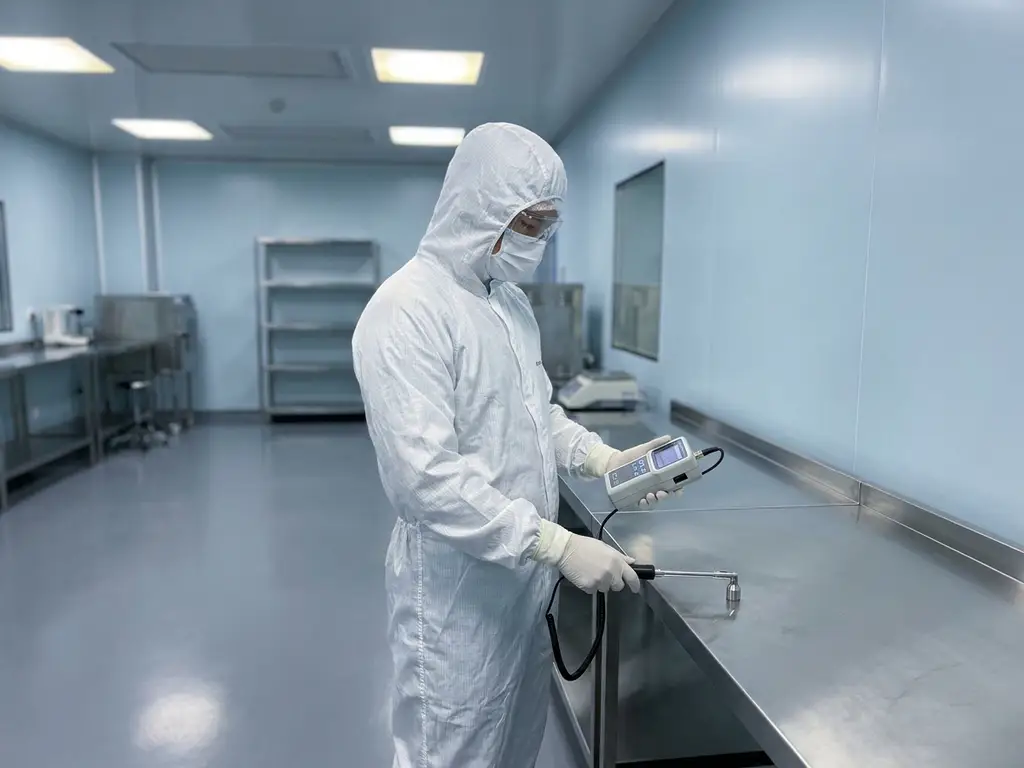
Viable particle monitoring detects living microorganisms such as bacteria, mould, and yeast that can cause biological contamination, while non-viable particle monitoring measures inert, non-living particles such as dust, fibres, and skin cells. Both forms of monitoring are essential in cleanrooms and controlled environments, particularly for pharma contamination management, medical device manufacturing, and sterile environment maintenance. The sections below address the most common questions about how each method works, what regulations apply, and how to reduce contamination at source.
What types of contaminants does each monitoring method detect?
Viable particle monitoring detects living microorganisms, including bacteria, fungi, mould spores, and yeast. Non-viable particle monitoring detects inert, non-living particles such as dust, fibres, skin flakes, and equipment-generated debris. The key distinction is biological activity: viable particles can grow, reproduce, and cause infection or product spoilage, while non-viable particles pose physical or chemical contamination risks.
In practice, the two categories often overlap in significance. A single non-viable particle can carry viable organisms on its surface, meaning that controlling one type of contamination frequently supports control of the other. For facilities operating under cleanroom hygiene standards, both categories must be monitored independently because they require different detection methods and trigger different corrective responses.
The contaminants most relevant to each method include:
- Viable: Bacteria, mould, yeast, fungal spores, and other biological agents capable of growth
- Non-viable: Dust particles, fibres, skin cells, packaging debris, and equipment wear particles
How does viable particle monitoring work in a cleanroom?
Viable particle monitoring in a cleanroom works by collecting air or surface samples and culturing them on growth media to identify and count living microorganisms. Common methods include active air sampling, settle plates, contact plates, and swabs. Results are expressed as colony-forming units (CFUs) per cubic metre of air or per surface area sampled.
Active air samplers draw a known volume of air across an agar plate or collection medium at defined intervals, allowing quantification of airborne microbial load. Settle plates are left open in the environment for a set period to passively capture organisms that fall from the air. Surface monitoring using contact plates or swabs targets high-touch areas such as equipment surfaces, gowning zones, and entry points.
Because viable monitoring relies on culture-based incubation, results are not immediate. Standard incubation periods can take several days, which means viable monitoring is primarily used for trend analysis and periodic compliance verification rather than real-time contamination detection. This delay is a known limitation in pharma contamination control programmes, and it reinforces the value of preventive measures at entry points rather than relying solely on post-detection response.
How does non-viable particle monitoring work in a cleanroom?
Non-viable particle monitoring works by using optical particle counters (OPCs) to measure the size and concentration of airborne particles in real time. As air passes through the counter, a laser beam detects and sizes particles based on the light they scatter. Results are expressed as particle counts per cubic metre, typically at thresholds of 0.5 microns and 5 microns.
Unlike viable monitoring, non-viable monitoring delivers immediate data, making it suitable for continuous environmental monitoring and real-time alert systems. OPCs can be portable for periodic checks or fixed within the cleanroom infrastructure for ongoing surveillance. Many facilities integrate non-viable monitoring data into building management systems to trigger alarms when particle counts exceed defined action or alert limits.
Non-viable monitoring is also used during qualification activities such as Installation Qualification (IQ), Operational Qualification (OQ), and Performance Qualification (PQ) to confirm that a cleanroom meets its classified grade before and during operation. Because non-viable particle counts respond immediately to changes in personnel activity, equipment operation, or air handling performance, they serve as a sensitive early-warning indicator of cleanroom hygiene conditions.
What are the regulatory requirements for both monitoring types?
Regulatory requirements for viable and non-viable particle monitoring are defined by international standards and national guidelines, including EU GMP Annex 1, ISO 14644, and FDA guidance for sterile drug manufacturing. Both monitoring types are mandatory in Grade A and B environments under EU GMP Annex 1, with specific action and alert limits assigned to each cleanroom grade.
Key regulatory frameworks and their requirements include:
- EU GMP Annex 1 (2022 revision): Mandates both viable and non-viable monitoring in all critical and supporting cleanroom grades, with defined limits for CFUs and particle counts per cubic metre at rest and in operation
- ISO 14644-1: Sets the classification system for cleanrooms based on non-viable particle counts, from ISO Class 1 (most stringent) to ISO Class 9
- ISO 14644-2: Addresses monitoring requirements and frequency to demonstrate ongoing compliance with the classified grade
- FDA 21 CFR Part 211 and Aseptic Processing Guidance: Requires environmental monitoring programmes for sterile drug manufacturing, covering both viable and non-viable parameters
- USP Chapter 1116: Provides microbiological guidance for pharmaceutical cleanrooms, including recommended limits for viable monitoring by grade
Hygiene compliance programmes must document monitoring frequency, sampling locations, alert and action limits, and the corrective actions triggered when limits are exceeded. Facilities that fail to maintain validated monitoring programmes risk regulatory observations, warning letters, and potential manufacturing shutdowns.
Can non-viable particles carry viable contamination?
Yes, non-viable particles can carry viable contamination. Microorganisms rarely travel through the air alone. They typically attach to larger carrier particles such as skin cells, dust, fibres, or droplet nuclei. This means a particle counted as non-viable by an optical counter may still transport living bacteria or fungal spores to a critical surface or product.
This relationship has important implications for contamination control strategy. Reducing the total non-viable particle burden in a cleanroom also reduces the potential vehicles available for microbial transport. High non-viable particle counts can therefore be treated as a leading indicator of elevated viable contamination risk, even before viable monitoring results are available.
In sterile environments and hospital contamination control programmes, this interdependence reinforces the need for a layered approach. Air filtration, gowning discipline, surface cleaning, and entry-point contamination control all contribute to reducing both particle types simultaneously. Addressing non-viable particles at source, particularly at floor level where up to 80% of contaminants enter controlled spaces, directly reduces the microbial load carried into critical zones.
What’s the best way to reduce both viable and non-viable contamination at entry points?
The most effective way to reduce both viable and non-viable contamination at entry points is to physically capture particles from footwear and wheeled equipment before they enter the controlled environment. Entry-point contamination control using high-performance floor mats, combined with robust gowning procedures and air pressure differentials, prevents particles from being tracked or carried into cleanrooms in the first place.
Preventive capture at the point of entry is more reliable than relying on monitoring to detect contamination after it has already entered the controlled zone. Key strategies include:
- Installing contamination control mats at all pedestrian and wheeled traffic entry points to capture particles from shoe soles and wheels before they cross into clean zones
- Maintaining positive pressure differentials between cleanroom grades to prevent unfiltered air from migrating inward
- Enforcing gowning discipline in airlocks and gowning rooms to minimise particle shedding from personnel
- Scheduling cleaning and maintenance activities during low-risk periods and following documented procedures that minimise particle disturbance
- Monitoring entry-point particle counts as part of the environmental monitoring programme to identify trends linked to specific traffic patterns or activities
Disposable sticky mats are a common entry-point solution but have significant limitations. They lose adhesion quickly, generate single-use plastic waste, and offer inconsistent performance as layers are peeled away. Reusable polymeric mats provide a more reliable and sustainable alternative for long-term facility hygiene.
How Dycem helps reduce viable and non-viable contamination at entry points
Dycem contamination control mats are engineered to address the root cause of entry-point contamination, capturing up to 99.9% of shoe and wheel contaminants before they enter cleanrooms, gowning rooms, airlocks, and controlled corridors. Every Dycem mat is built with Biomaster antimicrobial protection, which inhibits microbial growth on the mat surface, directly supporting both viable and non-viable contamination control objectives.
Dycem’s product range covers the full range of facility entry-point needs:
- Dycem CleanZone: Designed for pedestrian and light-wheeled traffic at cleanroom entrances, gowning rooms, and critical corridors, delivering consistent particulate capture in the most sensitive zones
- Dycem WorkZone: Engineered for heavy-wheeled traffic including forklifts and pallet trucks, providing contamination control in demanding industrial and logistics environments
- Dycem Floating Mats: Flexible, repositionable mats suited to variable or temporary controlled zones where fixed installation is not practical
Unlike disposable sticky mats, Dycem mats are reusable, washable, and designed to last three to five years, reducing operational disruption and single-use plastic waste. ISO-certified manufacturing ensures consistent quality, and Dycem’s contamination control specialists provide consultative support from initial site survey through to installation and ongoing compliance review. Explore the full range of contamination control solutions or contact a specialist to arrange a free site survey.