

Which in-situ methods verify mat collection performance?
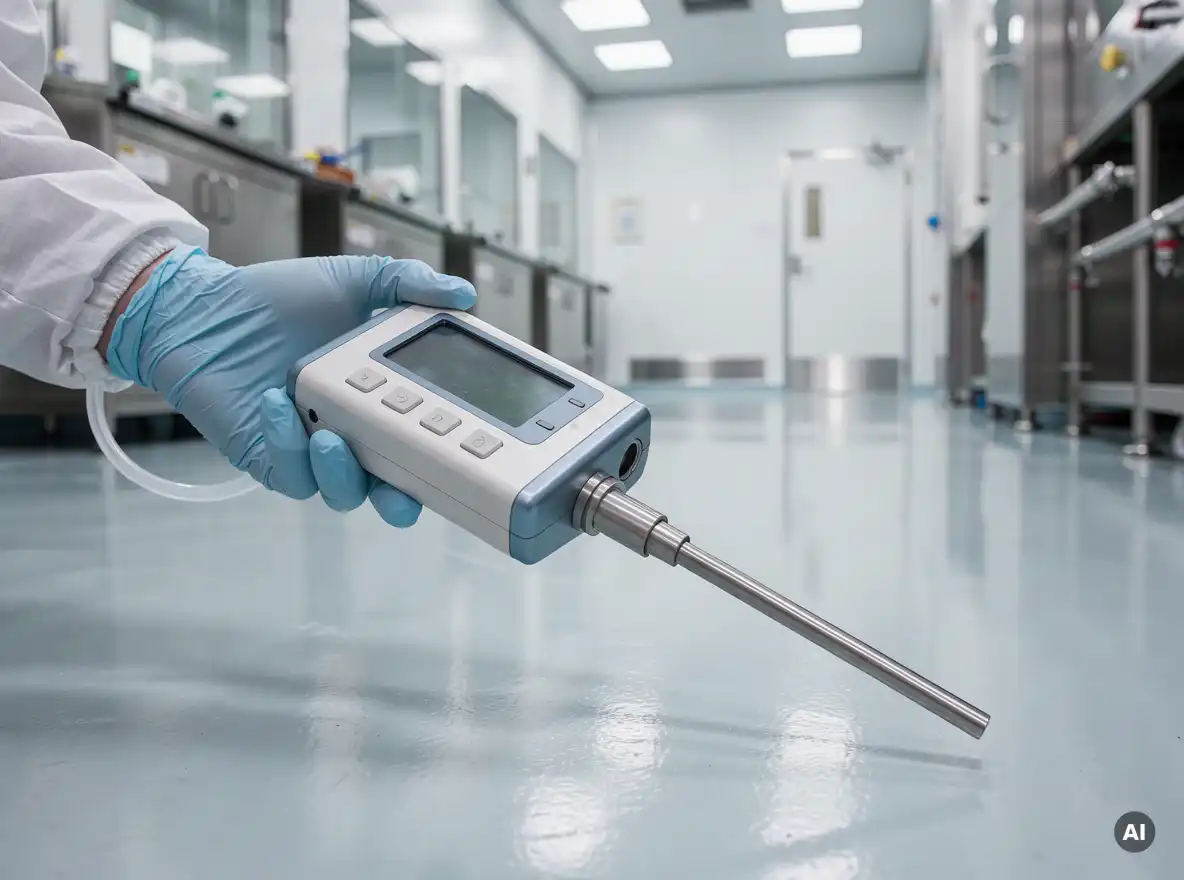
In-situ verification uses one of three approaches: surface sampling of the mat itself, measurement of particles transferred beyond the mat, or comparison of controlled test contamination before and after contact. Each method assesses how well a mat captures and retains particulate carried by footwear and wheels without removing the mat from service.
The most common approaches include:
- Surface particle sampling: Contact plates, adhesive tape lifts, or swabs are used to sample the mat surface and quantify retained particulate. This shows what the mat is holding and how heavily loaded it is. Note that contact plates and swabs are also used for viable (microbial) surface monitoring, which is a separate measurement from non-viable particle counts.
- Controlled challenge testing: A known quantity of test particulate is applied to footwear or a wheeled test device, which then crosses the mat. Contaminant remaining on the sole or wheel is compared with a reference crossing on a bare floor.
- Downstream floor sampling: Particulate on the floor beyond the mat is sampled and compared with the floor before the mat, indicating how much contamination is carried further into the controlled area.
- Visual and photographic assessment: Standardised, dated images of the mat surface and downstream floor provide a qualitative record that supports quantitative results.
Every method measures something slightly different, so choose the one that matches the question you need answered. Surface sampling describes loading, while challenge testing describes capture performance. Dycem offers a dedicated particle collection efficiency testing service for installed mats, which applies a structured protocol rather than ad hoc sampling.
How do you set up a repeatable mat efficiency test?
A repeatable test fixes every variable except the mat’s condition: the sampling location, the test contamination, the footwear or wheel type, the number of crossings, the cleaning state, and the measurement method. Documenting each variable allows a later test to be compared directly with the first.
A practical sequence looks like this:
- Define the objective. Decide whether you are validating a new installation, checking routine performance, or investigating a contamination event.
- Record the baseline condition. Note the mat type, installation date, last cleaning, and recent traffic volume before testing begins.
- Select fixed sampling points. Mark or map locations, for example the entry edge, centre, and exit edge of the mat, so each retest uses the same positions.
- Standardise the challenge. Use the same test particulate, footwear or wheel type, load, and number of passes each time.
- Control the cleaning state. Test at a consistent point in the cleaning cycle, ideally just before scheduled cleaning and again just after, so you can see the effect of cleaning.
- Use calibrated instruments and trained personnel. Particle counters should be within calibration, and the same operator technique should be applied throughout.
- Document everything. Keep results, photographs, and conditions in a log that supports audit readiness.
Testing protocols for regulated facilities should be agreed with quality assurance teams and aligned with the site’s environmental monitoring and contamination control strategy. A generic test should not be presented as a validated procedure without that alignment. Mat testing also does not replace the facility’s routine airborne particle, viable air and surface monitoring programme; it provides complementary evidence about one contamination route.
What results indicate acceptable collection efficiency?
Acceptable collection efficiency is a result that meets the facility’s own predefined acceptance criteria and shows stable, consistent performance against the baseline. No single universal pass mark applies, because acceptable limits depend on the cleanroom classification, process risk, and the criteria set in the site’s contamination control strategy.
When interpreting results, look at several indicators together:
- Comparison with the baseline: Performance close to the commissioning result suggests the mat is functioning as intended.
- Trend direction: A gradual decline across successive tests is more informative than one isolated reading.
- Downstream cleanliness: Low and stable particulate on the floor beyond the mat indicates effective capture at the point of entry.
- Consistency across sampling points: Large differences between locations can point to uneven wear, damage, or a traffic path that bypasses the mat.
Dycem states that its mats are engineered to capture up to 99.9% of shoe and wheel contaminants. That is a manufacturer-reported figure that reflects performance under the conditions in which it was measured, so it should be treated as a reference point rather than a guarantee for every installed mat or facility. Your own acceptance criteria and site data are the measures that matter. For background on how classification affects expectations, see Grade A and Grade B cleanroom environments. Note that EU GMP grades and ISO 14644-1 cleanroom classes are not automatically interchangeable, so acceptance criteria should reference the standard your site actually works to.
How does mat type affect testing results?
Mat type affects results because each design is built for different traffic, which changes how contamination arrives and how the surface wears. Pedestrian mats see footwear, while heavy-duty areas see wheels and loads, so test methods, challenge conditions, and expected loading patterns must match the mat in use.
Consider the main distinctions:
- Pedestrian and light-wheeled areas: Dycem CleanZone is engineered for pedestrian and light-wheeled traffic in areas such as gowning rooms, cleanroom entrances, corridors, and airlocks. Testing here typically uses footwear and light carts as the challenge.
- Heavy-duty areas: Dycem WorkZone is designed for heavy-wheeled industrial traffic such as forklifts, pallet trucks, and large carts. Testing should reflect heavy wheel contact and higher surface stress.
- Loose-laid installations: Dycem Floating Mats are movable mats that sit on top of existing floors, so edge condition and positioning can influence results and should be checked during testing.
Comparing results across different mat types without accounting for traffic, installation method, and substrate can be misleading. Always compare like with like. Disposable alternatives behave differently again, since peel-off layers change the exposed surface with every sheet removed, which makes consistent measurement harder than with a reusable polymeric surface. See how this compares in the guide to sticky mats.
Why does mat performance drop between tests?
Mat performance drops between tests mainly because the surface becomes loaded with captured particulate, because cleaning has been missed or delayed, or because wear and physical damage reduce contact quality. Changes in traffic volume or an altered traffic route can also reduce measured collection efficiency.
The most common causes include:
- Surface loading: A mat holding a large amount of contamination has less capacity to capture more until it is cleaned.
- Inconsistent cleaning: Irregular frequency, the wrong cleaning method, or residues left on the surface can affect performance. Follow the manufacturer’s cleaning guidance for Dycem mats to keep the surface working as designed.
- Wear and damage: Cuts, lifting edges, and abrasion from heavy or abnormal loads reduce effective contact area.
- Changed traffic conditions: More traffic, different footwear, or new wheeled equipment alters the contamination load the mat must handle.
- Test variation: Differences in operator technique, instrument calibration, or sampling location can look like a performance drop when the mat itself is unchanged.
Before concluding that a mat has degraded, rule out test variation by reviewing the log against the original protocol. If the cause is genuine loading or wear, correct it through cleaning, repair, or replacement, and retest to confirm recovery.
How often should installed mats be retested?
Installed mats should be retested at a frequency set by risk, traffic, and regulatory context, commonly at commissioning, after any significant change, and at regular scheduled intervals thereafter. There is no single mandated interval for every site, so the schedule should be defined in the facility’s contamination control strategy.
Consider these triggers when setting a retesting plan:
- Commissioning: Establish a baseline immediately after installation.
- Scheduled intervals: Higher-risk entry points, such as airlocks and gowning room thresholds, justify more frequent checks than low-risk corridors.
- Event-driven checks: Retest after a contamination excursion, a change in traffic or equipment, a cleaning procedure change, or visible damage.
- Before audits: Confirm current performance so records are ready for inspection.
Dycem mats are designed for a service life of 3 to 5 years, depending on traffic, cleaning and conditions of use, which makes periodic testing a useful way to confirm performance across that lifespan and to plan replacement based on evidence rather than assumption. For guidance on building testing into a wider plan, read about contamination control strategy under EU GMP Annex 1, which applies specifically to sterile medicinal product manufacture.
Testing an installed mat is most valuable when it is planned, documented, and repeated on the same terms. To verify how your current mats are performing against a consistent method, explore Dycem’s particle collection efficiency testing service.
Frequently Asked Questions
How do I get started with in-situ mat efficiency testing if we have never tested before?
Start by defining your objective, such as setting a baseline on a newly installed mat or investigating a contamination event. Then record the mat type, installation date, last cleaning, and traffic volume, mark fixed sampling points, and agree the method with your quality assurance team. Running a first baseline test straight after commissioning gives you a reference point for every later retest.
How do I set acceptance criteria if there is no universal pass mark?
Base your criteria on your cleanroom classification, process risk, and the contamination control strategy already in place at your site. Use your commissioning baseline as the starting reference, then define an acceptable deviation from it and a trigger level for corrective action. Document and have QA approve the criteria before testing so results are judged against fixed limits rather than after the fact.
When should I replace a mat rather than just clean it and retest?
If cleaning according to the manufacturer’s guidance does not restore results close to your baseline, or if you find cuts, lifting edges, or abrasion that reduce contact area, replacement is likely the right step. A declining trend across several tests as the mat approaches the end of its expected 3 to 5 year service life also supports planning replacement. Retest the new mat to establish a fresh baseline.