

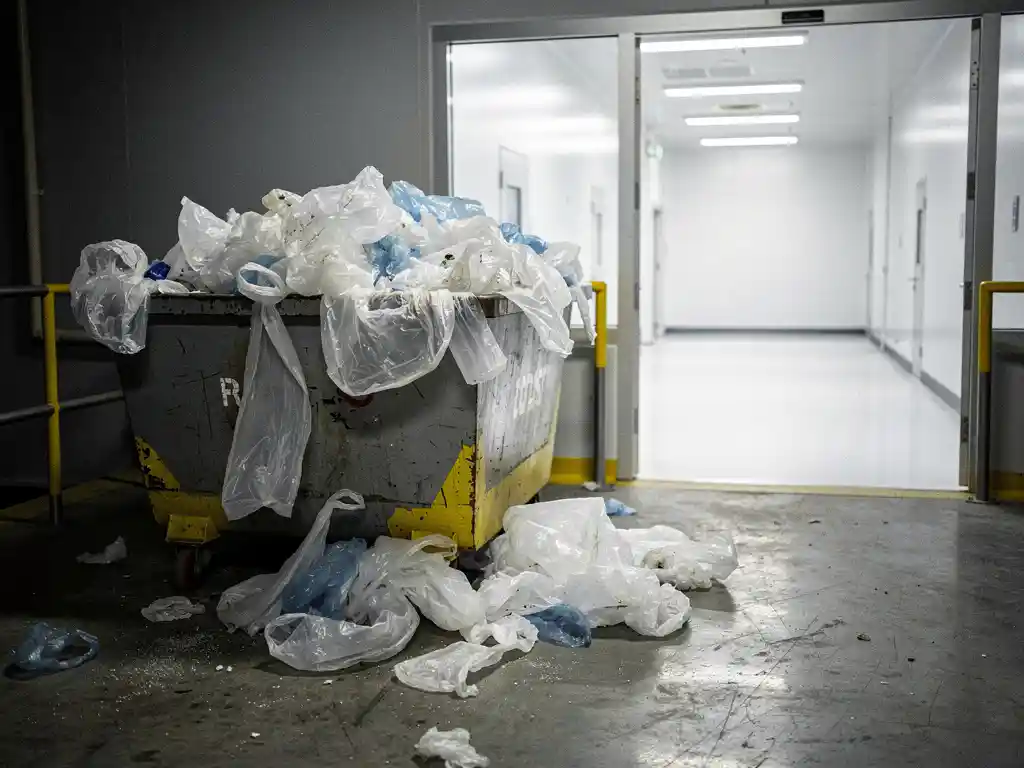
The hidden environmental costs of disposable floor mats are substantial: single-use sticky mats generate significant volumes of plastic waste, contribute to carbon emissions through repeated manufacturing and disposal cycles, and create supply chain inefficiencies that compound over time. For regulated facilities using large quantities of peel-off mats, these costs accumulate quietly but consistently across every operational year. The sections below examine each dimension of this environmental burden and explain how reusable alternatives address it.
How much plastic waste do disposable sticky mats generate?
Disposable sticky mats generate a considerable volume of plastic waste because each mat consists of multiple laminated polymer layers, each of which is peeled away and discarded after use. A single mat pad typically contains between 30 and 60 individual sheets, all of which are destined for landfill once saturated with particulate. Facilities using multiple mat stations across high-traffic entry points can discard hundreds of sheets per week.
The scale of this waste becomes clearer when considered at the facility level. A mid-sized pharmaceutical or electronics manufacturer operating several cleanroom entry points may go through dozens of full mat pads each month. Each pad represents a block of single-use plastic that cannot be recycled due to the adhesive and contamination load it carries. Across a year, this amounts to a substantial and entirely avoidable stream of polymer waste entering the waste stream.
What makes this particularly difficult to justify in 2026 is that many of the industries relying on disposable mats have formal ESG commitments and sustainability reporting obligations. The volume of single-use plastic generated by sticky mat programmes sits in direct tension with those commitments, often without being formally tracked or attributed to contamination control operations.
What happens to disposable floor mats after they’re thrown away?
After disposal, the vast majority of used sticky mat sheets go directly to landfill. Because each sheet is coated with adhesive and loaded with captured particulate, including dust, microbes, and chemical residues in some environments, they are classified as contaminated waste and are not suitable for standard recycling streams. This means the plastic content is effectively lost from any circular economy pathway.
In highly regulated environments such as pharmaceutical manufacturing or medical device production, used mats may be classified as controlled or regulated waste depending on the nature of the substances handled. This can trigger specific disposal requirements, adding both cost and administrative burden to what appears on the surface to be a simple consumable purchase.
The long-term environmental consequence is straightforward: polymer materials that take centuries to degrade accumulate in landfill sites, contributing to the broader problem of single-use plastic pollution. Unlike packaging or food containers, sticky mat waste attracts little public scrutiny, which means it often goes unexamined even in facilities with otherwise robust waste reduction programmes.
Are disposable sticky mats more carbon-intensive than reusable mats?
Yes. Disposable sticky mats carry a higher carbon footprint than reusable contamination control mats when assessed across their full lifecycle. The carbon intensity of single-use mats comes from two compounding factors: the repeated manufacturing of new product to replace what has been discarded, and the logistics emissions associated with frequent replenishment deliveries to the facility.
A reusable mat system, by contrast, requires a single manufacturing event followed by a product lifespan of three to five years. The energy and raw material input that goes into producing a reusable polymeric mat is amortised across years of continuous use, whereas a disposable mat consumes equivalent resources for a lifespan measured in days or hours.
When facilities conduct total lifecycle assessments, the carbon differential between the two approaches becomes difficult to ignore. Reusable systems reduce the frequency of inbound deliveries, eliminate the need for waste collection and disposal transport, and remove the upstream manufacturing emissions associated with constant replenishment. For organisations with science-based carbon reduction targets, switching from disposable to reusable contamination control is one of the more straightforward interventions available within a facilities management context.
What are the hidden supply chain costs of single-use mat programmes?
The hidden supply chain costs of disposable mat programmes extend well beyond the unit price per pad. Procurement teams typically focus on the cost per mat, but the true cost of a single-use programme includes ordering administration, storage space for mat inventory, waste disposal fees, and the operational time spent replacing mats across multiple entry points throughout the working day.
Supply chain fragility is another underappreciated risk. Facilities that depend on regular deliveries of disposable mats are exposed to stock shortages, delivery delays, and price volatility in polymer raw materials. During periods of supply chain disruption, contamination control cannot be paused, meaning facilities may face compliance gaps or be forced to pay premium prices for emergency stock.
There is also a hidden labour cost. Staff time spent peeling, replacing, and disposing of mat sheets across a large facility adds up across shifts and sites. This is rarely captured in procurement comparisons but represents a real operational overhead that a reusable system eliminates almost entirely. When procurement and operations leaders assess total cost of ownership rather than unit cost, the economic case for reusable mats consistently strengthens.
How do reusable contamination control mats reduce environmental impact?
Reusable contamination control mats reduce environmental impact by eliminating the cycle of manufacture, use, and disposal that defines single-use programmes. A single reusable mat that performs for three to five years replaces hundreds of disposable mat pads over the same period, dramatically reducing the volume of plastic entering the waste stream and the carbon emissions associated with repeated production and delivery.
The environmental benefits compound across several dimensions:
- Waste reduction: No peel-off sheets means no contaminated polymer waste going to landfill after each use cycle.
- Lower carbon footprint: One manufacturing event per mat replaces dozens of production runs for disposable equivalents over the same operational period.
- Reduced logistics emissions: Infrequent replenishment deliveries replace the continuous supply chain activity required to keep disposable programmes running.
- Support for ESG reporting: Switching to reusable mats provides a measurable, documentable reduction in single-use plastic consumption that can be reported against sustainability targets.
- Compliance alignment: Reusable mats manufactured to ISO 9001 and 14001 standards, and compliant with EU REACH and California Proposition 65, support environmental compliance obligations alongside contamination control requirements.
Reusable mats also support antimicrobial performance through built-in Biomaster silver-ion technology, which inhibits microbial growth by up to 99.9%, meaning their performance does not degrade in the way that a disposable mat’s adhesive layer does over a single-use cycle.
Which industries are most affected by disposable mat waste?
The industries most affected by disposable sticky mat waste are those operating large numbers of controlled environment entry points under strict contamination management protocols. Pharmaceutical manufacturing, medical device production, food and beverage processing, electronics fabrication, and aerospace assembly are the primary sectors where sticky mat consumption is highest and where the environmental impact is therefore most concentrated.
In pharmaceutical and medical device facilities, cleanroom entry points may require mat replacement multiple times per shift to maintain validated contamination control standards. At this frequency, a single facility can generate thousands of discarded mat sheets per week. The same pattern applies in semiconductor fabrication, where even trace particulate contamination can render products defective, driving high-frequency mat replacement across extensive cleanroom footprints.
Food and beverage manufacturers face a related challenge: contamination control requirements are stringent, but sustainability commitments are increasingly visible to consumers and regulators alike. The use of large volumes of single-use plastic in hygiene protocols sits uncomfortably alongside public-facing sustainability claims, making the environmental cost of disposable mat programmes a reputational as well as an operational concern.
Aerospace and automotive manufacturers operating precision assembly environments similarly consume significant quantities of disposable mats across large facilities with multiple controlled zones, making the cumulative waste impact substantial at the sector level.
How Dycem helps reduce the environmental impact of contamination control
Dycem’s reusable contamination control mat systems are designed to address both the performance requirements of regulated environments and the environmental costs that disposable programmes impose. Key advantages include:
- A product lifespan of three to five years, replacing hundreds of disposable mat pads per entry point
- Capture and retention of up to 99.9% of shoe and wheel-borne contaminants, maintaining performance without single-use waste
- Built-in Biomaster antimicrobial protection, inhibiting microbial growth by up to 99.9% throughout the mat’s operational life
- ISO 9001 and 14001 certified manufacturing, with EU REACH and California Proposition 65 compliance
- A measurable reduction in single-use plastic consumption, supporting ESG targets and sustainability reporting
- The Dycem CleanZone system, purpose-built for cleanroom entrances, gowning rooms, airlocks, and critical corridors where contamination risk is highest
If your facility is currently operating a disposable sticky mat programme and you want to understand the environmental and operational case for switching, contact Dycem today to arrange a consultation and free site survey.