

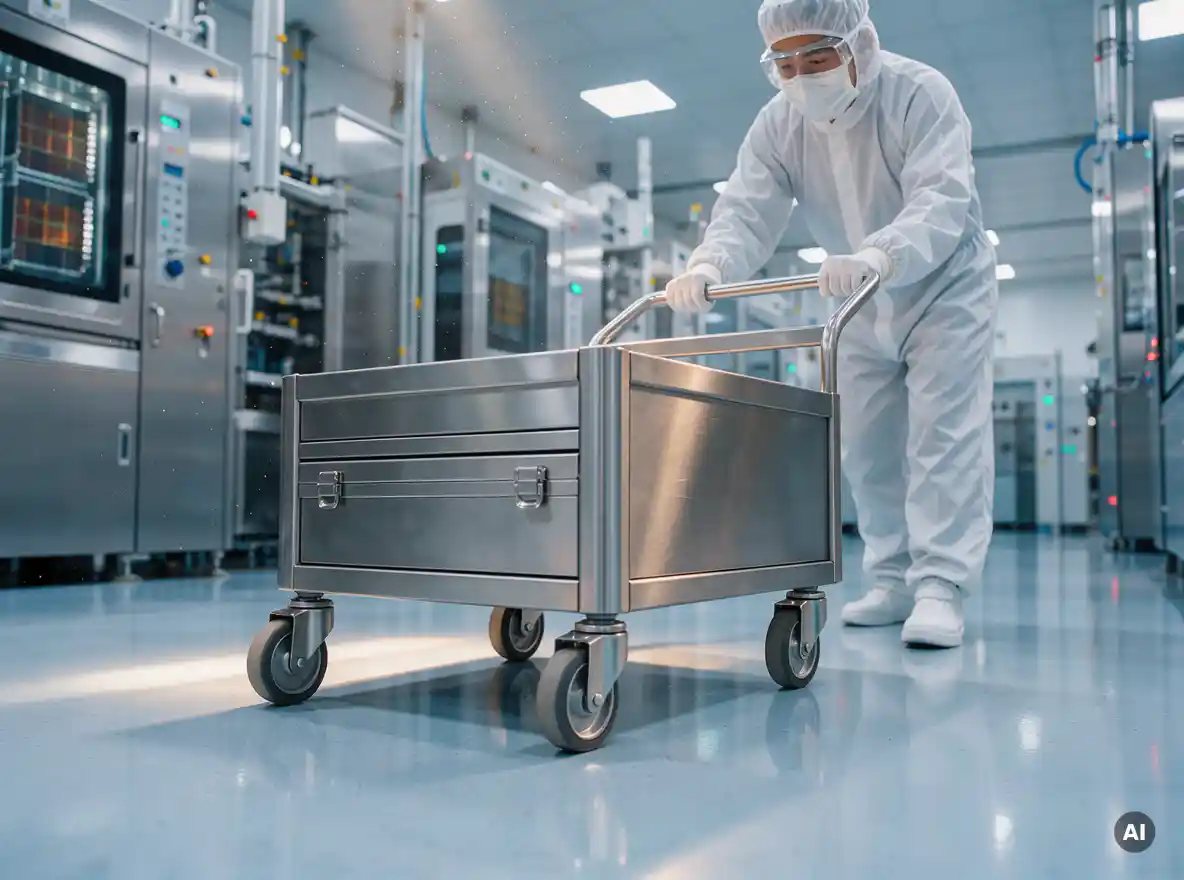
Semiconductor fabs reduce particles tracked in by maintenance carts by controlling the cart itself (wheel material, cleaning and dedicated use) and by capturing wheel-borne contamination at every threshold the cart crosses. No single measure is enough, so the most effective approach layers cart preparation, controlled routes and reusable floor-level contamination control, then verifies results with monitoring.
In an electronics cleanroom, a cart carries floor-level debris from uncontrolled areas into zones where a single particle can affect yield. The sections below explain why carts shed particles, where the risk is highest, how to prepare carts, what works at floor level and how to confirm that particle counts are falling.
Why do maintenance cart wheels shed so many particles?
Maintenance cart wheels shed particles because they pick up debris from every surface they roll across, then release it as they flex, skid and vibrate. Wheel material, bearings and worn tread add particles of their own, while repeated movement between zones spreads the contamination into cleaner areas.
There are two distinct sources, and both matter:
- Transferred contamination: dust, fibres, metal fines and residues collected from service corridors, loading areas and subfab spaces, then deposited at the next threshold.
- Generated contamination: particles produced by the cart, including abraded wheel material, bearing wear, lubricant mist and flaking surface finishes.
Carts also move differently from pedestrians. They are loaded with tools, spare parts and consumables, which raises the contact pressure of each wheel, and they turn and stop abruptly at doorways and airlocks. Floor-level contamination is a major route into controlled spaces, which is why wheels deserve the same attention as footwear.
Which fab zones carry the highest cart contamination risk?
The highest-risk zones are the transitions where a cart moves from a less controlled area into a cleaner one: gowning and material transfer points, cleanroom entrances, airlocks and pass-throughs, and the corridors that link the subfab, service chases and the fab floor. Risk rises with the cleanliness difference between the two sides.
Typical points to assess in a fab include:
- Subfab to fab floor routes, where carts carry equipment support parts and pump or abatement components.
- Material airlocks and equipment bays, where tool maintenance triggers frequent cart traffic.
- Gray-to-white space boundaries, which concentrate wheel contact with uncontrolled flooring.
- Corridors and turning points, where carts slow, turn and shed debris along the route.
Mapping actual cart routes is more useful than assuming risk from the floor plan. Observing where carts originate, which doors they use and where they pause shows which thresholds need the strongest control. This mapping also supports an electronics cleanroom contamination control strategy that matches measures to real traffic patterns. ISO 14644-1 classifies air cleanliness by particle concentration, and ISO 14644-2 covers monitoring and periodic testing of cleanroom performance. Neither standard prescribes a specific cart protocol, so each fab needs to set its own controls based on its risk assessment.
How should maintenance carts be designed and prepared for cleanroom use?
Maintenance carts for cleanroom use should be built from smooth, cleanable, non-shedding materials, fitted with wheels suited to the cleanliness class, assigned to a defined zone, and cleaned to a documented routine before entry. Dedicating carts to the controlled area is one of the most effective preparation steps.
Key preparation measures include:
- Choose appropriate construction. Smooth stainless or compatible coated surfaces, minimal crevices and enclosed or sealed fixings reduce places where particles collect and release.
- Select suitable wheels. Non-marking, low-shedding wheels with sealed bearings reduce generated particles. Verify suitability with the supplier for your cleanliness requirement rather than assuming it.
- Dedicate carts by zone. A cart that stays inside the cleanroom never carries gray-space debris across a boundary. Where sharing is unavoidable, use a transfer point to change from an outer cart to an inner one.
- Clean on a defined schedule. Wipe frames, shelves and wheels using validated, cleanroom-compatible materials, and inspect wheels for wear, flat spots and embedded debris.
- Control what goes on the cart. Bag or wipe parts and tools before loading, and keep packaging that sheds fibres off the cart.
- Consider ESD requirements. Where electrostatic discharge is a concern, wheel and floor choices should be reviewed as part of the wider ESD control programme.
These steps reduce what the cart brings to the threshold, but they cannot remove every particle that wheels pick up in transit. That is why floor-level capture still matters.
Do adhesive floor mats actually stop wheel-borne particles?
Adhesive peel-off mats can remove some wheel-borne particles when fresh, but their performance falls as the top sheet loads with debris and they must be peeled and replaced regularly. Wheels can also lift or drag sheets, and the used layers create ongoing disposable waste.
The practical limitations are well known to cleanroom teams:
- Declining effectiveness: once the surface is covered, additional particles are less likely to be retained, so the mat must be peeled at the right moment.
- Dependence on discipline: performance relies on staff consistently removing used sheets, which is easy to overlook during busy maintenance windows.
- Handling risk: loose sheets and adhesive residue can themselves become a contamination or safety concern, particularly under heavier cart traffic.
- Waste: each peeled layer is single-use plastic, which makes adhesive mats a less sustainable option than a reusable system.
Reusable polymeric alternatives work differently: they attract and retain particles on a washable surface rather than relying on a disposable adhesive sheet. More detail on the differences is available in this overview of sticky mats compared with reusable options.
Where should contamination control mats be placed for carts?
Contamination control mats should be placed at every point where a cart crosses from a lower to a higher cleanliness zone, long enough that each wheel makes firm contact before the cart continues. Entrances, airlocks, transfer points and the approach to critical bays are the priority positions.
Placement guidance for cart traffic:
- Size for the cart, not the person. The mat should be long enough for every wheel to contact the surface at least once, and wide enough to cover the typical path including turns.
- Position before the boundary. Place the mat immediately outside or at the threshold so wheels are treated before entry, not after.
- Match the product to the load. Dycem CleanZone is designed for pedestrian and light-wheeled traffic, which suits many maintenance trolleys at cleanroom entrances, in corridors and in airlocks. Heavier carts, pallet trucks and similar equipment call for a heavy-duty solution such as Dycem WorkZone, so confirm the load and wheel type first.
- Keep surfaces clean. Reusable polymeric mats retain their performance when cleaned according to the manufacturer’s instructions, so build mat cleaning into the routine alongside cart cleaning.
- Avoid gaps in the route. If a cart can bypass the mat by turning or using a different door, the control is incomplete.
Floor-level contamination control is one layer in a broader strategy and does not replace cleanroom HVAC, filtration, gowning, validated cleaning or monitoring. Facilities planning an electronics cleanroom can find application examples on Dycem’s electronics industry page.
How can fabs verify that cart-related particles are decreasing?
Fabs verify improvement by comparing particle data before and after changes, using the same locations, methods and conditions. Combine airborne particle counts, surface or wheel sampling and visual inspection of mats and routes, then review trends over time rather than relying on a single reading.
A practical verification approach includes:
- Establish a baseline. Record particle counts and surface cleanliness near cart entry points before introducing new controls.
- Monitor consistently. Use the fab’s existing airborne particle monitoring to track counts near thresholds, noting cart movements and maintenance events alongside the data.
- Sample wheels and floors. Periodic surface sampling of cart wheels and adjacent floor areas shows whether contamination is being removed at the boundary. Airborne counts and surface measurements answer different questions, so use both.
- Inspect mats and carts. Visible debris loading on mats, and wear or residue on wheels, indicates how much is being captured and when cleaning is due.
- Track excursions. Correlate any particle excursions with specific cart routes, tasks or times to identify remaining weak points.
- Test mat performance. Where mats are already in use, independent measurement of their particle collection efficiency confirms whether they are still performing as intended.
Treat results as site specific. Particle behaviour depends on layout, traffic and cleaning practice, so each fab should set its own acceptance criteria within its contamination control strategy.
Reducing cart-borne particles starts at the threshold
Maintenance carts will always move between less and more controlled spaces, so the goal is to limit what they carry and capture what remains at each boundary. Dedicated, well-prepared carts, mapped routes, correctly sized reusable mats and trend-based monitoring work together to lower the particle load entering critical areas.
If you already use floor-level mats at cart entry points and want to confirm they are still performing, consider Dycem’s particle collection efficiency testing to measure how well your current installation is capturing wheel-borne contamination.
Frequently Asked Questions
How often should cart wheels be cleaned and inspected?
There is no universal interval, so set a frequency based on your cleanliness class, traffic levels and baseline data. A common approach is to wipe wheels and frames before every cleanroom entry or at the start of each shift, with a more detailed inspection on a weekly or monthly schedule. During inspections, look for flat spots, cracks, embedded debris, worn tread and lubricant residue, and replace wheels showing wear. Tighten the schedule if monitoring shows excursions linked to cart movement.
What should I do if particle counts spike after a maintenance cart enters a zone?
First, record the cart ID, route, task and time so you can correlate the excursion with a specific cause. Inspect the cart wheels and the mats along its route for visible debris, damage or overdue cleaning. Check whether the cart bypassed a mat or came from a less controlled area than intended, and review how parts and packaging were loaded. If the excursion repeats, tighten cart dedication, add or resize a mat at the relevant threshold, and increase sampling at that entry point.
How do I decide between dedicated carts and a cart-transfer point?
Dedicated carts are the better choice wherever practical, because a cart that never leaves the controlled zone cannot bring in gray-space debris. If tools and parts must come from outside, use a transfer station where items move from an outer cart to an inner one, with the inner cart staying inside. Choose transfer points when you have limited space or carts that must leave for servicing, and make sure staff follow the process consistently, since the control relies on discipline at the handover.