

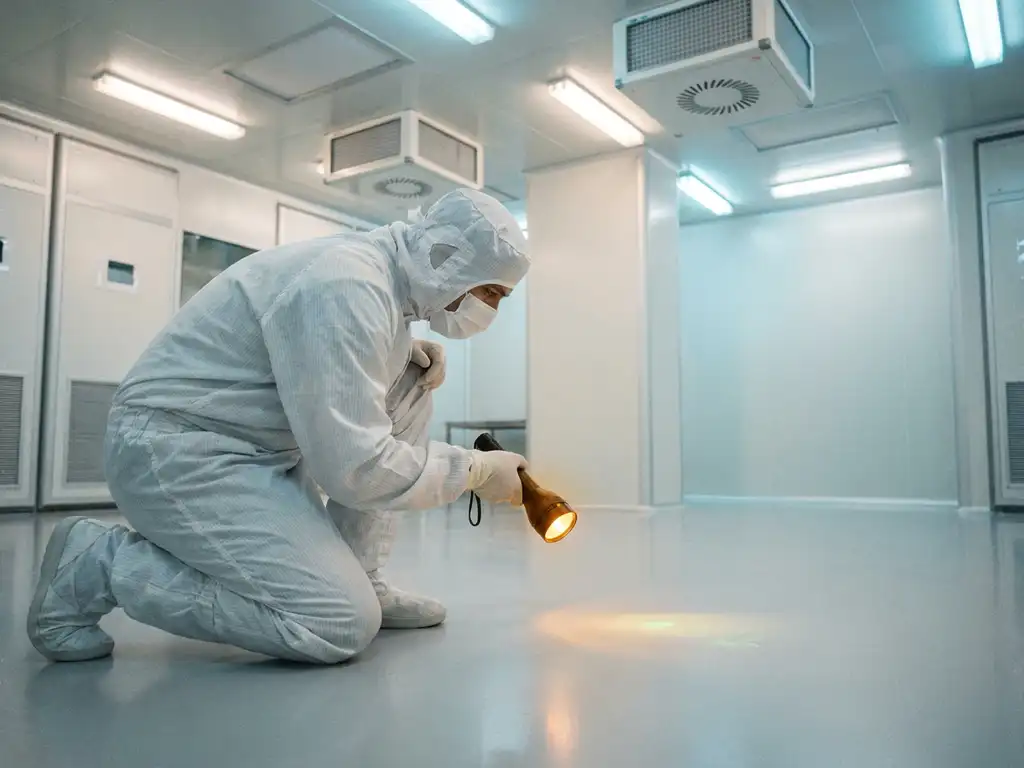
To identify contamination sources in a cleanroom, you need to systematically evaluate every point where people, materials, air, and equipment enter or move through the controlled environment. The most reliable approach combines environmental monitoring, particle counting, surface sampling, and direct observation of personnel behaviour and traffic patterns. This article covers the key questions facility managers ask when tracing and controlling cleanroom contamination.
Where does contamination enter a cleanroom?
Contamination enters a cleanroom through four primary routes: people, materials, air, and equipment. Of these, personnel are consistently the largest contributor, generating particles through skin shedding, clothing, and movement. Air handling failures, uncontrolled material transfer, and inadequately cleaned equipment surfaces account for the remaining pathways.
Understanding entry points is the foundation of any contamination control strategy. Each route introduces different types of contaminants and requires a different mitigation approach:
- Personnel: Skin cells, hair, cosmetics, and fibres from clothing are shed continuously. Every movement amplifies particle generation, making gowning protocols and entry procedures critical.
- Air: Breaches in HVAC integrity, poorly sealed airlocks, and pressure differentials that fall below specification allow unfiltered air to carry particles into controlled zones.
- Materials and components: Raw materials, packaging, tools, and equipment brought into the cleanroom can carry surface particulates and microbial contamination if not properly cleaned or decontaminated.
- Floors and footwear: Studies consistently show that a significant proportion of particulate contamination enters at floor level, carried in on shoes and wheeled equipment from adjacent uncontrolled areas.
Identifying which entry point is responsible for a contamination event requires correlating monitoring data with the timing and location of personnel and material movements.
What are the most common sources of cleanroom contamination?
The most common sources of cleanroom contamination are personnel, inadequate gowning, floor-level transfer, equipment surfaces, and compromised air handling systems. Personnel-generated contamination is the dominant source in most controlled environments, but floor-level ingress is frequently underestimated despite being one of the most consistent and preventable contributors.
Breaking these down further helps quality and facilities managers prioritise their control measures:
- Skin and clothing particles: The human body sheds thousands of particles per minute at rest, and significantly more during activity. Inadequate gowning, incorrect donning sequences, or worn garments accelerate this shedding.
- Footwear and floor transfer: Contaminants tracked in on shoes and wheeled equipment accumulate at entry points and migrate inward with each pass through the cleanroom. This is a continuous, cumulative source.
- Equipment and tooling: Lubricants, metal particles, and surface residues from machinery, carts, and hand tools introduce both particulate and chemical contamination.
- Process materials: Solvents, adhesives, cleaning agents, and raw materials can off-gas or shed particles if not selected and handled carefully.
- HVAC and filtration failures: Filter bypass, incorrect pressure cascades, or inadequate air change rates allow particles to accumulate rather than being continuously removed.
How do you trace contamination back to its source?
Tracing cleanroom contamination back to its source requires a structured investigation that correlates environmental monitoring data with operational records. The process begins by identifying when and where elevated particle counts or microbial results were first detected, then working backwards through personnel logs, material movements, and equipment maintenance records to isolate the probable cause.
A reliable root cause investigation typically follows this sequence:
- Define the event: Establish the nature of the contamination (particulate, microbial, or chemical), the location, and the time window in which it appeared.
- Review monitoring data: Pull particle counter logs, environmental monitoring results, and any out-of-specification records for the affected zones and time period.
- Map personnel and material movement: Cross-reference batch records, access logs, and gowning records to identify who and what entered the affected area during the window.
- Inspect physical entry points: Check airlocks, gowning areas, floor surfaces, and material transfer points for visible contamination or procedural gaps.
- Conduct targeted sampling: Use contact plates, swabs, or settle plates in suspect locations to confirm or rule out specific sources.
- Identify the root cause: Distinguish between systemic failures (process or equipment issues) and isolated deviations (human error or one-time events) to determine the appropriate corrective action.
Thorough documentation at each stage is essential, particularly in regulated industries where contamination investigations must satisfy GMP and FDA audit requirements.
What tools and tests are used to detect cleanroom contaminants?
The primary tools used to detect cleanroom contaminants include airborne particle counters, viable and non-viable air samplers, contact plates, surface swabs, settle plates, and HEPA filter integrity testers. The combination of tools deployed depends on whether the investigation targets particulate, microbial, or chemical contamination.
Particulate detection tools
Airborne particle counters measure the size and concentration of non-viable particles in real time, providing a continuous picture of air quality. Portable counters allow targeted sampling at specific locations during an investigation, while fixed monitoring networks provide trend data over time. HEPA filter integrity testing using photometric or DOP (dioctyl phthalate) methods confirms that filtration systems are performing to specification and not allowing bypass.
Microbial monitoring methods
Settle plates (open Petri dishes exposed to the air for a defined period) capture viable airborne organisms passively, while active air samplers draw a known volume of air across a growth medium for more precise quantification. Surface contamination is assessed using contact plates pressed directly onto flat surfaces and swabs for irregular or hard-to-reach areas. These methods together provide a comprehensive picture of microbial load across both air and surfaces in the controlled environment.
How can floor-level contamination be identified and controlled?
Floor-level contamination is identified by sampling floor surfaces at entry points, traffic routes, and high-activity zones using contact plates or swabs, then correlating results with particle monitoring data from adjacent air. Control is achieved by intercepting contaminants at the point of entry before they migrate into the cleanroom interior.
Floor surfaces are often overlooked in contamination investigations because attention focuses on air quality and personnel behaviour. However, footwear and wheeled equipment are reliable vectors for transferring particulates from uncontrolled areas into controlled zones with every pass. Key steps for identifying and controlling floor-level contamination include:
- Conducting regular surface sampling at all entry points, including gowning rooms, airlocks, and material transfer areas
- Reviewing traffic flow patterns to identify which routes carry the highest contamination risk
- Installing validated contamination control matting at critical entry points to capture particles from footwear and wheel surfaces before they enter controlled zones
- Monitoring mat performance through periodic surface sampling to confirm ongoing particle capture effectiveness
- Ensuring cleaning and maintenance schedules for floor areas are aligned with traffic frequency and contamination risk
Reusable contamination control mats engineered for cleanroom entry points provide a consistent, measurable barrier at the floor level. Unlike disposable peel-off alternatives, high-performance polymeric mats maintain their capture properties across their full service life and can be validated as part of a documented contamination control programme, which is increasingly important for facilities managing GMP or ISO compliance.
When should you conduct a cleanroom contamination audit?
A cleanroom contamination audit should be conducted at regular scheduled intervals as part of your environmental monitoring programme, and additionally in response to any out-of-specification event, process change, facility modification, or failed regulatory inspection. Routine audits catch drift before it becomes a deviation; reactive audits identify root causes after one has occurred.
The frequency of scheduled audits depends on the cleanroom classification, the regulatory framework governing the facility, and the criticality of the processes carried out there. ISO-classified rooms and GMP-regulated environments typically require documented monitoring at defined intervals, with audit scope expanding after any significant change to the facility or process.
Key triggers for an unscheduled contamination audit include:
- Particle counts or microbial results exceeding alert or action limits
- Introduction of new equipment, materials, or personnel into the controlled environment
- Facility modifications such as construction, maintenance work, or changes to HVAC configuration
- Product quality failures or customer complaints that suggest a contamination event
- Upcoming regulatory inspections where audit readiness needs to be confirmed
- Changes to gowning procedures, cleaning protocols, or entry and exit processes
Audits should be documented with sufficient detail to satisfy regulatory review, including the scope of sampling, the methods used, results, and any corrective actions taken. Treating contamination audits as a continuous improvement tool rather than a compliance exercise gives quality managers a more proactive view of their facility’s contamination risk profile.
How Dycem helps with cleanroom contamination control
Dycem’s reusable contamination control mats are engineered to address one of the most consistent and preventable sources of cleanroom contamination: floor-level ingress at entry points. Where disposable sticky mats degrade rapidly and generate plastic waste, Dycem’s polymeric mats deliver validated particulate capture performance across a service life of three to five years, making them a more reliable and sustainable option for facilities operating under GMP, ISO, or FDA requirements.
Dycem’s product range is designed to cover every controlled environment entry scenario:
- Dycem CleanZone: High-performance mats for pedestrian and light-wheeled traffic at cleanroom entrances, gowning rooms, and airlocks, capturing up to 99.9% of shoe and wheel contaminants
- Dycem WorkZone: Heavy-duty mats engineered for forklifts, pallet trucks, and large carts in demanding industrial and logistics environments
- Dycem Floating Mats: Repositionable mats for facilities with variable or temporary controlled zones requiring flexible contamination control coverage
- Dycem Bench Mats and Access Panels: Workstation and access-point solutions that extend contamination control beyond the floor into the wider controlled environment
All Dycem mats include built-in Biomaster antimicrobial protection, are manufactured to EN ISO 9001 and 14001 standards, and are customisable in size, format, and colour to suit any facility layout. Contamination control specialists are available to conduct a free site survey and help you identify the right solution for your entry points and traffic patterns. Explore the full range of Dycem contamination control products or contact the team to arrange your consultation.