

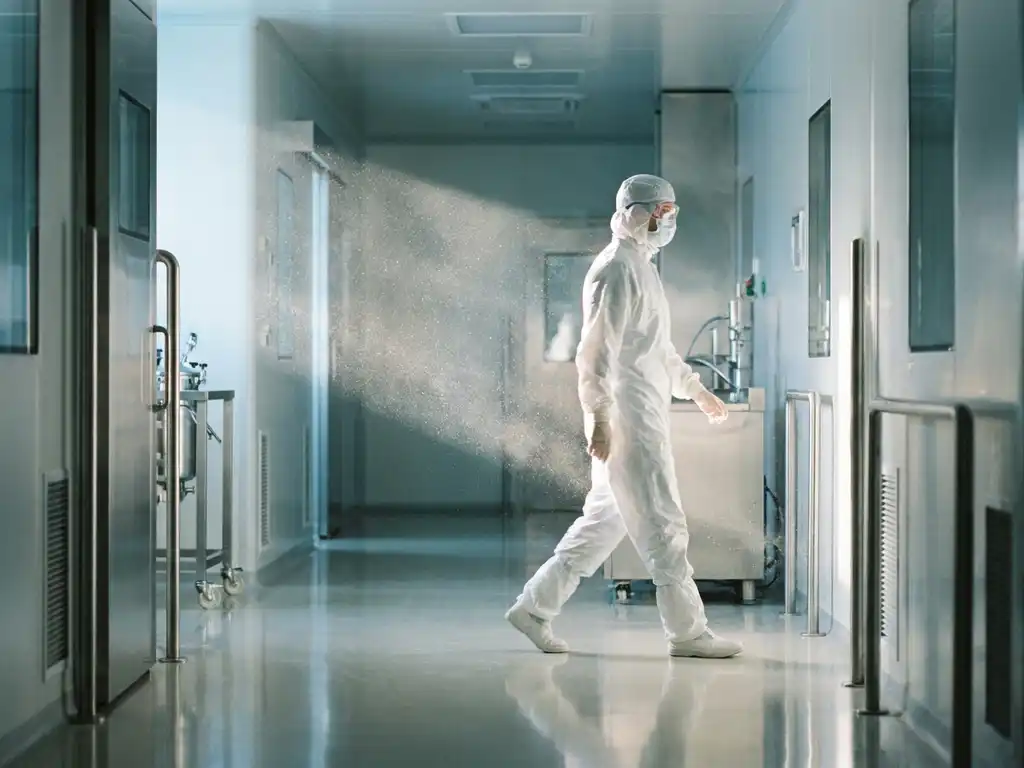
Airborne contamination in pharmaceutical production areas spreads through a combination of human activity, equipment movement, HVAC airflow patterns, and the resuspension of particles that have settled on surfaces, including floors. Personnel moving through cleanrooms and controlled environments are the single largest contributor, shedding skin cells, fibres, and microorganisms with every step. The sections below examine each of these mechanisms in detail, along with the regulatory standards that govern them and the practical steps facilities can take to reduce risk.
What are the main sources of airborne contamination in pharmaceutical facilities?
The main sources of airborne contamination in pharmaceutical facilities are personnel, raw materials, equipment, and the facility’s own air handling systems. Of these, people are consistently the most significant source, generating particulate matter continuously through skin shedding, breathing, and movement. Equipment, surfaces, and incoming materials contribute additional particle loads that can become airborne under the right conditions.
Breaking these sources down by category helps quality and facilities managers prioritise their contamination control programmes:
- Personnel: Human skin sheds thousands of particles per minute during normal activity. In a cleanroom environment, this rises significantly during physical tasks, gowning, and movement between zones.
- Raw materials and packaging: Incoming materials carry particles, fibres, and microbial contamination from external environments. Without adequate decontamination procedures at entry points, these particles enter the controlled space and can become airborne.
- Equipment and machinery: Vibration, heat, and mechanical friction from production equipment generate fine particulate matter. Maintenance activities, in particular, disturb settled particles and release them back into the air.
- Surfaces and floors: Particles that settle on horizontal surfaces, including floors, benches, and equipment housings, do not remain inert. They re-enter the air column through foot traffic, air turbulence, and cleaning activities.
- HVAC and air handling systems: Poorly maintained or inadequately designed systems can recirculate contaminated air, introduce external particles through filter bypass, or create turbulent airflow that lifts settled particles back into the breathing zone.
Understanding the full range of contamination sources is the first step toward building a robust pharma contamination control strategy that addresses risk at every point of entry, not just the most visible ones.
How does human movement spread airborne particles in cleanrooms?
Human movement spreads airborne particles in cleanrooms by generating turbulence that lifts settled contaminants from surfaces and by directly shedding biological material into the air. Every step a person takes creates localised air displacement. In a controlled environment with carefully designed laminar airflow, this disruption can redirect particles toward critical zones, product surfaces, or open containers.
The relationship between personnel behaviour and particle counts is well established in cleanroom science. Walking speed matters considerably. Moving quickly through a cleanroom generates far greater turbulence than slow, deliberate movement, which is why many cleanroom protocols specify a controlled gait and restricted access to critical areas. Similarly, gesturing, bending, and reaching all increase the rate at which skin cells and fibres are released into the surrounding air.
Gowning quality plays a parallel role. Even well-trained personnel wearing full cleanroom garments shed particles at a measurable rate. Gowning integrity, including the condition of suits, gloves, and shoe covers, directly affects how much of this biological load enters the controlled space rather than being contained at the boundary. Worn or improperly fitted garments are a consistent contributor to elevated particle counts during routine monitoring.
The number of people present in a cleanroom at any one time is also a direct multiplier of contamination risk. Occupancy limits exist precisely because each additional person adds to the cumulative particle generation rate in the space. Facilities operating above their validated occupancy thresholds during peak production periods often see corresponding spikes in environmental monitoring data.
Why does floor-level contamination become an airborne risk?
Floor-level contamination becomes an airborne risk because particles that settle on the floor are not permanently removed from the environment. Foot traffic, wheeled equipment, and air currents created by movement and HVAC systems all have the potential to resuspend these settled particles, returning them to the air where they can reach critical surfaces, open product, or personnel breathing zones.
Research in contamination science consistently identifies the floor as a reservoir for particulate and microbial contamination. Up to 80% of contaminants entering a controlled environment do so at floor level, carried in on footwear and wheeled equipment from adjacent, less-controlled spaces. Once inside, these particles settle but remain mobile. A single pass of a trolley or a person walking briskly across a cleanroom floor can resuspend a significant volume of previously settled material.
This mechanism is particularly relevant in pharmaceutical production because the particles most likely to be found at floor level, including skin cells, fibres, and environmental microorganisms, are exactly the categories of contamination that pose the greatest risk to sterile and controlled products. The floor is not a safe destination for these particles; it is a temporary holding point from which they can re-enter the air column at any time.
Effective floor-level contamination management therefore needs to address both the capture of incoming particles before they enter the controlled space and the ongoing reduction of the particle reservoir that accumulates on cleanroom floors over time. Relying solely on air filtration to manage contamination that originates at floor level is an incomplete strategy, because the air handling system cannot address particles that have already settled and are being continuously resuspended by activity in the space.
How does HVAC design affect airborne contamination spread?
HVAC design directly determines how airborne particles move through a pharmaceutical facility, whether they are diluted and removed or concentrated and redistributed. A well-designed system uses controlled airflow direction, velocity, and filtration to continuously sweep particles away from critical zones. A poorly designed or maintained system can do the opposite, creating dead zones, turbulent recirculation, and pathways that carry contamination toward sensitive areas.
The fundamental principle in cleanroom HVAC design is unidirectional, or laminar, airflow. In the most critical environments, such as ISO Class 5 zones used for aseptic processing, air flows in a single direction at a controlled velocity, carrying particles away from the product zone and toward return air grilles. Any disruption to this airflow pattern, whether from equipment placement, personnel positioning, or physical obstructions, creates turbulence that can redirect particles unpredictably.
Pressure differentials between zones are equally important. Pharmaceutical facilities are typically designed with a cascade of positive pressure zones, so that air flows outward from the most critical areas toward less controlled spaces, not inward. If this pressure differential is lost or reversed, even briefly, contaminated air from corridors and adjacent rooms can be drawn into the controlled environment. Maintaining and monitoring these differentials is a core requirement of GMP compliance.
Filter integrity is the third critical variable. HEPA filters are the standard for cleanroom air supply in pharma environments, capable of removing particles down to 0.3 microns at very high efficiency. However, filter bypass, seal degradation, and inadequate maintenance schedules can allow unfiltered air to enter the supply stream. Regular integrity testing and a documented maintenance programme are essential to ensuring the HVAC system performs as validated.
What regulatory standards govern airborne contamination in pharma production?
Airborne contamination in pharmaceutical production is governed by a framework of international and regional regulatory standards, including EU GMP Annex 1, FDA 21 CFR Part 211, ISO 14644, and USP standards. These regulations define acceptable particle counts, microbial limits, environmental monitoring requirements, and the design standards for cleanrooms and controlled environments used in pharmaceutical manufacturing.
EU GMP Annex 1, which was substantially revised in 2022, is particularly significant for sterile medicinal product manufacturing. It introduced the Contamination Control Strategy (CCS) as a formal requirement, meaning manufacturers must now document a holistic, risk-based approach to contamination prevention that covers all sources, including airborne particles, personnel, equipment, and utilities. This shift from prescriptive rules to outcome-based risk management places greater responsibility on quality teams to demonstrate that their contamination control measures are effective and validated.
ISO 14644 provides the technical classification system for cleanrooms, defining particle count limits for each ISO class from Class 1 (the most stringent) to Class 9. Pharmaceutical manufacturers use these classifications to specify the environmental conditions required at each stage of production, and environmental monitoring programmes are designed to verify that these conditions are consistently maintained.
FDA guidance, particularly for sterile drug products, aligns closely with international standards but adds specific expectations around process validation, media fill testing, and the investigation of environmental monitoring excursions. Facilities exporting to the US market must demonstrate compliance with both FDA expectations and their own national regulatory requirements, which in practice means maintaining robust, documented contamination control programmes that can withstand regulatory inspection.
Hygiene compliance across all of these frameworks is not a one-time achievement. It requires ongoing monitoring, documented corrective actions, and a culture of contamination awareness at every level of the organisation.
How can pharmaceutical facilities reduce airborne contamination risk at entry points?
Pharmaceutical facilities can reduce airborne contamination risk at entry points by implementing layered controls that address contamination before it enters the controlled space. This includes gowning protocols, airlocks, pressure differentials, and critically, effective floor-level contamination capture at every transition point between controlled and uncontrolled zones.
Entry points are where contamination control either succeeds or fails. Personnel and equipment moving from external or less-controlled environments carry particles on footwear, wheels, and clothing surfaces. Without effective capture at the point of entry, these particles are tracked directly into the cleanroom, where they settle on floors and surfaces and become a persistent source of airborne contamination through resuspension.
Key measures for entry point contamination control include:
- Airlocks and gowning rooms: Creating a physical transition zone between environments forces personnel to change behaviour and clothing before entering the controlled space, reducing the volume of particles carried in on garments and footwear.
- Pressure cascade management: Ensuring positive pressure differentials at critical entry points prevents contaminated air from flowing inward when doors are opened.
- Footwear and wheel decontamination: Capturing particles from the underside of shoes and wheeled equipment at entry prevents floor-level contamination from being tracked into the controlled zone.
- Personnel training: Entry point protocols are only effective if personnel follow them consistently. Regular training and audit of gowning and entry procedures reduce human error as a contamination pathway.
- Surface and floor hygiene: Regular, validated cleaning of entry point surfaces, including floors, walls, and equipment surfaces in gowning areas, reduces the particle reservoir available for resuspension.
How Dycem contamination control mats help reduce airborne contamination at entry points
Dycem’s reusable contamination control mats address one of the most persistent and underestimated sources of airborne contamination in pharmaceutical environments: particles tracked in at floor level. By capturing up to 99.9% of shoe and wheel contaminants at the point of entry, Dycem mats prevent these particles from ever reaching the cleanroom floor, removing them from the resuspension cycle entirely.
For pharmaceutical and medical device facilities, Dycem offers purpose-built solutions for every entry point and traffic type:
- Dycem CleanZone: Designed for cleanroom entrances, gowning rooms, airlocks, and critical corridors, delivering high-performance particulate capture at the most sensitive transition points.
- Dycem WorkZone: Engineered for heavy-wheeled traffic including forklifts and pallet trucks, extending contamination control to demanding logistics and production environments.
- Dycem Floating Mats: Repositionable mats for facilities that need flexible contamination control across variable or temporary zones.
All Dycem mats are built with integrated Biomaster antimicrobial protection, are reusable and washable, and have a lifespan of three to five years, making them a more sustainable and cost-effective alternative to disposable peel-off sticky mats. They are ISO-certified and compliant with EU REACH and California Proposition 65, supporting facilities that need to demonstrate hygiene compliance under GMP, FDA, and ISO 14644 frameworks.
Explore the full range of contamination control solutions or request a free site survey from a Dycem contamination control specialist to identify the right entry point strategy for your facility.