

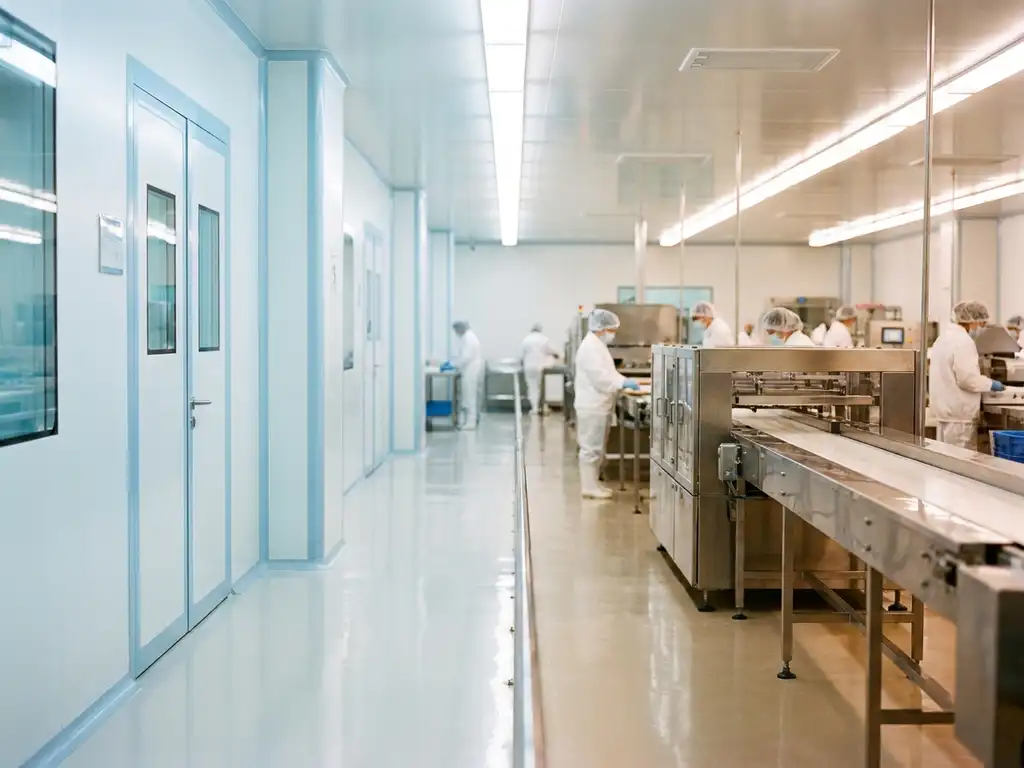
Pharmaceutical manufacturing and food production share a fundamental goal: keeping contaminants out of their processes. However, the nature of those contaminants, the regulatory frameworks governing them, and the consequences of failure differ significantly between the two industries. While pharma focuses primarily on microbial, particulate, and chemical contamination that could compromise patient safety, food production must manage biological, chemical, and physical hazards that threaten consumer health at scale. The sections below unpack the key differences and where the two industries align.
What contamination risks are unique to pharmaceutical manufacturing?
Pharmaceutical manufacturing faces contamination risks that are uniquely tied to the sterility and chemical integrity of drug products. The primary concern is microbial contamination — the introduction of bacteria, fungi, or endotoxins into sterile or aseptic environments — which can render a batch unsafe for patient use. Particulate contamination, including sub-visible particles from equipment or personnel, is equally critical in injectable and ophthalmic drug production.
Unlike food production, pharma must also manage cross-contamination between active pharmaceutical ingredients (APIs). Even trace amounts of one compound transferred into another product line can cause adverse patient reactions or regulatory rejection. This is particularly acute in facilities that manufacture multiple drug types or handle highly potent compounds such as cytotoxics.
Personnel are a major contamination vector in pharmaceutical environments. Human skin, hair, and breath continuously shed particles and microorganisms, which is why cleanrooms in pharma are classified under strict ISO and EU GMP grades — from Grade A (the most critical, such as filling zones) down to Grade D (background cleanroom areas). Every entry point into these zones is a potential contamination pathway, and controlling what personnel and equipment bring in is a non-negotiable operational requirement.
What contamination risks are unique to food and beverage production?
Food and beverage production faces contamination risks centred on biological hazards such as Listeria, Salmonella, and E. coli, as well as allergen cross-contact and physical foreign body contamination. Unlike pharmaceutical environments, food facilities must also manage the risk of pests, raw material variability, and the movement of allergens between production lines — all of which can trigger product recalls or pose direct consumer health risks.
Allergen management is a challenge with no direct equivalent in pharma. A facility producing both gluten-containing and gluten-free products, or handling tree nuts alongside nut-free lines, must implement rigorous zoning and cleaning protocols to prevent cross-contact. The consequences of failure are immediate and consumer-facing, often resulting in high-profile recalls and reputational damage.
Physical contamination — fragments of packaging, equipment wear, or debris tracked in from external areas — is another significant risk in food environments. Unlike pharmaceutical cleanrooms, food production areas frequently involve wet processes, high-pressure cleaning, and the movement of large wheeled equipment, all of which can redistribute contaminants across the facility floor and into product zones.
How do GMP and food safety regulations compare for contamination control?
GMP (Good Manufacturing Practice) in pharmaceuticals and food safety regulations share a common foundation — both require documented contamination control procedures, facility hygiene standards, and traceability — but they differ significantly in specificity and enforcement. Pharmaceutical GMP, governed by bodies such as the FDA, EMA, and EU GMP guidelines, mandates validated cleanroom classifications, environmental monitoring programmes, and batch-level contamination records. Food safety frameworks such as HACCP, FSMA, and BRC standards focus on hazard analysis, critical control points, and preventive controls rather than classified environments.
In pharmaceutical manufacturing, contamination control is built into the product release process. A batch cannot be approved for distribution without documented evidence that the manufacturing environment met defined microbial and particulate limits throughout production. This creates a direct link between environmental contamination control and regulatory compliance at every stage.
Food safety regulation, while rigorous, operates on a risk-based rather than classification-based model. Facilities identify their specific hazard points through HACCP analysis and implement controls proportionate to the risk. This gives food manufacturers more flexibility in how they achieve compliance, but it also means contamination control practices can vary more widely between facilities than they do in pharmaceutical environments, where GMP standards are prescriptive and globally harmonised.
How does floor-level contamination management differ between the two industries?
Floor-level contamination management differs between pharma and food production primarily in the type of contaminant being controlled and the traffic patterns involved. In pharmaceutical cleanrooms, the priority is capturing particulate and microbial contamination brought in on footwear and light equipment wheels at controlled entry points. In food production, the floor is also a vector for biological hazards, allergens, and physical debris — often distributed by heavier wheeled traffic such as forklifts and pallet trucks moving between raw material, processing, and packaging zones.
Pharmaceutical facilities typically manage floor-level contamination at precisely defined entry points: gowning rooms, airlocks, and cleanroom thresholds. The focus is on preventing external contamination from crossing into classified zones, and solutions must be compatible with cleanroom validation requirements. Entry control is systematic and personnel-focused.
Food production environments face a more complex challenge because contamination can originate both externally and internally. Wet floors, drainage areas, and high-traffic logistics routes create ongoing contamination risks throughout the facility, not just at the perimeter. Effective floor-level management in food environments must account for both pedestrian and heavy vehicle traffic, and solutions need to perform reliably under frequent cleaning cycles and demanding operational conditions.
In both industries, research consistently shows that the majority of contamination entering controlled environments does so at floor level — carried in on shoes and wheels. This makes entry-point floor management one of the highest-impact contamination control measures available to facilities in either sector.
Which contamination control solutions work across both pharma and food environments?
Reusable polymeric contamination control mats are among the solutions that perform effectively across both pharmaceutical and food production environments. They address the shared challenge of floor-level contamination at entry points, capturing particulate, microbial, and physical debris from footwear and wheeled equipment before it enters controlled zones. Their antimicrobial properties add an additional layer of protection relevant to both industries.
Beyond mats, both industries rely on a combination of gowning protocols, air handling systems, surface cleaning regimes, and environmental monitoring. The specific configuration of these measures differs by industry and facility type, but the underlying logic is consistent: identify where contamination enters, and control it at that point.
Where solutions diverge is in their specification. Pharmaceutical environments typically require materials that are compatible with cleanroom validation, non-shedding, and capable of withstanding IPA or other cleanroom-grade disinfectants. Food environments prioritise materials that can withstand wet cleaning, high-pressure washdowns, and the physical demands of heavy vehicle traffic. The contamination control mat range addresses both requirements through products engineered for different traffic loads and environmental conditions, from cleanroom pedestrian zones to heavy-duty logistics areas.
Should pharma and food facilities use the same contamination control standards?
Pharma and food facilities should not apply identical contamination control standards, but they should apply equally rigorous ones tailored to their specific risk profiles. The nature of the hazard, the regulatory framework, and the consequences of failure differ enough between the two industries that a one-size-fits-all approach would leave critical gaps in either environment. What both industries share is the need for systematic, validated, and consistently applied contamination control at every defined risk point.
For pharmaceutical facilities, contamination control standards must align with classified cleanroom grades, environmental monitoring requirements, and GMP validation expectations. Standards are prescriptive, and deviations must be documented and investigated. For food facilities, standards are built around hazard analysis and the specific risks present in that facility — allergens, pathogens, or physical contaminants — with controls proportionate to the severity and likelihood of each hazard.
The practical implication for quality and facilities managers is that benchmarking against the wrong industry standard can create a false sense of compliance. A food facility adopting pharmaceutical cleanroom protocols without adapting them to food-specific risks may over-engineer some controls while missing others entirely. Equally, a pharmaceutical facility that treats contamination control with the flexibility appropriate to food production risks falling short of GMP requirements.
The most effective approach in either industry is to start with a thorough assessment of contamination entry points, traffic patterns, and regulatory obligations — and then build a control strategy that addresses those specific conditions with validated, evidence-based solutions.
How Dycem supports contamination control in pharma and food environments
Dycem’s reusable contamination control mats are engineered to address floor-level contamination at the entry points that matter most — whether that is a pharmaceutical cleanroom threshold or a food production zone boundary. With built-in Biomaster antimicrobial protection, a lifespan exceeding three years, and ISO-certified manufacturing, Dycem mats deliver consistent, validated performance in both regulated environments.
- Dycem CleanZone is designed for pedestrian and light-wheeled traffic at cleanroom entrances, gowning rooms, and airlocks — capturing up to 99.9% of shoe and wheel contaminants at the most sensitive entry points in pharmaceutical and medical device facilities.
- Dycem WorkZone handles heavy-wheeled traffic including forklifts and pallet trucks, making it the right solution for food production logistics areas, warehouse entry points, and high-throughput processing zones.
- Dycem Floating Mats offer repositionable contamination control for facilities with variable or temporary zone configurations — useful in food environments where production layouts change seasonally or by product run.
- All Dycem mats are reusable and washable, significantly reducing the environmental waste associated with disposable sticky mat programmes while lowering total cost of ownership over time.
Whether your facility operates under GMP, HACCP, or both, Dycem’s contamination control specialists can assess your entry points and recommend the right solution for your environment. Contact the Dycem team to arrange a free site survey and find out how floor-level contamination control can be strengthened across your facility.