

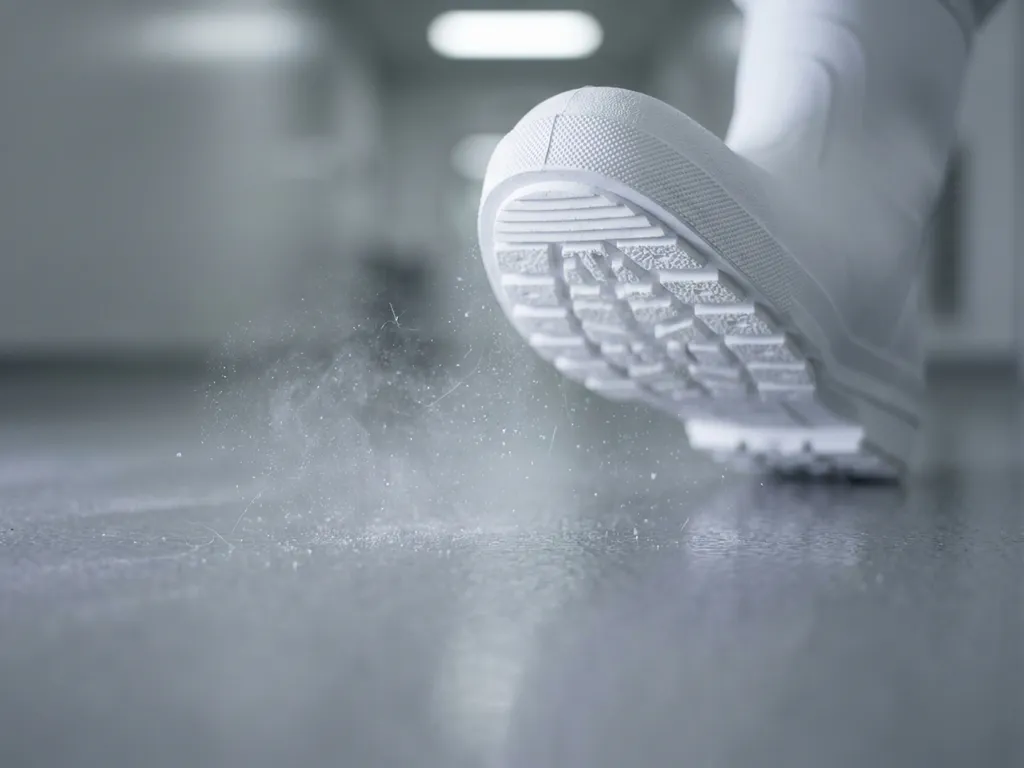
Particle transfer at floor level happens when contaminants attached to the soles of shoes or the wheels of trolleys and equipment are physically transported from uncontrolled areas into controlled environments. The mechanism is straightforward: any surface that contacts a contaminated floor picks up particles and carries them forward with each subsequent step or rotation. For facilities operating cleanrooms or controlled environments, understanding this transfer pathway is the first step toward preventing it.
Why does floor level account for most contamination in cleanrooms?
Floor level accounts for the majority of contamination entering cleanrooms because every person and piece of equipment that enters a controlled space makes direct, repeated contact with the floor. Research and industry experience consistently point to footwear and wheeled traffic as the primary contamination vector, with up to 80% of particulate contamination entering controlled environments at floor level.
Unlike airborne particles, which filtration systems and positive pressure environments can manage effectively, floor-borne contamination is introduced mechanically. Each footstep or wheel rotation creates a direct physical link between the outside world and the controlled zone. The more foot and vehicle traffic a facility handles, the greater the cumulative particle load transferred across that boundary.
Gravity also plays a role. Particles that become airborne during activity eventually settle onto floors, where they accumulate and wait to be picked up by the next person or trolley passing through. This means the floor is not just a transfer medium but also a reservoir that continuously replenishes itself.
How do particles transfer from shoes and wheels into controlled environments?
Particles transfer from shoes and wheels through a process of mechanical adhesion and release. Contaminants stick to the undersides of shoes or the contact surfaces of wheels as they pass over contaminated areas, and are then deposited onto cleaner surfaces with each subsequent step or rotation. The efficiency of this transfer depends on particle size, surface texture, and the weight and speed of the traffic involved.
For pedestrian traffic, the heel-to-toe rolling motion of a footstep repeatedly presses the sole against the floor, releasing particles at each point of contact. Soft or textured sole materials tend to trap more particles and carry them further than smooth ones. For wheeled equipment, the continuous rotation of a wheel means the same contaminated surface contacts the clean floor repeatedly as the equipment moves forward, distributing particles across a much larger area than a single footstep would.
Particle release is also influenced by speed and pressure. Faster-moving trolleys and heavier loads increase the mechanical force applied to the floor, which can dislodge particles from wheel surfaces and embed them into floor materials. This is why high-traffic corridors and loading areas often represent the highest-risk entry points in a facility.
What types of contaminants are commonly carried at floor level?
The most common floor-level contaminants include particulate matter such as dust, fibres, and skin cells, as well as biological material including bacteria, mould spores, and allergens. Chemical residues from outdoor environments, cleaning agents, and industrial processes are also frequently tracked in. The specific contaminant profile varies by industry and facility location, but the categories remain broadly consistent.
In pharmaceutical and medical device environments, the primary concern is microbial contamination and foreign particulate matter that could compromise product sterility or introduce visible defects. In food and beverage facilities, allergens, pathogens, and environmental microbes are the critical risks. Electronics and aerospace manufacturers focus on sub-micron particles that can cause product failures invisible to the naked eye.
Outdoor environments contribute a significant portion of floor-level contaminants. Soil particles, pollen, moisture, and pollutants are tracked in on footwear from car parks, loading bays, and external walkways. These materials do not just introduce particles directly but can also serve as nutrients for microbial growth once inside a controlled space.
What conditions make floor-level particle transfer worse?
Several conditions amplify floor-level particle transfer: high foot and vehicle traffic volumes, inadequate entry controls, inappropriate flooring materials, and the absence of a defined contamination boundary between uncontrolled and controlled zones. Any one of these factors increases the particle load entering a facility, and in combination they can overwhelm even well-designed contamination control programmes.
Traffic volume is the most direct amplifier. A facility with dozens of personnel and frequent equipment movements across a single entry point will accumulate contamination far faster than one with restricted access. Shift changes, deliveries, and maintenance activities represent peak-risk periods when particle transfer is most likely to occur.
Flooring material also matters. Smooth, hard floors allow particles to be resuspended with air movement or foot traffic, while textured or porous surfaces trap particles that are then difficult to remove through standard cleaning. In either case, the floor becomes a reservoir that feeds contamination back into the environment long after the original transfer event.
Humidity and moisture can worsen the situation by causing particles to clump together and adhere more stubbornly to surfaces, making them harder to capture with passive control methods. Conversely, very dry conditions increase static charge on particles, which can cause them to cling to surfaces and be carried further into controlled zones.
How effective are different floor-level contamination control methods?
Floor-level contamination control methods vary significantly in their effectiveness. Reusable polymeric contamination control mats consistently outperform disposable sticky mats, footbaths, and shoe cover programmes in terms of particle capture efficiency, operational reliability, and total cost of ownership. The most effective approach combines a purpose-designed mat system at every controlled entry point with supporting hygiene protocols.
Disposable sticky mats
Disposable peel-off sticky mats are widely used but have well-documented limitations. Their adhesive surface becomes saturated quickly under moderate traffic, reducing capture efficiency after only a short period of use. They require frequent replacement to maintain any meaningful performance, generating significant single-use plastic waste and ongoing procurement costs. They also provide no antimicrobial protection and are prone to edge lifting, which creates trip hazards and bypasses the contamination barrier entirely.
Footbaths and shoe cover programmes
Chemical footbaths can address microbial contamination but do nothing to capture particulate matter, and their effectiveness depends entirely on correct chemical concentration and dwell time. Shoe cover programmes introduce their own contamination risks through improper application and removal, and add time and cost to every facility entry. Neither method addresses wheeled traffic, leaving a significant contamination pathway uncontrolled.
Reusable contamination control mats
Reusable polymeric mats engineered specifically for contamination control offer the most consistent performance across both pedestrian and wheeled traffic. Their polymer construction captures particles mechanically rather than relying on adhesive saturation, and built-in antimicrobial protection addresses microbial transfer simultaneously. With a lifespan measured in years rather than days, they represent a more sustainable and cost-effective alternative to disposable solutions. Dycem’s contamination control mat range covers entry points from cleanroom corridors to heavy-traffic industrial zones.
When should a facility reassess its floor-level contamination strategy?
A facility should reassess its floor-level contamination strategy when contamination incidents increase, when regulatory audits identify entry-point weaknesses, when traffic patterns change significantly, or when the current solution is generating unsustainable costs or waste. Proactive reassessment is also warranted whenever a facility expands, changes production lines, or moves into a higher-risk regulatory classification.
Contamination incidents that cannot be traced to equipment failure or process deviation often point to an inadequate entry-point strategy. If environmental monitoring data shows elevated particle counts near access points, or if microbial excursions correlate with shift changes or delivery schedules, the floor-level control system deserves close scrutiny.
Audit findings are another clear trigger. Regulatory bodies inspecting GMP-compliant facilities expect to see documented, validated contamination control measures at every controlled entry point. A facility relying on disposable mats without a documented change schedule, or using footbaths without concentration records, is likely to face observations that require corrective action.
Operational changes such as increased throughput, new product lines, or facility reconfiguration can also alter contamination risk profiles in ways that existing controls were not designed to handle. Regular review, at minimum annually and after any significant operational change, ensures that the contamination control strategy remains proportionate to the actual risk.
How Dycem helps control floor-level particle transfer
Dycem’s reusable contamination control mats are engineered specifically to intercept particles at the floor level before they cross into controlled environments. Each mat captures shoe and wheel contaminants through a high-performance polymer surface, while built-in Biomaster antimicrobial protection addresses microbial transfer simultaneously. The range is designed to cover every type of entry point a facility operates:
- Dycem CleanZone for pedestrian and light-wheeled traffic at cleanroom entrances, gowning rooms, and critical corridors
- Dycem WorkZone for heavy-wheeled traffic including forklifts and pallet trucks in demanding industrial environments
- Dycem Floating Mats for flexible, repositionable contamination control across variable or temporary zones
- Dycem Bench Mats and Access Panels for extending contamination control beyond the floor to workstations and access points
Unlike disposable sticky mats, Dycem mats are reusable, washable, and designed to last three to five years, making them a more sustainable and cost-effective long-term solution. ISO-certified manufacturing ensures consistent quality across every product, supporting compliance with GMP, FDA, and ISO regulatory requirements.
If your facility is reviewing its contamination entry points or preparing for a regulatory audit, speak to a Dycem specialist to arrange a free site survey and find out which solution is right for your environment.
Related Articles
- Should food manufacturers use antimicrobial flooring at every zone entry?
- How do antimicrobial mats work at food facility entry points?
- How do you investigate a contamination event under GMP?
- How do you train cleanroom staff on contamination prevention in 2026?
- How do you create a floor-level contamination control protocol from scratch?