

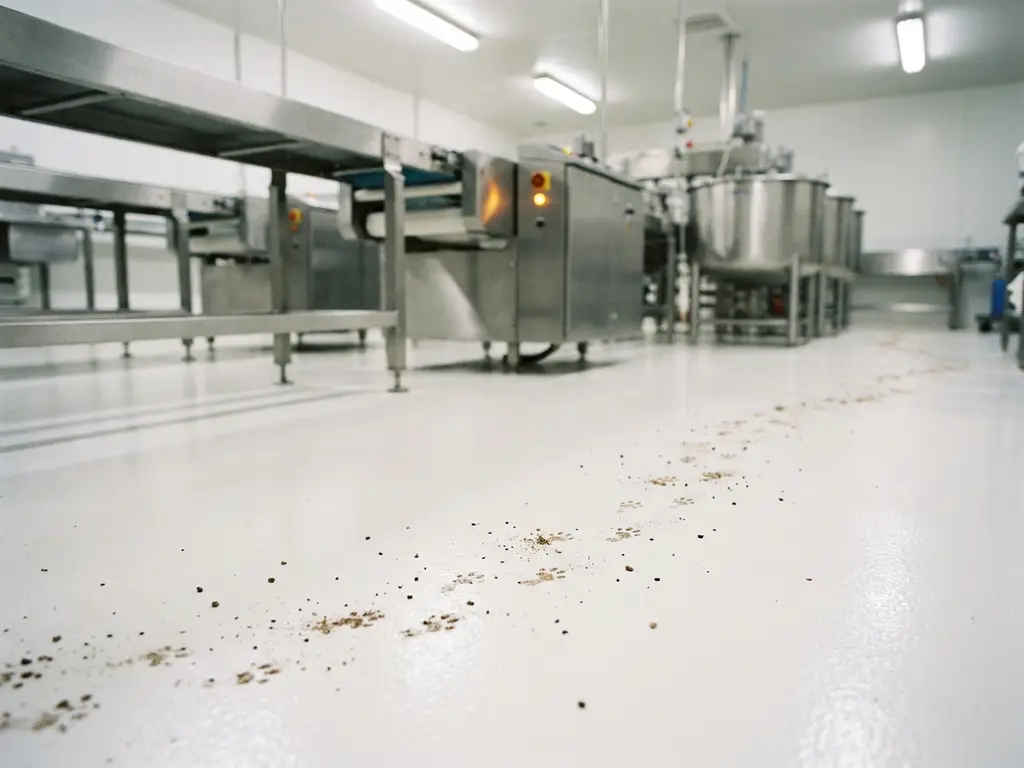
Pest activity contributes to microbial contamination in food facilities by introducing bacteria, fungi, and other pathogens directly onto surfaces, equipment, and products through physical contact, droppings, urine, and shed materials. Even low-level pest presence can trigger significant microbial load increases across a facility, making pest-driven contamination one of the most serious hygiene risks in food manufacturing. The sections below address the most important questions food facility managers face when assessing and controlling this risk.
What types of microorganisms do pests carry into food facilities?
Pests carry a wide range of dangerous microorganisms into food facilities, including bacteria such as Salmonella, Listeria monocytogenes, E. coli, and Campylobacter, as well as mould spores, yeasts, and parasites. Rodents, insects, and birds each act as vectors for distinct pathogen profiles, and a single pest incursion can introduce multiple microbial threats simultaneously.
Rodents are particularly high-risk carriers. Their digestive systems harbour Salmonella and Leptospira bacteria, which are shed continuously through droppings and urine. Because rodents travel extensively through a facility overnight, the contamination footprint from a single animal can be substantial by morning. Cockroaches are known vectors for Salmonella, Staphylococcus aureus, and various moulds, transferring these organisms from drains and waste areas directly to food preparation surfaces via their legs and bodies. Flies present a different mechanism: they regurgitate digestive fluids onto food surfaces as part of their feeding behaviour, depositing a concentrated microbial payload in the process. Birds introduce Campylobacter and Listeria through droppings, which can be tracked inward on footwear, wheels, and equipment from external loading areas.
The microbial contamination risk is compounded by the fact that many of these pathogens are capable of surviving on hard surfaces for extended periods, meaning that even after a pest has moved on, the contamination it deposited remains active.
How do pests physically spread contamination across a facility?
Pests spread microbial contamination across food facilities through direct contact with surfaces, secondary transfer via foot traffic and wheeled equipment, and airborne dispersal of shed materials such as fur, skin cells, and faecal particles. Contamination rarely stays localised to the point of pest entry and can migrate rapidly into production and storage zones.
The mechanics of spread follow predictable patterns. A rodent moving from an external entry point to a food storage area deposits contamination at every contact point along its route. Insects land on contaminated surfaces and then on food or packaging, creating direct transfer pathways. Perhaps less obviously, human workers and wheeled equipment become secondary vectors: a pallet truck that passes through a pest-affected area and then enters a production zone carries microbial contamination on its wheels into spaces that may never have had direct pest access.
This secondary transfer dynamic is one of the most underestimated aspects of pest-related microbial contamination in food manufacturing. Floor-level contamination introduced by pests at entry points, loading docks, or perimeter corridors can be mechanically redistributed deep into controlled zones by routine operational traffic. Addressing this pathway requires contamination control measures at transition points between facility zones, not just pest exclusion at the perimeter.
Which areas of a food facility are most vulnerable to pest-driven contamination?
The most vulnerable areas in a food facility are entry and exit points, loading docks, waste handling zones, drains, and any area where raw materials are received or stored. These locations represent the highest probability of pest access and the greatest risk of microbial contamination spreading inward toward production environments.
Loading docks are particularly high-risk because they combine external access, frequent traffic, and the presence of food materials in close proximity. Pests entering at this point can reach refrigeration units, raw material storage, or packaging areas within a short distance. Drain systems present a chronic vulnerability: cockroaches and rodents use drainage infrastructure as internal transit routes, bypassing perimeter controls entirely and emerging in areas that operators may consider protected.
Waste storage and compactor areas attract pests consistently and create sustained pressure on adjacent facility zones. Staff changing rooms and gowning areas are often overlooked but represent a critical interface: contamination carried in on footwear or clothing from external environments can be introduced here and then carried into production zones by workers. Raw material intake areas, where external packaging enters the facility, are another consistent vulnerability, as packaging surfaces can carry both pest activity residue and associated microbial load from supplier premises or transit environments.
What are the regulatory consequences of pest-related microbial contamination?
Pest-related microbial contamination in food facilities can result in regulatory enforcement action, including product recalls, facility shutdowns, warning letters, and financial penalties. In regulated markets, evidence of pest activity or associated microbial findings during an inspection is treated as a critical non-conformance under frameworks such as FSMA, BRC Global Standards, and EU food hygiene regulations.
In the United States, FDA inspections under the Food Safety Modernization Act treat pest evidence as a significant indicator of inadequate preventive controls. A facility that cannot demonstrate an effective pest management programme, or where inspectors identify pest-related contamination during an audit, may receive a Form 483 observation or, in serious cases, a Warning Letter that becomes part of the public record. Repeated findings can result in import alerts or mandatory facility closure.
In the UK and EU, the BRC Global Standard for Food Safety and EU Regulation 852/2004 both require documented pest control procedures and evidence of their effectiveness. A critical finding related to pest activity during a BRC audit can result in certificate suspension, which has direct commercial consequences for facilities supplying major retailers. Beyond regulatory action, pest-related contamination that reaches the consumer level creates product liability exposure and reputational damage that can be significantly more costly than the compliance investment required to prevent it. For quality and EHS managers, pest-driven microbial risk is therefore not simply a hygiene matter but a business continuity issue.
How can contamination control flooring reduce pest-related microbial risk at entry points?
Contamination control flooring reduces pest-related microbial risk at entry points by capturing and retaining the microbial load carried on footwear and wheeled equipment before it can be transferred into controlled production zones. High-performance polymeric mats positioned at facility entry points, loading dock transitions, and zone boundaries intercept floor-level contamination at the point of transfer rather than allowing it to migrate inward.
The logic is straightforward: even when pest exclusion measures are in place, residual contamination from pest activity in external or perimeter areas will be tracked inward on the soles of shoes and the wheels of pallet trucks and carts. A mat system engineered to attract, capture, and retain particulate and microbial material at those transition points acts as a consistent mechanical barrier that reduces the volume of contamination reaching sensitive areas.
Dycem contamination control mats incorporate Biomaster silver-ion antimicrobial technology, which inhibits microbial growth within the mat surface by up to 99.9%. This means the mat does not simply trap contamination but actively suppresses the microbial activity of what it captures, reducing the risk of cross-contamination from the mat surface itself. For food facilities where pest pressure at perimeter and loading zones is a persistent operational reality, flooring solutions at zone transitions provide a practical and validated layer of defence that complements rather than replaces pest management programmes.
What other measures work alongside flooring solutions to control pest-driven contamination?
Effective control of pest-driven microbial contamination in food facilities requires a layered approach combining pest exclusion, environmental monitoring, cleaning protocols, staff hygiene procedures, and physical contamination control at zone transitions. No single measure is sufficient on its own; the strength of a contamination control programme lies in how well these elements work together.
- Structural pest exclusion: Sealing entry points, installing door seals, maintaining drainage systems, and eliminating harbourage sites reduces the frequency and scale of pest incursion at the source.
- Environmental monitoring: Regular swabbing programmes that test surfaces for indicator organisms and target pathogens provide early warning of microbial load increases that may be linked to pest activity, even before a pest sighting is recorded.
- Scheduled deep cleaning: Routine cleaning removes the organic material that sustains both pest populations and the microbial communities they introduce. Drain cleaning and waste area hygiene are particularly important in high-risk zones.
- Staff training and hygiene protocols: Workers who understand the secondary transfer risk, particularly in relation to footwear and clothing, are less likely to inadvertently carry contamination from pest-affected areas into controlled zones.
- Zoning and traffic management: Defining clear boundaries between external-facing and controlled areas, and managing the flow of people and equipment between them, limits the pathways through which pest-related contamination can migrate inward.
- Supplier and incoming goods controls: Inspecting external packaging and raw materials at intake, and managing the conditions under which they enter the facility, reduces the microbial load introduced from external sources.
When these measures are combined with contamination control flooring at key transition points, facilities create overlapping layers of defence that are far more effective than any single intervention. The goal is not to eliminate every possible contamination pathway in isolation but to reduce the probability and consequence of contamination reaching critical areas through multiple, reinforcing controls.
How Dycem helps with pest-related microbial contamination in food facilities
Dycem provides a proven, reusable contamination control solution that addresses one of the most persistent pathways for pest-related microbial spread: floor-level transfer at facility entry points and zone transitions. Key benefits for food manufacturing environments include:
- Capture and retention of up to 99.9% of particles from footwear and wheeled equipment at the point of entry
- Built-in Biomaster silver-ion technology that inhibits microbial growth on the mat surface by up to 99.9%
- A 3 to 5 year product lifespan that reduces the cost and waste associated with disposable sticky mat alternatives
- ISO-certified manufacturing compliant with EN ISO 9001 and 14001 standards, supporting audit-ready contamination control documentation
- Customisable mat formats including CleanZone and WorkZone solutions suited to pedestrian corridors, gowning areas, loading docks, and heavy-wheeled traffic zones
Dycem’s contamination control specialists work consultatively with food facility teams to assess entry points, traffic flows, and zone boundaries, recommending a solution tailored to the specific contamination risks of each site. To find out how Dycem can support your facility’s pest-related contamination control programme, speak to a contamination control specialist today.