

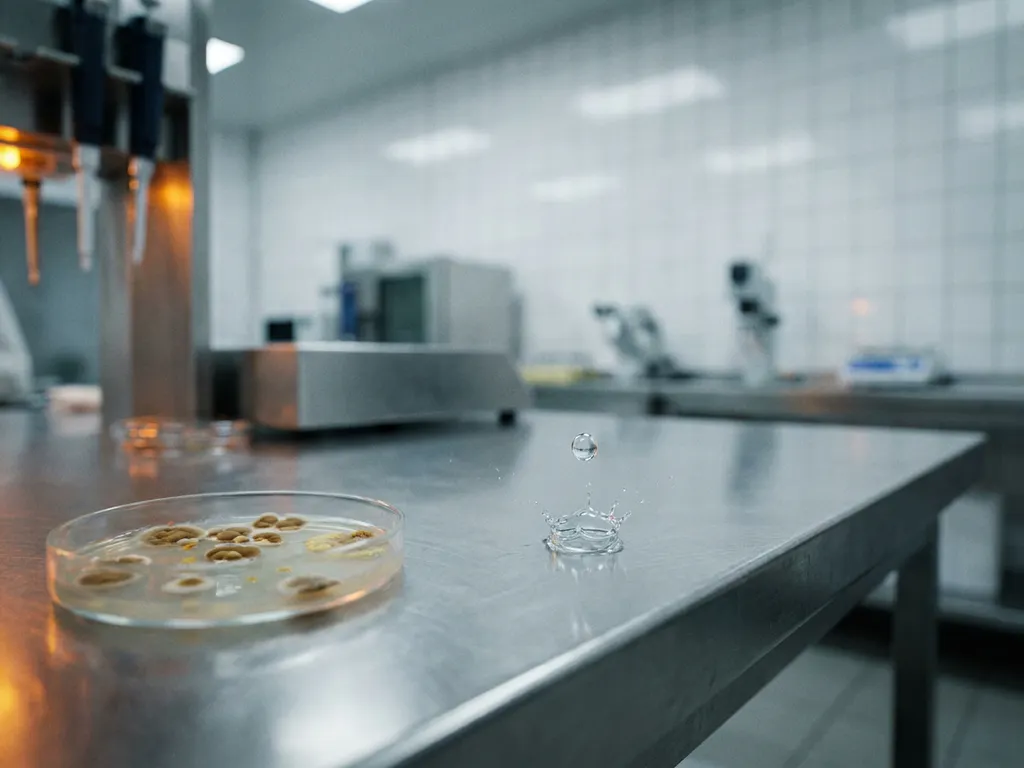
Water activity directly influences microbial contamination in food facilities by determining whether microorganisms can grow, survive, or remain dormant. When water activity is high, bacteria, yeasts, and moulds thrive. As it drops, microbial growth slows and eventually stops altogether. For food safety professionals, managing water activity is one of the most reliable and scientifically grounded tools available for controlling contamination risk across production environments.
Understanding how water activity interacts with other contamination pathways, including physical sources like foot traffic and equipment movement, helps facilities build a more complete defence against product spoilage, pathogen risk, and regulatory non-compliance. This article works through the key questions food safety and quality teams ask about water activity and what the answers mean in practice.
What happens to microorganisms when water activity drops?
When water activity drops, microorganisms lose access to the free water they need to carry out essential metabolic processes. Without sufficient moisture availability, cells cannot absorb nutrients, remove waste, or replicate effectively. Growth rates slow, then stop. At very low water activity levels, most microorganisms enter a dormant state, though many remain viable and can reactivate if conditions change.
The relationship between water activity and microbial behaviour is not a simple on/off switch. Different organisms respond at different thresholds, and the rate of decline matters. A gradual reduction in water activity gives some microbes time to adapt through mechanisms such as osmoregulation, where cells accumulate compatible solutes to maintain internal balance. A rapid drop is generally more effective at inhibiting growth.
It is also important to note that dormancy is not the same as elimination. Pathogens that survive in low water activity conditions can recontaminate products if moisture is reintroduced, for example during condensation events, cleaning procedures, or changes in storage conditions. This is why water activity management must be treated as an ongoing control measure rather than a one-time intervention.
What water activity level stops microbial growth?
Most microbial growth in food environments stops at a water activity level of 0.60 or below. However, the threshold varies significantly by organism. Most spoilage bacteria require a water activity of at least 0.90 to grow, while many moulds can survive down to around 0.70, and certain xerophilic moulds and osmophilic yeasts can persist at levels as low as 0.60.
For practical food safety management, the following general thresholds are widely recognised:
- Above 0.95: High-risk zone for most pathogenic bacteria, including Salmonella, Listeria monocytogenes, and E. coli
- 0.90 to 0.95: Growth of many spoilage bacteria slows but remains possible
- 0.80 to 0.90: Bacterial growth largely inhibited; yeasts and moulds remain a concern
- 0.70 to 0.80: Most yeasts and moulds inhibited; xerophilic organisms may still be active
- Below 0.60: No microbial growth expected under standard conditions
Regulatory frameworks such as those from the FDA and Codex Alimentarius use water activity thresholds as part of hazard analysis and critical control point assessments. Facilities producing shelf-stable or low-moisture foods often target water activity below 0.85 as a validated safety parameter, though the precise target depends on product type, storage conditions, and the specific pathogens of concern.
How does water activity differ from moisture content in food safety?
Water activity and moisture content are related but distinct measurements. Moisture content is the total amount of water present in a food product, expressed as a percentage of the product’s weight. Water activity measures the availability of that water for microbial and chemical activity, expressed on a scale of 0 to 1. Two products with identical moisture content can have very different water activity levels depending on how tightly water is bound to other molecules.
This distinction is critical in food safety because microorganisms and chemical reactions respond to free water, not total water. A product with a high moisture content but strong water-binding ingredients, such as sugar or salt, may have a low water activity and be microbiologically stable. Conversely, a product with relatively low moisture content but poor water-binding capacity could present a higher contamination risk than its moisture reading suggests.
For quality and safety teams, water activity is the more meaningful measurement when assessing microbial contamination risk. Moisture content remains useful for texture, yield, and process control, but water activity is the parameter that directly predicts whether pathogens or spoilage organisms can proliferate. Modern food safety standards increasingly specify water activity targets rather than moisture content limits for this reason.
Which food pathogens are most tolerant of low water activity?
Among the food pathogens of greatest regulatory and public health concern, Staphylococcus aureus is one of the most tolerant of reduced water activity, capable of growing at levels as low as 0.83 under aerobic conditions. Certain moulds capable of producing mycotoxins, including some Aspergillus species, can also remain active at relatively low water activity levels, making them a persistent concern in grain, nut, and dried fruit processing.
Listeria monocytogenes is notable not for its low water activity tolerance but for its ability to survive desiccation and persist in food facility environments for extended periods. While it generally requires water activity above 0.92 to grow, it can remain viable on surfaces and equipment at lower levels, creating a reservoir for contamination when conditions improve. This persistence makes environmental monitoring and surface hygiene particularly important in facilities handling ready-to-eat products.
Salmonella is another pathogen with documented survival in low-moisture environments. It has been implicated in outbreaks linked to peanut butter, powdered infant formula, and spices, all low water activity products where the assumption of microbiological safety based on dryness alone proved incorrect. The key lesson for food safety professionals is that low water activity inhibits growth but does not guarantee pathogen elimination, and process controls must account for survival as well as proliferation.
How do food facilities control water activity to reduce contamination risk?
Food facilities control water activity through a combination of formulation design, processing conditions, packaging, and environmental management. The approach varies depending on the product category, but the underlying principle is consistent: reduce the availability of free water to a level that prevents microbial growth throughout the product’s intended shelf life and storage conditions.
Formulation and processing controls
Adjusting the composition of a product is one of the most direct ways to manage water activity. Humectants such as salt, sugar, glycerol, and sorbitol bind free water and lower water activity without necessarily reducing total moisture. Drying processes including spray drying, freeze drying, and hot air drying remove water directly. Combinations of these approaches are common in products where both texture and safety must be managed simultaneously.
Processing temperature and time also affect water activity outcomes. Thermal treatments can drive off moisture, and controlled cooling can prevent condensation that would raise surface water activity on finished products. Accurate monitoring at critical control points, using calibrated water activity meters, ensures that products leave the production line within validated safety parameters.
Environmental and storage controls
Controlling the relative humidity of storage and production environments is equally important. Even a product formulated to a safe water activity level can absorb moisture from the surrounding air if the environment is poorly controlled, raising its water activity and creating conditions for microbial growth. Temperature fluctuations that cause condensation are a particular risk in facilities handling low-moisture products.
Packaging plays a supporting role by creating a barrier between the product and the external environment. Moisture-barrier packaging materials, desiccant sachets, and modified atmosphere packaging all help maintain water activity stability throughout distribution and retail. Facilities should validate that packaging performance holds under the temperature and humidity conditions the product is likely to encounter across its supply chain.
How does floor-level contamination interact with water activity risks in food facilities?
Floor-level contamination introduces a physical pathway for microbial transfer that operates independently of, but interacts with, water activity risks in food facilities. Foot traffic and wheeled equipment carry particulates, moisture, and microorganisms from lower-hygiene zones into higher-hygiene production areas. When these contaminants include moisture-laden debris, they can locally elevate water activity on surfaces, equipment bases, and floor joints, creating microenvironments where pathogen survival and growth become possible even in facilities with otherwise well-controlled conditions.
The relationship becomes especially significant in facilities producing low-moisture or shelf-stable products. These environments are designed around the assumption that water activity is controlled throughout the production zone. Physical contamination events that introduce moisture, whether through wet footwear, cleaning water tracked across zones, or condensation carried on equipment wheels, can undermine that assumption at the floor level where monitoring is often less intensive than at product contact surfaces.
Facilities that rely on disposable sticky mats or footbaths as their primary entry-point control often find these measures inconsistent. Sticky mats become saturated and lose effectiveness quickly under heavy traffic. Footbaths introduce standing liquid that can itself become a contamination source if not maintained rigorously. Both approaches require frequent replacement or monitoring to remain effective, creating operational burden and ongoing cost.
A more reliable approach addresses floor-level contamination at the point of entry, before particulates and moisture are tracked further into controlled zones. This is where physical contamination control at gowning rooms, cleanroom entrances, and production entry points becomes a meaningful part of a facility’s broader food safety strategy, complementing the water activity controls applied within the production environment itself.
How Dycem helps control contamination at the point of entry in food facilities
Dycem’s contamination control mats are engineered to capture and retain the particulates, debris, and moisture that foot traffic and wheeled equipment carry into food production environments. Where floor-level contamination interacts with water activity risks, removing contaminants before they enter controlled zones reduces the physical pathways through which moisture and microorganisms can reach product contact areas.
- Up to 99.9% particulate capture: Dycem’s polymeric mat technology attracts and retains contaminants from shoe soles and equipment wheels at entry points
- Built-in Biomaster antimicrobial protection: Silver-ion technology inhibits microbial growth within the mat itself, reducing the risk of the mat becoming a secondary contamination source
- Reusable and washable: Unlike disposable sticky mats, Dycem mats are designed for 3 to 5 years of performance, maintaining consistent efficacy without the operational disruption of frequent replacement
- Tailored to facility layout: Mats are customisable in size and format to suit gowning rooms, production entrances, airlocks, and high-traffic corridors within food manufacturing environments
- ISO-certified manufacturing: Compliant with EN ISO 9001 and 14001 standards, California Proposition 65, and EU REACH regulations, supporting audit readiness across regulated food production sites
For food safety and quality managers looking to strengthen entry-point controls as part of a broader contamination management strategy, Dycem offers a free site survey and consultation to identify where floor-level contamination risk is highest and how a mat solution can be configured to address it. Contact Dycem today to arrange your site assessment.