

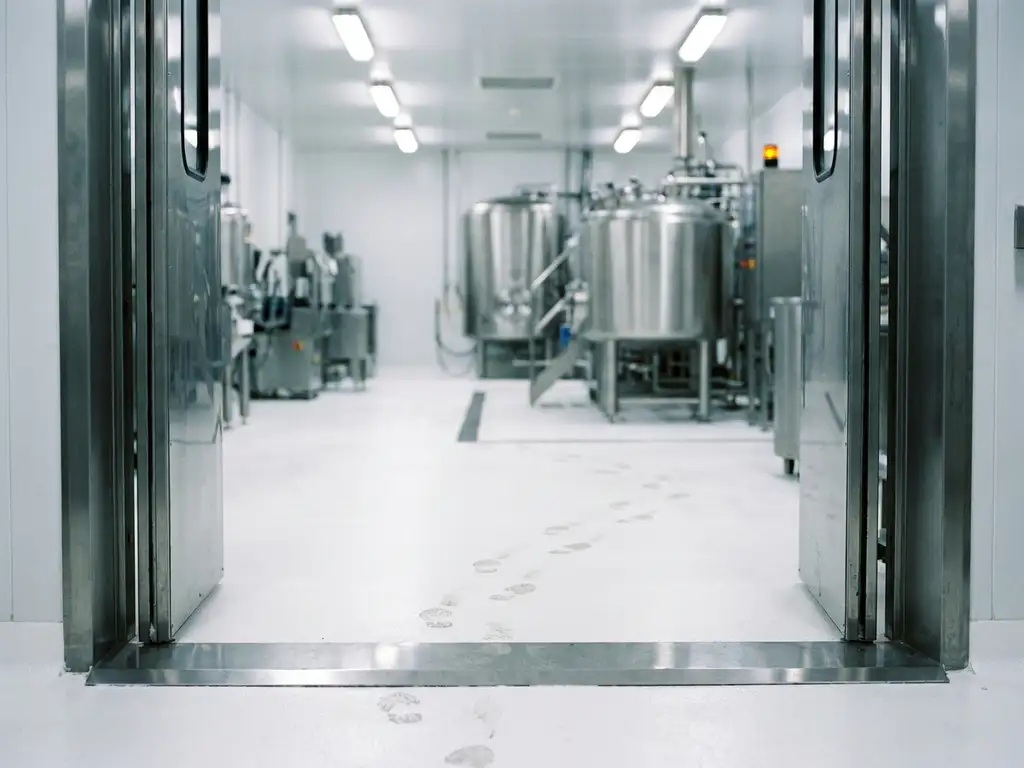
The most overlooked contamination entry points in food plants are footwear, wheeled vehicles, loading docks, and raw material intake areas. While production zones and equipment cleaning receive rigorous attention, the pathways through which contaminants physically enter the facility are frequently underestimated. Understanding these entry points is the first step toward building a contamination control strategy that actually holds up under audit.
Where does contamination most commonly enter a food plant?
Contamination most commonly enters food plants through floor-level pathways: the soles of footwear, the wheels of trolleys and forklifts, and the surfaces of incoming raw materials and packaging. Industry evidence consistently shows that up to 80% of contaminants entering controlled environments arrive at floor level, making entry points the single most critical zone to manage in any food facility.
Despite this, many food manufacturers invest heavily in in-process hygiene controls while leaving entry points poorly protected. Personnel walking between zones, vehicles moving from external loading areas into production, and packaging brought in from outside all act as vectors for dirt, dust, allergens, and microbial contamination. The challenge is that these transfer events happen constantly, at high frequency, and often without any visible warning sign that contamination is being introduced.
Effective food plant contamination control starts at the perimeter and works inward, treating every transition between zones as a potential contamination event that needs to be managed systematically.
Why is footwear one of the biggest contamination risks in food facilities?
Footwear is one of the biggest contamination risks in food facilities because shoe soles accumulate and transport particulate matter, microbial contamination, allergens, and chemical residues across every surface they contact. Every step taken through a non-controlled area and then into a food production zone has the potential to deposit contaminants directly onto the floor, from where they can become airborne or contact food-contact surfaces.
The risk compounds in facilities where personnel move frequently between zones: from external areas to changing rooms, from warehouses to production floors, or from raw material handling areas to finished goods zones. Without a reliable mechanism to capture and retain what footwear carries, each transition becomes an uncontrolled transfer event.
Traditional responses to footwear contamination include disposable shoe covers and sticky peel-off mats. Both have well-documented limitations. Shoe covers are only as effective as the discipline with which they are applied and changed, and they generate significant single-use plastic waste. Sticky mats lose adhesion rapidly with use, require frequent replacement, and provide inconsistent performance across different footwear types. Neither approach offers a reliable, long-term solution to the scale of risk that footwear presents in a busy food manufacturing environment.
How do wheeled vehicles spread contamination inside food plants?
Wheeled vehicles spread contamination inside food plants by carrying particulates, moisture, and microbial matter on their wheels from one zone to another, depositing contaminants across wide floor areas with each pass. A forklift that has travelled through a loading dock and into a production area can distribute external contamination across dozens of metres of floor surface in a single journey.
The challenge with wheeled vehicle contamination is the scale of transfer. Unlike a single footstep, a forklift or pallet truck wheel covers a large surface area and operates under significant weight, which can grind particulate matter into floor surfaces rather than simply depositing it. This makes subsequent cleaning more difficult and increases the risk that contamination will persist between scheduled cleaning cycles.
Food facilities that rely solely on scheduled floor cleaning to manage wheeled vehicle contamination are accepting a gap in their control strategy. Contamination introduced between cleaning cycles has time to migrate, become airborne, or contact food-contact surfaces before it is addressed. Capturing contaminants at the point of entry, before vehicles move into controlled zones, is a far more effective approach than attempting to recover the situation after the fact.
What contamination risks are hidden at loading docks and raw material intake areas?
Loading docks and raw material intake areas present some of the highest contamination risks in a food plant precisely because they are transition zones between the external environment and the controlled interior. Contaminants introduced here include soil, dust, pests, allergens from incoming materials, moisture from weather exposure, and microbial matter from external vehicles and packaging surfaces.
Several specific risks are frequently underestimated at these points:
- External vehicle contamination: Delivery vehicles bring contaminants from multiple previous sites, depositing them onto dock floors and the wheels of any internal vehicles used to unload them.
- Packaging surfaces: Outer packaging arriving from suppliers may carry dust, allergens, or microbial contamination from external storage or transit environments.
- Personnel crossover: Staff involved in goods receipt often move between the dock area and internal zones without a formal decontamination step, creating a direct transfer pathway.
- Seasonal and weather-related risks: Rain, wind, and temperature changes at open dock doors increase the volume of airborne and floor-level contamination entering the facility during intake operations.
Loading docks are often treated as logistics areas rather than contamination control zones, which means they receive less rigorous hygiene management than production areas. Closing this gap requires treating the dock as the first line of defence in a layered contamination control strategy, not an afterthought.
How can contamination control mats reduce entry-point risks in food manufacturing?
Contamination control mats reduce entry-point risks in food manufacturing by capturing and retaining particulates, microbial matter, and other contaminants from footwear and wheels at the precise moment of entry, before they can be carried further into the facility. Positioned at transition points between zones, high-performance polymeric mats act as a physical barrier that intercepts contamination at its most predictable location.
Unlike sticky peel-off mats, which lose effectiveness quickly and require constant replacement, reusable polymeric mats are engineered to deliver consistent performance over years of use. Built-in antimicrobial technology, such as Biomaster silver-ion protection, inhibits microbial growth on the mat surface by up to 99.9%, adding a second layer of control beyond simple particulate capture. This is particularly relevant in food manufacturing environments where microbial contamination carries direct food safety implications.
For facilities managing both pedestrian and heavy vehicle traffic, different mat formats address different risk profiles. Mats designed for light pedestrian zones perform differently from those engineered to withstand repeated forklift and pallet truck traffic, and a well-designed contamination control plan will specify the appropriate solution for each entry point rather than applying a single format across the facility.
The environmental and cost case for reusable mats is also significant for food manufacturers operating under sustainability commitments. A mat designed to perform for three to five years replaces thousands of disposable sticky mat sheets over the same period, reducing both procurement costs and single-use plastic waste.
What should a contamination control plan include for food plant entry points?
A contamination control plan for food plant entry points should identify every transition zone between external and controlled areas, assign a risk level to each, specify the control measures in place at each point, and define the monitoring and maintenance procedures that keep those controls effective over time. A plan that covers production hygiene but not entry-point management leaves a significant gap in the facility’s overall contamination risk profile.
Key elements to include are:
- Entry-point mapping: A systematic review of every point at which personnel, vehicles, or materials cross from external or lower-control areas into food production zones.
- Risk classification: Assigning contamination risk levels to each entry point based on traffic volume, the nature of contamination likely to be introduced, and the sensitivity of the adjacent production zone.
- Control specification: Defining the specific measures at each entry point, whether contamination control mats, gowning requirements, vehicle cleaning stations, or a combination of these.
- Cleaning and maintenance schedules: Documenting how and when each control measure is cleaned, inspected, and replaced or refreshed, with records that demonstrate compliance during audits.
- Personnel training: Ensuring that all staff understand why entry-point controls exist, how to use them correctly, and what to do if a control measure appears compromised.
- Validation and review: Periodically testing whether entry-point controls are performing as intended, using environmental monitoring data or contamination tracking, and updating the plan when facility layouts, traffic flows, or risk profiles change.
A well-documented entry-point control plan also supports audit readiness. Regulators and certification bodies expect food manufacturers to demonstrate that contamination risks have been identified and that controls are in place, maintained, and reviewed. Entry points that are managed informally or inconsistently are a common finding during food safety audits and one of the easier gaps to close with the right approach.
How Dycem helps with contamination entry point control in food plants
Dycem’s reusable contamination control mats are purpose-built to address the entry-point risks that food manufacturers face every day. Whether the challenge is pedestrian footwear contamination at cleanroom entrances, heavy vehicle traffic through loading zones, or the need for flexible coverage across variable facility layouts, Dycem provides a proven solution. Key advantages include:
- Capture of up to 99.9% of shoe and wheel contaminants at the point of entry
- Built-in Biomaster antimicrobial protection inhibiting microbial growth by up to 99.9%
- A three-to-five-year product lifespan that significantly reduces the cost and waste associated with disposable sticky mats
- ISO-certified manufacturing meeting EN ISO 9001 and 14001 standards, California Proposition 65, and EU REACH compliance
- Customisable formats, including CleanZone for pedestrian and light-wheeled traffic zones and WorkZone for heavy vehicle areas, to match the specific demands of any facility layout
If you are reviewing your facility’s contamination control strategy or preparing for an upcoming audit, speak to a Dycem specialist. Contact Dycem today to arrange a free site survey and find out which solution is right for your food plant.