

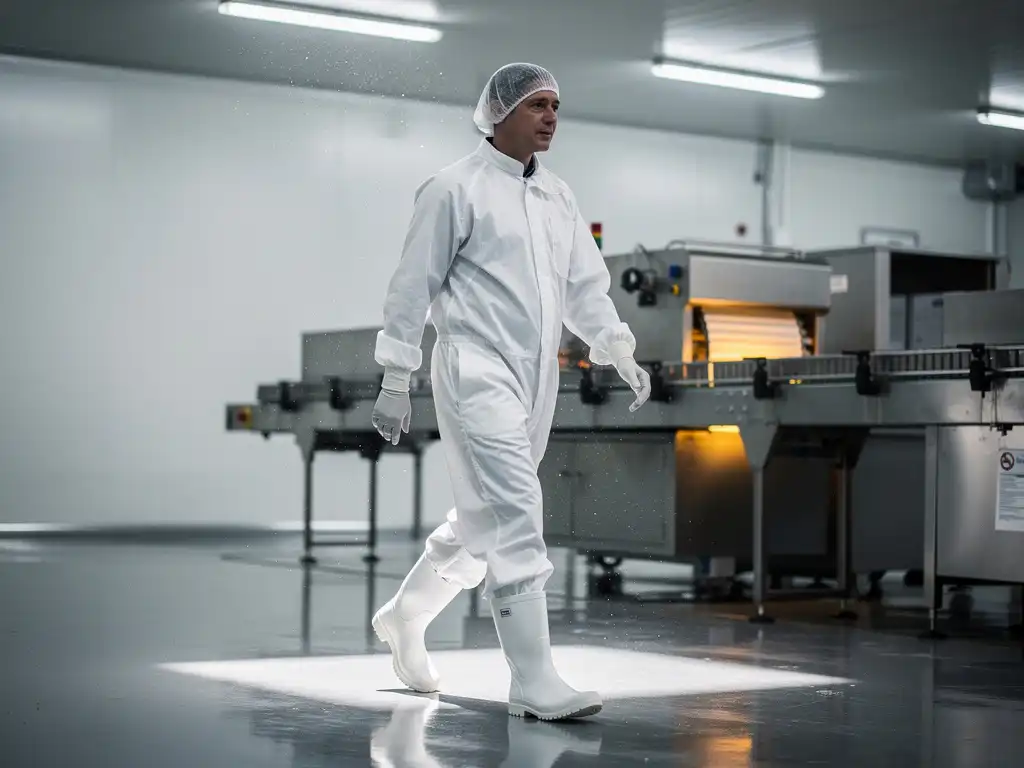
Footwear carries bacteria into food production areas by acting as a direct physical vector, transporting microorganisms from contaminated surfaces into controlled zones with every step. Soles pick up pathogens from floors, drains, raw material handling areas, and outdoor environments, then deposit them wherever workers walk. In food manufacturing, where microbial contamination can compromise product safety, trigger recalls, and breach regulatory requirements, shoe-borne bacteria represent a serious and often underestimated risk.
The following sections break down exactly how footwear contamination spreads bacteria, which areas face the greatest exposure, and what food manufacturers can do to control it at the source.
What types of bacteria does footwear carry into food production areas?
Footwear commonly carries pathogens including Listeria monocytogenes, Salmonella, E. coli, and Campylobacter into food production areas. These microorganisms are picked up from outdoor environments, loading bays, raw material zones, and drainage areas, then transported on shoe soles into spaces where food is processed, packaged, or stored.
Shoe soles are particularly effective at harbouring and transferring bacteria because of their textured surfaces. The grooves and treads designed to provide grip also trap organic matter, moisture, and microbial communities that persist long after visible dirt has been removed. Bacteria can survive on shoe soles for extended periods, especially in environments with fluctuating temperatures or high humidity.
In food manufacturing facilities, the concern extends beyond common environmental bacteria to include spoilage organisms that shorten product shelf life and pathogens that pose direct risks to consumer health. The presence of Listeria in particular is a persistent challenge in food production, as it thrives in cool, damp conditions and can survive on floors and equipment for months if not actively controlled.
How does footwear transfer bacteria from one zone to another?
Footwear transfers bacteria between zones through direct contact with contaminated surfaces followed by physical movement into cleaner areas. Each step deposits a proportion of the microbial load carried on the sole, creating a trail of contamination that spreads progressively deeper into a facility as workers move between zones throughout a shift.
This cross-contamination pathway is especially problematic in facilities that handle both raw and ready-to-eat products. A worker moving from a raw intake area to a processing zone without adequate footwear hygiene controls can introduce pathogens directly into an environment where they can come into contact with finished product. The transfer is not limited to visible soiling. Bacteria move on soles that appear clean to the naked eye, which is why relying on visual inspection alone is insufficient.
Wheel traffic compounds the problem. Trolleys, pallet trucks, and carts travel the same routes as workers, picking up contamination from one area and depositing it in another. In large facilities with complex traffic flows, this creates multiple simultaneous contamination vectors that are difficult to manage without systematic controls at every transition point between zones.
Which areas of a food facility are most at risk from shoe-borne contamination?
The highest-risk areas for shoe-borne contamination in a food facility are entry points, zone transition corridors, production floors, and areas adjacent to raw material handling or drainage. These locations experience the heaviest foot traffic and the greatest movement between environments with different cleanliness requirements.
Entry points are critical because they represent the first opportunity to intercept contamination before it reaches controlled zones. Workers arriving from outside, from vehicle loading areas, or from non-production spaces bring the highest microbial loads on their footwear. Without effective controls at these thresholds, bacteria enter the facility and disperse rapidly.
Zone transitions within the facility create secondary risk points. Moving between raw and cooked product areas, between chilled and ambient zones, or between packaging and production spaces all represent moments where cross-contamination can occur. Drainage channels and floor drains are also high-risk surfaces because they accumulate organic matter and moisture, creating reservoirs of microbial activity that footwear can disturb and redistribute.
Why do traditional footwear hygiene methods fall short in food manufacturing?
Traditional footwear hygiene methods such as boot dips, disposable overshoes, and sticky peel-off mats consistently underperform in food manufacturing environments because they either fail to capture sufficient contamination, introduce new hygiene risks, or create operational inconsistencies that undermine their effectiveness.
Boot dip stations rely on chemical disinfectants that require precise concentration management to remain effective. In practice, solution strength degrades quickly with use, and workers often step through too quickly for meaningful contact time. Poorly maintained boot dips can themselves become sources of contamination, harbouring bacteria in stagnant liquid.
Disposable sticky mats capture surface-level particles but lose adhesion rapidly under heavy foot traffic. Once the top layer is saturated, the mat provides little protection and must be peeled away and replaced frequently. This creates ongoing waste, recurring costs, and gaps in protection during changeover. In food production environments where traffic is continuous, the window of effective performance is often too short to be reliable.
Disposable overshoes address some risks but introduce others. They are frequently applied incorrectly, contaminated during the donning process, or removed in ways that transfer bacteria from the outer surface back onto hands or clean footwear. Compliance also tends to be inconsistent, particularly during busy production periods when time pressure leads workers to shortcut hygiene protocols.
What contamination control standards apply to footwear hygiene in food facilities?
Footwear hygiene in food facilities is governed by a combination of regulatory frameworks and industry standards including the Food Safety Modernization Act (FSMA) in the United States, EU Food Hygiene Regulations (EC 852/2004) in Europe, and internationally recognised standards such as BRCGS, SQF, and ISO 22000. These frameworks require facilities to implement documented procedures that prevent physical and biological contamination at all stages of production.
Good Manufacturing Practice (GMP) guidelines, which underpin compliance across the pharmaceutical, food, and beverage sectors, specifically address personnel hygiene and movement controls. Facilities operating under GMP are expected to demonstrate that contamination risks from personnel, including shoe-borne pathogens, are identified, assessed, and mitigated through validated controls.
Third-party audit schemes such as BRCGS and SQF require facilities to maintain records of hygiene procedures and demonstrate their effectiveness. Auditors look for evidence that entry point controls are consistently applied and that the facility has assessed the risk of cross-contamination between zones. Footwear hygiene is a standard area of scrutiny, and facilities that rely on informal or poorly documented methods are likely to face findings during inspections.
How can food manufacturers prevent footwear contamination at entry points?
Food manufacturers can prevent footwear contamination at entry points by installing validated, high-performance contamination control systems that capture and retain microorganisms and particulates before they enter controlled zones. The most effective approach combines physical barrier solutions at every zone transition with clear personnel hygiene protocols and regular monitoring.
Key principles for effective entry point contamination control include:
- Positioning controls at every zone boundary, not only at the main facility entrance. Each transition between areas with different cleanliness requirements is a potential contamination event.
- Selecting solutions validated for microbial capture, not just visible particle removal. Effective footwear contamination control must address pathogens that are invisible to the naked eye.
- Ensuring controls remain effective under realistic traffic conditions. A solution that performs well at low volume but degrades under production-level foot traffic provides inconsistent protection.
- Integrating wheel traffic controls alongside pedestrian controls, since carts and trolleys carry contamination through the same entry points as workers.
- Supporting controls with documented procedures that satisfy the audit and compliance requirements of BRCGS, SQF, FSMA, and GMP frameworks.
Reusable polymeric contamination control mats offer a practical and evidence-backed approach to footwear contamination prevention at entry points. Unlike disposable alternatives, they maintain consistent performance across high traffic volumes and do not require constant replacement, which reduces both operational disruption and single-use plastic waste.
How Dycem helps prevent footwear contamination in food production
Dycem’s contamination control mats are purpose-built to address the specific challenges of shoe-borne and wheel-borne contamination in food manufacturing environments. Here is how they support food facilities:
- Capture up to 99.9% of particles from shoe soles and wheeled traffic before they enter controlled zones
- Biomaster silver-ion antimicrobial technology inhibits microbial growth on the mat surface by up to 99.9%, preventing the mat itself from becoming a contamination source
- Dycem CleanZone mats are engineered for pedestrian and light-wheeled traffic areas including production entrances, gowning rooms, and zone transition corridors
- Dycem WorkZone mats handle heavy-wheeled traffic including pallet trucks and forklifts, extending contamination control to logistics and raw material handling areas
- Reusable and long-lasting with a 3 to 5 year lifespan, eliminating the recurring cost and waste of disposable sticky mats
- ISO-certified manufacturing to EN ISO 9001 and 14001, with compliance to EU REACH and California Proposition 65, supporting audit-ready documentation
If footwear contamination is a compliance or operational concern at your facility, speak to a Dycem specialist to arrange a free site survey and find out which solution is right for your environment.