

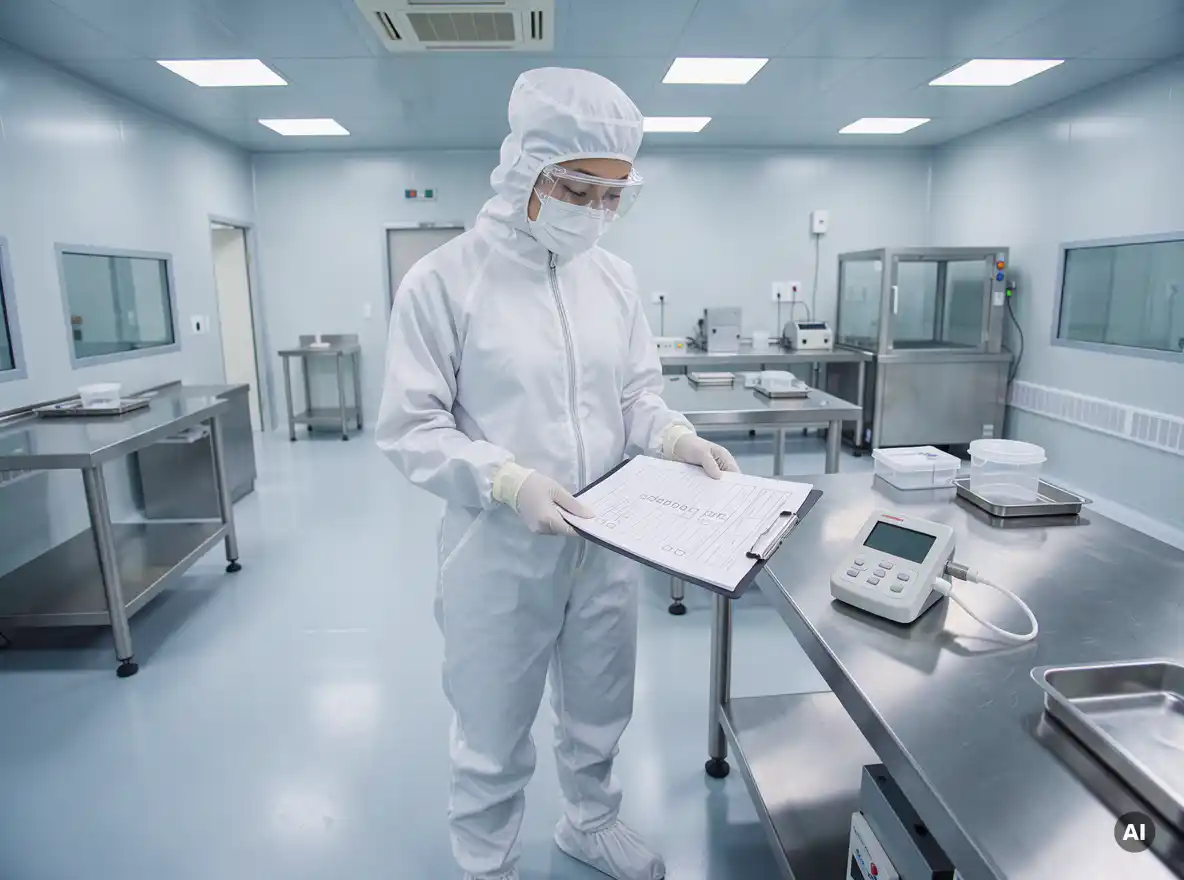
Cleanroom classification determines the cleanliness level of a room by measuring airborne particle concentrations against ISO 14644-1 limits, while cleanroom qualification is the documented process of proving that the room, its systems, and its operating procedures perform as intended. Classification measures what the air contains. Qualification verifies that the facility is correctly installed and performs reliably for its intended use.
Both activities support the same goal of controlling cleanroom contamination, but they answer different questions and are performed at different stages. The sections below explain the sequence, the methods, the differences, and the factors that can influence results.
Which comes first: classification or qualification?
Classification is one component of the wider qualification process, so the two overlap rather than follow a strict one-then-the-other order. In practice, a new cleanroom is built, commissioned, and tested for particle counts to confirm its ISO class, and this testing forms part of the evidence used in overall qualification.
Qualification is typically structured in stages, commonly described as installation qualification (IQ), operational qualification (OQ), and performance qualification (PQ). Particle count testing for classification is usually carried out in the “as built” and “at rest” states, often alongside operational qualification, and again in the “operational” state as part of performance qualification where relevant. Facilities should always follow the protocol set by their own quality system, since the exact sequencing varies by industry and regulatory framework.
How is a cleanroom classified under ISO 14644-1?
Under ISO 14644-1, a cleanroom is classified by counting airborne particles at defined sampling locations and comparing the results with the maximum permitted concentration for a given ISO class. Classes range from ISO Class 1 (the cleanest) to ISO Class 9, and each class sets limits for specified particle sizes per cubic metre of air.
The process generally involves these elements:
- Selecting the occupancy state: as built, at rest, or operational. The class must always be stated alongside the state in which it was measured.
- Determining sampling locations: the number of locations is derived from the cleanroom floor area using the method set out in the standard.
- Measuring particle concentrations: an airborne particle counter samples the air at each location for a calculated minimum volume.
- Comparing results with class limits: the data is evaluated against the particle size thresholds for the target class.
- Documenting the outcome: a report records the class, occupancy state, particle sizes considered, and test conditions.
Classification covers non-viable airborne particulates only. It does not measure microbial contamination, which is assessed through separate viable environmental monitoring, such as active air sampling and settle plates, and surface sampling. For a deeper look at that distinction, see this guide to viable and non-viable particle monitoring.
What does cleanroom qualification actually involve?
Cleanroom qualification is a documented verification that the facility, its equipment, and its environmental controls are correctly installed, operate within defined limits, and consistently perform for the intended process. It produces objective evidence that the room is fit for purpose, not just a single particle count result.
Qualification commonly covers the following stages and checks:
- Installation qualification (IQ): confirms that HVAC systems, HEPA filters, pass-throughs, and other installed components match the design specification.
- Operational qualification (OQ): tests whether systems function across their intended operating ranges.
- Performance qualification (PQ): demonstrates that the room performs consistently under realistic working conditions.
Typical tests include HEPA filter integrity testing, airflow velocity and volume measurement, room pressure differentials between adjacent spaces, airflow visualisation, recovery time testing, and particle counting. Which tests apply, and which acceptance criteria are used, depends on the facility type, the contamination control and containment requirements, and the regulations governing it. For sterile medicinal product manufacture in the EU, for example, EU GMP Annex 1 sets additional expectations, including the contamination control strategy that underpins qualification decisions.
What’s the difference between classification and qualification?
The core difference is scope. Classification assigns a cleanliness grade based on airborne particle concentration, while qualification demonstrates that the whole facility and its supporting systems are installed correctly and perform reliably for their intended use. Classification is a measurement. Qualification is a validation exercise.
The two compare as follows:
- Purpose: classification states the ISO class achieved; qualification proves the room is fit for its intended process.
- Scope: classification focuses on airborne particles; qualification also covers airflow, pressure differentials, filter integrity, equipment, and procedures.
- Output: classification produces a class designation tied to an occupancy state; qualification produces a documented protocol, test results, and an approval record.
- Governing documents: classification follows ISO 14644-1; qualification draws on other parts of the ISO 14644 series covering testing and monitoring, plus any industry regulations such as EU GMP.
It is also worth separating ISO classes from EU GMP Grades A to D. They are not directly interchangeable, and a room meeting a particular ISO class does not automatically meet a given GMP grade, which carries additional requirements such as microbial limits. The relationship between grades is explained in this article on the difference between Grade A and Grade B environments.
How often must cleanrooms be reclassified and requalified?
ISO 14644-2 sets minimum intervals for particle count testing to demonstrate continued compliance with the ISO class, and these intervals depend on the class. For example, ISO Class 5 or cleaner is typically retested every six months, while less stringent classes may be retested every twelve months. Requalification frequency is defined by each facility’s quality system and regulatory obligations, and ISO 14644-2 also expects routine monitoring based on a risk assessment.
Beyond scheduled intervals, reclassification or partial requalification is typically triggered by events such as:
- Changes to HVAC systems, HEPA filters, or room layout
- Major maintenance or repair work affecting environmental controls
- Persistent excursions or adverse trends from routine monitoring
- Changes in process, equipment, or personnel flow
- Extended shutdowns before the room returns to service
Routine monitoring between formal tests helps show that a room remains in a state of control. Facilities should document their rationale for intervals through risk assessment rather than relying on a default schedule.
Can floor-level contamination affect classification and qualification results?
Yes. Particles carried in on footwear and wheels can be resuspended into the air by movement, which can raise particle counts during testing and weaken the room’s performance in operational states. A facility with poor control at its entry points may struggle to maintain results between formal tests, even when the HVAC system is correctly specified.
Floor-level contamination matters because cleanroom air handling is designed to dilute and remove particles, not to compensate for a continuous incoming load. Contaminants tracked across gowning rooms, airlocks, and corridors add to that load every time a person or trolley passes through. Reducing particles at the point of entry therefore supports stable cleanroom hygiene and more consistent monitoring data.
Reusable polymeric flooring is one practical measure within this layered approach. Dycem CleanZone is designed for pedestrian and light-wheeled traffic at cleanroom entrances, gowning areas, corridors, and airlocks, where it captures and retains particles from footwear and wheels. It works alongside, not in place of, HEPA filtration, validated cleaning, gowning procedures, and environmental monitoring, and it does not by itself guarantee a classification or qualification outcome.
Understanding the distinction between classification and qualification helps quality teams plan testing, interpret results, and decide where additional controls are justified. Classification tells you the class a room achieved at the time of testing, while qualification shows that the entire facility is built and operated to keep delivering it. For facilities reviewing their entry point controls, a complimentary site survey with a Dycem contamination control specialist can help identify where floor-level contamination is entering controlled areas.
Frequently Asked Questions
What should I do if my cleanroom fails a classification test?
Start by documenting the failure and reviewing the test conditions, including occupancy state, equipment calibration, and sampling locations. Investigate likely root causes such as filter leaks, insufficient air changes, inadequate cleaning, personnel behaviour, or contamination being carried in at entry points. Once corrective actions are implemented, retest in the same state and record the investigation, actions taken, and results in line with your quality system.
Does an ISO class automatically mean my room meets an EU GMP grade?
No. ISO classes and EU GMP Grades A to D are related but not interchangeable, because GMP sets additional requirements such as limits in both at-rest and in-operation states, microbial limits, and expectations around contamination control. A room achieving ISO Class 5 particle counts, for instance, still needs to satisfy the full GMP grade criteria and your contamination control strategy before it can be considered compliant.
Can I rely on routine environmental monitoring instead of periodic reclassification?
No. Routine monitoring shows that a room remains in a state of control between formal tests, but it does not replace the periodic particle count testing intervals described in ISO 14644-2 or the requalification requirements in your quality system. The two activities work together, with monitoring providing trend data and formal testing providing documented, standardised evidence of compliance.