

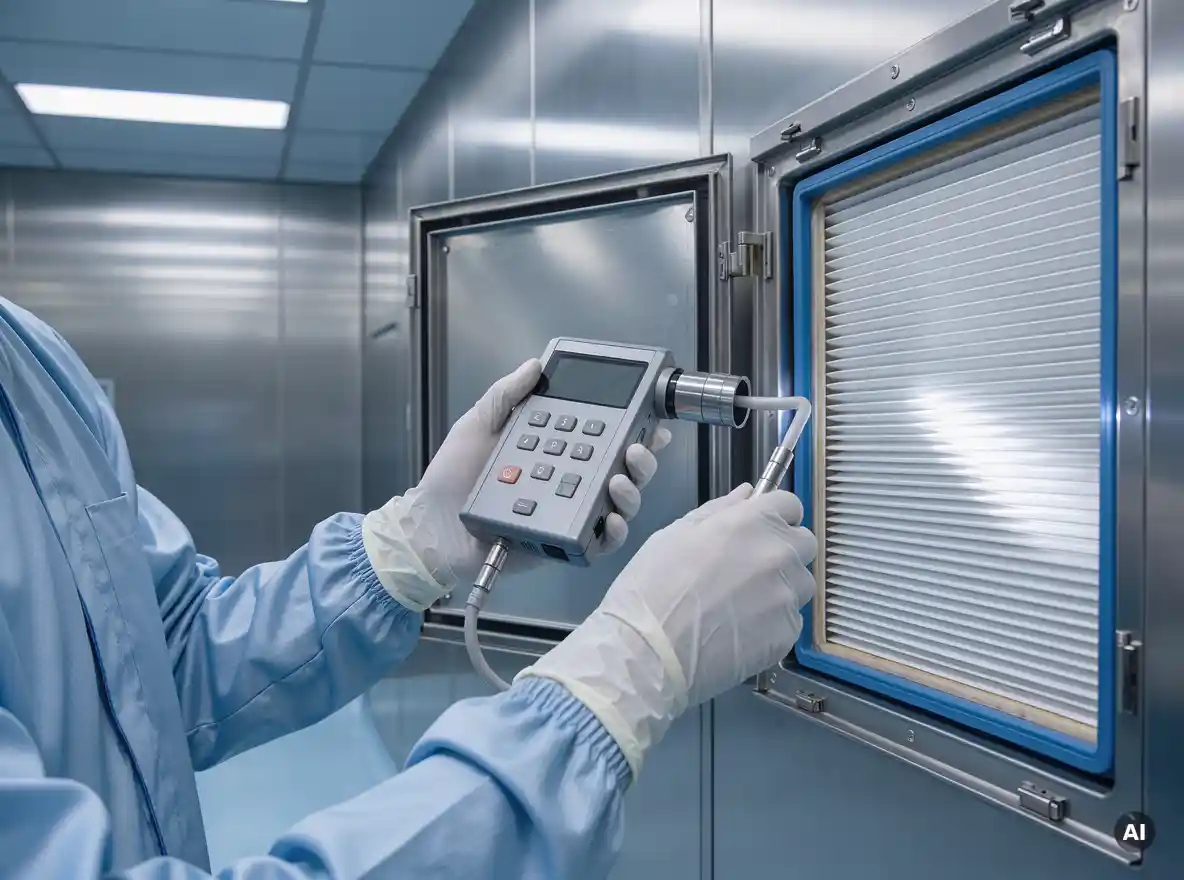
When cleanroom particle counts rise after maintenance, investigate the maintenance activities themselves, the people and equipment involved, HVAC and HEPA filter integrity, floor-level contamination carried in on footwear and wheels, and the cleaning and verification steps taken before release. In most cases, several small breaches combine rather than a single failure causing the spike.
Because the cause is rarely obvious, a structured investigation works better than assumptions. The questions below set out where to look first and how to prevent a repeat of the same cleanroom contamination event.
Which maintenance activities introduce the most particles into a cleanroom?
Maintenance activities that disturb surfaces, open sealed systems, or bring in tools and materials introduce the most particles. Drilling, cutting, fastener removal, ceiling and wall interventions, filter work, and the movement of toolboxes, ladders, and trolleys are common sources of particulate in a controlled environment.
Several activity types deserve particular attention:
- Mechanical work: abrasion, lubricant handling, and panel or fixture removal release particles directly at the point of work.
- Disturbance of residues: sweeping or wiping dry areas can resuspend settled particles rather than remove them.
- Material transfer: cardboard, packaging, wood, and non-cleanroom paper shed fibres and should not enter the room.
- Increased personnel traffic: contractors moving in and out raise the number of door openings and the contamination carried on shoes and wheels.
Reviewing the work order against this list shows which tasks most likely explain the timing and location of the increase.
How can you tell whether the particles are coming from people, equipment, or air?
Compare when and where counts rise against the maintenance timeline. Spikes that follow personnel movement and door openings point to people, localized rises near tools or opened machinery point to equipment, and room-wide elevation that persists regardless of activity points to the air supply system.
A practical approach is to correlate three data sets:
- Time: overlay particle count logs with the maintenance schedule, shift changes, and door access records.
- Location: check which sampling points rose first and which stayed stable. Counts that fall with distance from the work area suggest a local source.
- Particle size: larger particles (for example, 5 µm and above) tend to settle quickly and often indicate people, abrasion, or debris, while a broad rise across sizes can suggest an airflow or filtration problem. Treat this as a guide rather than proof.
If viable contamination is also a concern, remember that non-viable particle counts and microbial results answer different questions: airborne particle counters measure total particles, while viable monitoring (such as active air sampling, settle plates, and surface sampling) detects microorganisms. Our guide to viable and non-viable particle monitoring explains how the two complement each other.
Could HVAC or HEPA filter issues explain the higher particle counts?
Yes. Maintenance on air handling systems can alter airflow, disturb filters, or compromise seals, any of which can raise particle counts. If counts are elevated throughout the room and do not fall when work stops, HVAC and HEPA integrity should be investigated early.
Items to verify include:
- Filter installation and seals: confirm that HEPA filters, gaskets, and housings were reseated correctly after any intervention.
- Integrity testing: where filters were touched or replaced, check whether leak testing was completed and documented in line with your site procedures and applicable guidance, such as the ISO 14644 series.
- Airflow and pressure: check airflow volumes, airflow patterns, and pressure differentials between rooms against the values defined for your facility, since a shift can draw in air from less clean areas. Appropriate values depend on your contamination control and containment requirements rather than a single universal figure.
- Recovery performance: assess whether the room returns to its classified state within the recovery time established during qualification once activity stops.
If the HVAC system is working to specification and counts remain high, the source is more likely to be local, which leads to the floor.
Why does floor-level contamination often rise after maintenance work?
Floor-level contamination rises after maintenance because contractors, carts, and tools bring dust and debris in on shoes and wheels, and the work itself deposits particles on the floor. That material is then redistributed by foot traffic, wheeled movement, and air turbulence, reaching the monitored air volume.
Floors are the most common route for contaminants entering controlled spaces. Maintenance multiplies the exposure because staff arrive from technical areas, plant rooms, and corridors that are not held to cleanroom standards, often carrying equipment on wheels that has travelled across them.
Floor-level control at entry points is one layer of a wider strategy. Reusable polymeric mats such as Dycem CleanZone are designed to capture and retain particles from footwear and light wheeled traffic at gowning rooms, airlocks, and cleanroom entrances. They do not replace gowning, validated cleaning, or HEPA filtration, but they can reduce the contamination load these controls must manage. For heavy-wheeled industrial traffic, WorkZone is the heavy-duty option.
What should be checked and documented before the room is released back to production?
Before release, confirm that the work is complete, the room has been cleaned and verified, and environmental data meet the acceptance criteria defined for the room’s classification or grade. Document each step so the release decision can be justified during an audit.
A typical release checklist, to be adapted to your own validated procedures, includes:
- Work completion: all tools, materials, and waste removed, with a record of what was brought in.
- Cleaning and disinfection: performed with approved agents and methods, with records of who carried it out and when.
- Environmental data: particle counts, pressure differentials, and airflow readings compared against acceptance criteria. Where required, include viable microbial monitoring.
- Filter and system checks: integrity test results for any HEPA filter that was disturbed.
- Entry control status: confirm that floor-level contamination control at entrances is clean and functioning, including a check of any entrance mats.
- Quality sign-off: a documented decision by authorized personnel, recording any deviations and their resolution.
For sterile medicinal product manufacturing, this documentation should also fit within the facility’s contamination control strategy. See our overview of a contamination control strategy under EU GMP Annex 1 for context.
How can repeat particle spikes after maintenance be prevented?
Prevent repeat spikes by planning maintenance as a controlled contamination event: define work methods in advance, restrict what enters the room, control entry points, and review each spike to find its root cause. Consistent preparation matters more than reacting after the counts rise.
Practical measures include:
- Pre-work planning: specify tools, cleanroom-compatible materials, and containment methods such as localized barriers or extraction at the point of work.
- Contractor controls: train and gown external staff to the standard your procedures require for the area and limit unnecessary movement in and out.
- Cleaned equipment: clean tools, carts, and trolleys before entry and assign dedicated equipment to the cleanroom where practical.
- Entry point control: maintain floor-level contamination control at gowning rooms and airlocks, and keep it cleaned according to the manufacturer’s instructions. Dycem’s cleaning guidance covers this for its mats.
- Trend review: record the cause of every post-maintenance spike and feed the findings back into procedures.
If rising counts after maintenance are a recurring pattern in your facility, a floor-level review can identify where contamination is entering. Dycem offers a complimentary site survey to assess traffic flows and entry points as part of a broader contamination control plan.
Frequently Asked Questions
How long should it take for a cleanroom to recover after maintenance, and what if it doesn't?
Recovery time depends on your room classification, air change rate, and the validated recovery performance established during qualification, so compare results against your own site’s acceptance criteria. If counts do not return to the classified limits within the expected time once activity stops, suspect an air supply issue such as a disturbed HEPA filter seal, altered airflow, or pressure differential problems. Escalate to an integrity test and an airflow and pressure check rather than simply extending cleaning.
Is it acceptable to just re-clean the room and re-test if counts are high?
Re-cleaning can be a valid corrective step, but doing it without identifying the cause often leads to repeat spikes. Wipe-down methods that disturb dry residues can even resuspend particles, so use validated cleaning methods and agents. Document the initial result as a deviation, record what was done, and investigate the root cause alongside the re-test.
What if the particle spike appears in one area only and not across the whole room?
A localized rise usually points to a local source, such as the work area, an opened machine, a traffic route, or a nearby door. Check which sampling points rose first, how counts change with distance from the work, and whether foot or wheeled traffic passes through that zone. Consider adding temporary containment, extraction at the point of work, or additional entry controls, and consider temporary extra monitoring points to confirm the source.