

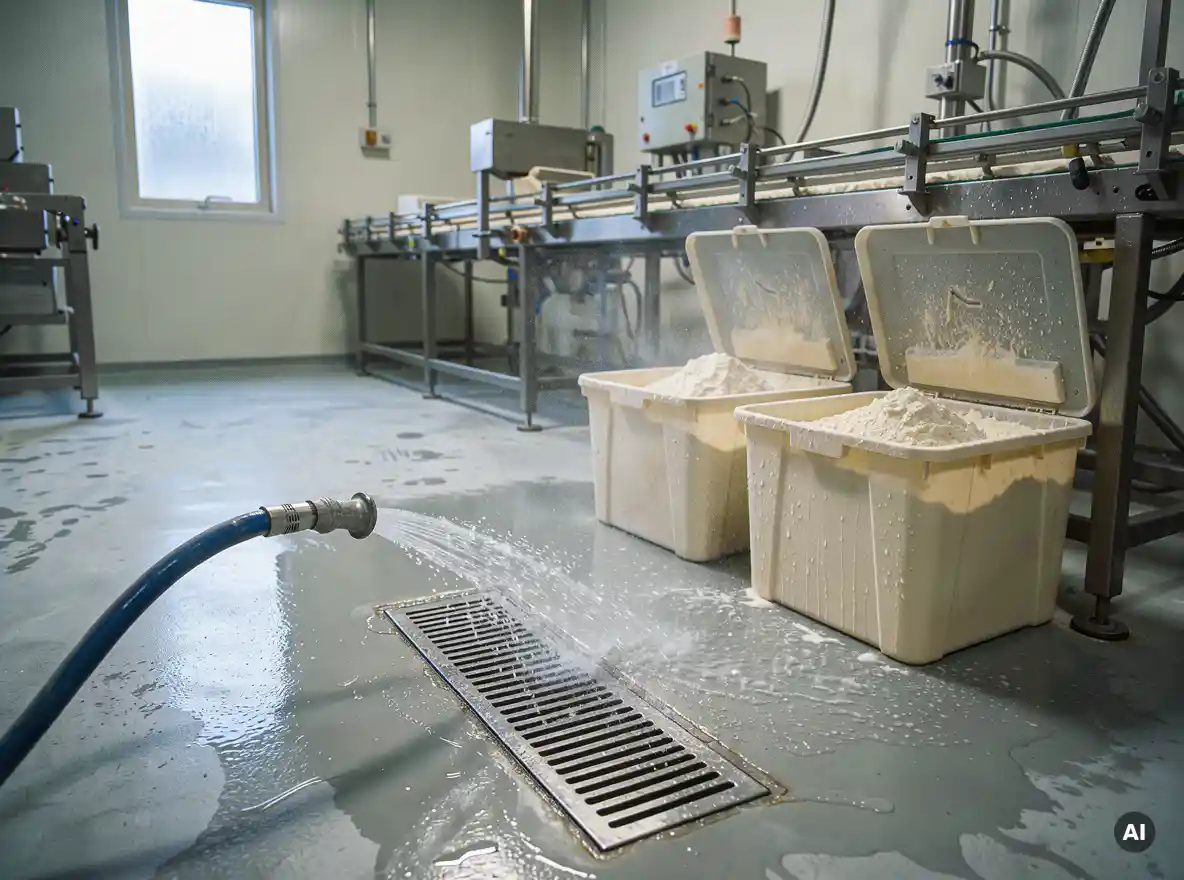
Yes, wet cleaning can increase contamination risk in dry food production areas. Water left on floors, equipment, and surfaces can carry microbes, support their growth, and spread residues through splashing, aerosols, and wheeled traffic. The level of risk depends on how much water is used, how well areas are dried, and whether controls protect entry points. Below, we cover the mechanisms, risks, alternatives, and safeguards, including how food hygiene mats help.
How does moisture spread microbes in dry processing areas?
Moisture spreads microbes by giving them a medium to travel in and a surface to grow on. Water from wet cleaning can splash, pool, wick into porous materials, and transfer onto footwear and wheels, moving bacteria and mould spores from one zone to another.
In a dry food facility, ingredients such as flours, powders, spices, and snacks are typically low in water activity, which limits microbial growth. Introducing water changes that. Residual films of water on floors, drains, and equipment feet can allow organisms such as Salmonella and Listeria monocytogenes to survive and, in some conditions, multiply. Industry guidance on low-moisture food hygiene consistently identifies uncontrolled water as one of the main ways pathogens become established in these environments.
Spread occurs through several routes:
- Splash and spray: High-pressure hoses and aggressive scrubbing project droplets onto equipment, walls, and open product zones.
- Aerosols: Fine droplets generated during rinsing can carry microorganisms and settle on surfaces some distance away.
- Foot and wheel transfer: Damp floors pick up soil and microbes, and footwear and trolley wheels then carry them into adjacent dry zones.
- Pooling and wicking: Water that collects at low points or seeps into joints and cracks creates harbourage sites that are difficult to clean.
What are the biggest risks when wet cleaning dry food facilities?
The biggest risks are pathogen establishment in residual water, cross-contamination through splashing and aerosols, product contact with moisture, and the creation of harbourage sites in hard-to-dry areas. Each can undermine a hygiene programme designed around keeping the environment dry.
Specific risks to assess include:
- Pathogen persistence: Microorganisms can survive for long periods in dry environments and become active again when water is introduced.
- Cross-contamination: Water moves contaminants from lower-hygiene areas such as drains, entrances, and waste zones toward higher-hygiene production areas.
- Moisture ingress into product or equipment: Wet residues can cause caking, clumping, mould, or corrosion, and can affect electrical components and conveyors.
- Biofilm and harbourage formation: Standing water in seams, cracks, and under equipment supports biofilm development that resists routine cleaning.
- Slip hazards: Wet floors raise safety risks for staff and can disrupt forklift and trolley movement.
- Chemical residues: Detergents and sanitisers that are not fully removed or dried can contaminate product or leave films that attract soil.
These risks are not an argument against wet cleaning in every case. They are an argument for treating it as a controlled, risk-assessed activity rather than a default routine. Food safety management systems based on HACCP, and certification schemes such as BRCGS, expect sites to justify their cleaning methods and verify that they are effective.
Is dry cleaning safer than wet cleaning for dry food areas?
Dry cleaning is generally the lower-risk default for dry food areas because it removes soil without introducing water. Methods such as brushing, vacuuming, and wiping with minimal moisture keep conditions unfavourable to microbial growth. Dry cleaning alone, however, may not remove all residues or reduce microbial loads where those are the concern.
Dry methods suit routine removal of dust, powders, and loose debris. Vacuum systems with appropriate filtration capture particulates rather than redistributing them, and dry wiping or controlled alcohol-based wipes can address surfaces without leaving standing water.
Dry cleaning has limits. It does not dissolve sticky or oily residues, and it does not by itself deliver a validated reduction in microbial load. Where allergen changeovers or sanitation requirements demand a higher standard of cleanliness, dry cleaning may need to be combined with targeted wet or damp steps. The safest approach matches the method to the soil, the zone, and the hazard, and verifies the result.
When is wet cleaning still necessary in dry production zones?
Wet cleaning remains necessary when dry methods cannot remove the contamination present. Typical triggers are allergen changeovers, sticky or oily residues, spills of liquid ingredients, microbial contamination events, and periodic deep cleans where regulatory or customer standards require a validated sanitation step.
Common situations include:
- Allergen control: Removing allergen residues between products may require wet cleaning to meet the facility’s validated procedures.
- Heavy or adhered soil: Sugars, fats, and syrups do not respond to dry removal alone.
- Corrective action: A positive environmental monitoring result may call for targeted wet sanitation of the affected area.
- Scheduled deep cleans: Some sites run periodic wet cleans of floors, walls, and equipment, usually during planned shutdowns with time to dry.
The principle is to keep wet cleaning deliberate and limited. Understanding how a site is divided by risk helps here. Dycem’s guide to hygienic zoning in food and beverage manufacturing explains how zones can be defined so that cleaning methods and movement controls match each area’s hygiene requirements.
How can facilities wet clean without raising contamination risk?
Facilities can wet clean more safely by using the minimum water needed, choosing low-pressure methods, isolating the area, drying thoroughly, and verifying results before production restarts. A documented, validated procedure matters more than any single technique.
Practical measures include:
- Remove dry soil first. Vacuum or brush loose material before introducing water so it does not turn into residue.
- Use low-volume methods. Prefer damp wiping, foam, or controlled application over high-pressure hosing, which creates aerosols and splashes.
- Isolate the area. Protect adjacent zones and open product, and schedule wet cleaning when production is not running.
- Work from clean to dirty and top to bottom. This reduces the chance of redistributing contamination into cleaned areas.
- Dry thoroughly. Remove standing water with squeegees, wet vacuums, or controlled drying, and allow adequate time before restart.
- Verify. Use visual inspection, ATP testing, or environmental monitoring in line with the site’s hygiene programme to confirm the area is clean and dry.
Training matters as much as equipment. Staff need to understand why water control is critical, and procedures should state acceptable methods, water volumes, drying times, and release criteria for each zone.
How do floor controls reduce contamination at entry points?
Floor controls reduce contamination at entry points by capturing soil and microbes from footwear and wheels before they cross into cleaner zones. Because floors are a major route for contaminants, controlling them at transitions reduces how much needs removing later by wet or dry cleaning.
This is where food hygiene mats play a role. Dycem’s reusable polymeric mats are designed to attract, capture, and retain particles from shoes and wheels. Dycem states that 80% of contaminants enter controlled environments at floor level, and that its mats can capture up to 99.9% of footwear and wheel contaminants under test conditions. These are manufacturer-reported figures, and performance in a given facility depends on traffic, installation, and cleaning, so it should be evaluated on site. The mats incorporate Biomaster silver-ion antimicrobial technology, but this supports, and does not replace, cleaning, disinfection, and environmental monitoring.
In dry food facilities, placing mats at entrances to production areas, at changes between hygiene zones, and at doors where trolleys pass can reduce the soil that reaches the production floor. That means less debris to clean, and fewer reasons to resort to wet cleaning. Dycem CleanZone is engineered for pedestrian and light-wheeled traffic, while Dycem WorkZone suits heavy-wheeled industrial traffic such as forklifts and pallet trucks. Unlike disposable peel-off alternatives, reusable mats are washed in place and reused over a multi-year service life, which can reduce waste. You can find sector-specific information on the food industry solutions page.
Floor controls do not replace HACCP, hygienic zoning, validated cleaning, or environmental monitoring. They are one layer in a wider contamination control strategy that keeps contamination out so that cleaning, wet or dry, has less to do.
Wet cleaning does not have to be avoided entirely in dry food production, but it should be treated as a controlled exception, used where dry methods cannot do the job and managed so that water never becomes the carrier of contamination. Reducing the soil that enters production in the first place makes that easier. If you want to assess where floor-level contamination enters your facility, arrange a complimentary site survey with a Dycem contamination control specialist.
Frequently Asked Questions
How long should I allow for drying after wet cleaning before restarting production?
There is no universal time, because it depends on ventilation, temperature, floor and equipment materials, and how much water was used. Set a release criterion rather than a fixed time: surfaces should be visibly dry with no standing water in seams, drain surrounds, or under equipment, and verified by inspection or moisture checks. Use squeegees, wet vacuums, or controlled airflow to speed drying, and record the actual drying time during validation so the schedule is realistic.
What should I do if environmental monitoring finds Salmonella or Listeria after a wet clean?
Treat it as a corrective action event. Stop production in the affected area if needed, investigate likely water pathways such as pooling, splashing, drains, or wheeled traffic, and carry out targeted cleaning and sanitation followed by re-sampling. Review whether the wet cleaning method itself, for example high-pressure hosing, spread the contamination, and update the procedure and zone controls accordingly.
Do floor mats and other entry controls mean I can stop wet cleaning altogether?
No. Floor controls reduce how much soil and microbial load enters production, which can lower how often wet cleaning is needed, but they do not replace validated cleaning, allergen management, or environmental monitoring. Allergen changeovers, sticky residues, and corrective actions may still require wet or damp methods. Think of mats as one layer of a contamination control strategy that works alongside hygienic zoning and HACCP.