

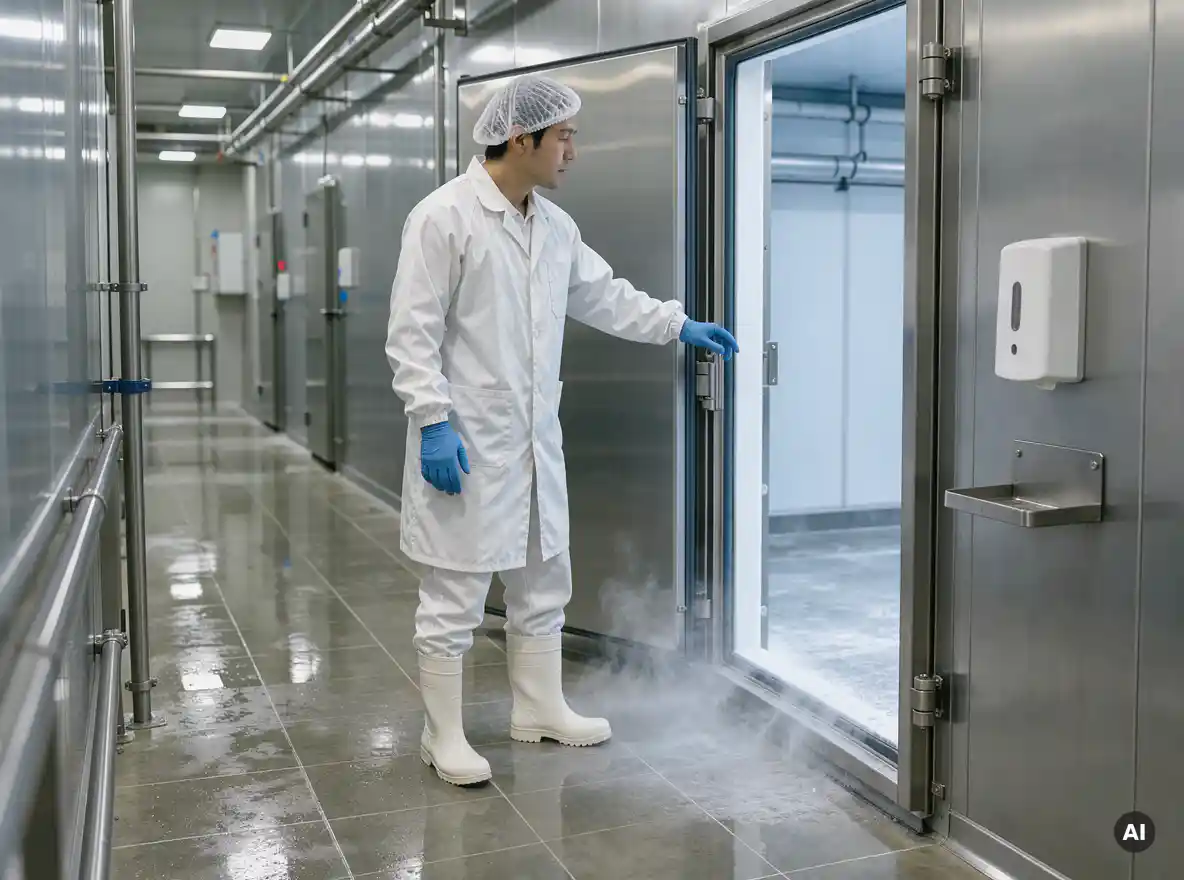
Food factories should manage contamination risk at cold-room entrances by combining hygiene zoning, controlled traffic flow, and floor-level contamination control that captures dirt from footwear and wheels before it crosses the threshold. These controls work together, backed by a documented cleaning and verification routine.
Cold-room doors are high-traffic transition points between zones of different hygiene status, so a single weak control can undermine the rest of the programme. The sections below cover why these entrances are vulnerable, how carts and forklifts spread contamination, which food hygiene mats and flooring options suit the location, and how to verify that controls keep working.
What makes cold-room entrances a contamination hotspot?
Cold-room entrances are contamination hotspots because they combine concentrated foot and wheeled traffic, frequent door openings, and a transition between zones with different hygiene requirements. Anything carried on footwear or wheels at this point can be deposited directly onto the floor of the chilled or frozen area.
Several factors make the threshold especially vulnerable:
- Repeated traffic through a single point. Operators, maintenance staff, and material handlers all converge on the same doorway, often in rapid succession.
- Floor-level transfer. Dycem’s guidance indicates that around 80% of contaminants enter controlled environments at floor level, carried by shoes and wheels.
- Moisture at the door. Condensation, meltwater, and wash-down residue are tracked across the threshold, and they carry soil and microorganisms with them.
- Cold surfaces that slow cleaning. Low temperatures and wet floors make thorough cleaning harder to perform and verify, so contamination can persist.
- Risk of cross-contamination. Moving between raw and ready-to-eat areas without adequate controls can transfer pathogens such as Listeria monocytogenes, which can survive and grow at refrigeration temperatures.
Because the entrance is where a hygiene boundary is crossed, it is also where an effective barrier delivers the greatest return.
How do wheeled carts and forklifts spread contamination?
Wheeled carts, pallet trucks, and forklifts spread contamination by picking up soil, product residue, and microorganisms on their wheels in one area and depositing them along their path into the next. Because wheels travel the same route repeatedly, they can create a continuous contamination trail across zones.
Wheeled equipment is often a greater risk than foot traffic for three reasons. First, wheels contact the floor continuously and can carry material from heavily soiled areas such as loading bays and dispatch. Second, the same equipment often moves between zones during a shift without being cleaned. Third, heavy loads press contaminants into wheel treads, so they release gradually over long distances.
Practical controls include:
- Dedicating equipment to specific zones wherever operations allow, so wheels do not cross hygiene boundaries.
- Defining a single, controlled crossing point for any equipment that must move between zones.
- Placing wheel-contact contamination control flooring at that crossing point to remove debris before the equipment enters the cold room.
- Scheduling routine cleaning of wheels and undercarriages as part of the sanitation programme.
Equipment flow should be designed as deliberately as personnel flow, since the two behave very differently at a doorway.
Which flooring and matting options work at cold-room doors?
The best option at a cold-room door depends on the traffic type: reusable polymeric mats suit pedestrian and light-wheeled traffic, heavy-duty polymeric flooring suits forklifts and pallet trucks, and floating mats suit areas where permanent installation is impractical. All three are designed to capture contamination at the threshold rather than simply mask it.
Matching the product to the traffic is the key selection criterion. Dycem describes its range as follows:
- Dycem CleanZone is engineered for pedestrian and light-wheeled traffic, and is used at points such as gowning rooms, corridors, and airlocks where contamination is trapped before entering a controlled space.
- Dycem WorkZone is designed for heavy-wheeled traffic, including forklifts and pallet trucks, which makes it relevant for cold-room doors serving material handling routes.
- Dycem Floating Mats are freestanding and can be repositioned or expanded as layouts change, which suits areas where fixed installation is unsuitable.
Dycem reports that its mats can capture up to 99.9% of shoe and wheel contaminants under its own test conditions, and that Biomaster silver-ion technology inhibits microbial growth on the mat surface by up to 99.9%. These are manufacturer-reported results and will not be identical in every facility, as real-world performance depends on traffic, soiling, and maintenance. Antimicrobial properties do not replace cleaning, disinfection, or environmental monitoring, so they should be treated as a supporting control within the sanitation programme.
Reusable polymeric mats are also a more sustainable option than disposable peel-off sticky mats, which generate repeated plastic waste and require frequent replacement. For a closer comparison, see Dycem’s overview of sticky mats.
How should hygiene zoning be set up at entrances?
Hygiene zoning at entrances should establish clearly defined areas of rising hygiene status, with a physical barrier and a defined control point at each boundary. Personnel and equipment cross only at designated points, where footwear and wheels are cleaned and, where required, protective clothing is changed.
A practical approach follows these steps:
- Map the risk. Identify which zones handle raw materials and which handle ready-to-eat or chilled products, and where traffic currently crosses between them.
- Define the boundaries. Mark transitions with physical features such as barriers, door controls, or colour coding, so the boundary is obvious to staff.
- Install a control point at each boundary. This typically combines handwashing and footwear controls with contamination control flooring that captures floor-level soil.
- Control the direction of movement. One-way flow from higher- to lower-risk areas reduces the chance of reverse contamination.
- Train and reinforce. Zoning only works if staff understand and follow it, so signage and induction training matter as much as the equipment.
Zoning supports wider food safety programmes such as HACCP and standards such as BRCGS, although it does not by itself guarantee compliance with either, and contamination control flooring is not a substitute for other essential controls. Dycem explains the principles in more detail in its article on hygienic zoning in food and beverage manufacturing, and its food industry page covers sector-specific applications.
How often should entrance controls be cleaned and checked?
Entrance controls should be cleaned and inspected on a documented schedule based on traffic volume and risk, typically at set intervals within each shift or day, with periodic deeper verification. There is no universal frequency, so each facility should define it within its own hazard analysis and sanitation procedures.
A workable routine usually includes:
- Frequent visual checks. Staff inspect the entrance flooring for visible soiling, damage, or displacement during each shift.
- Scheduled cleaning. Mats are cleaned following the manufacturer’s guidance, with frequency raised for high-traffic or heavily soiled doorways. Dycem publishes instructions on cleaning Dycem, since cleaning method and frequency should follow product-specific guidance.
- Record keeping. Cleaning and inspection records support audit readiness and help identify patterns.
- Periodic verification. Environmental monitoring, such as swabbing near the entrance, helps confirm the controls are working, and results should drive adjustments to frequency.
- Replacement planning. Dycem designs its mats to perform for 3 to 5 years, but wear, damage, and reduced performance should trigger review rather than a fixed assumption.
Increase the frequency whenever monitoring shows rising contamination, after a sanitation incident, or when traffic patterns change.
Strengthening cold-room entrance control
Effective control at cold-room entrances rests on understanding where contamination enters, matching flooring to the traffic type, enforcing hygiene zoning, and checking performance regularly. Floor-level contamination control is one layer in this system and works alongside, not in place of, cleaning, personal hygiene, and environmental monitoring.
Facilities reviewing their cold-room doors can start with a complimentary site survey, where a Dycem specialist assesses traffic flows and contamination entry points and recommends a suitable layout.
Frequently Asked Questions
What should I do if forklifts keep tracking moisture and debris through the door despite having a mat?
First check that the flooring is rated for heavy-wheeled traffic, since a pedestrian-grade mat can be displaced or damaged by forklifts. Then confirm the mat is long enough that every wheel makes several contacts before entering the cold room, and that equipment is crossing at the designated point rather than bypassing it. Also review whether the mat is being cleaned often enough, because a saturated or soiled surface will stop capturing contaminants effectively.
How can I tell whether my entrance controls are actually working?
Combine visual checks with environmental monitoring. Swabbing the floor just inside the cold room, and comparing results against the area immediately outside, can show whether contamination is being stopped at the threshold. Track results over time, and if counts rise or a pathogen such as Listeria is detected, increase cleaning frequency, review traffic flow, and investigate the source before it spreads.
Are there practical alternatives when a permanent floor installation isn't possible at a cold-room door?
Freestanding floating mats are designed for this situation, as they can be placed on existing flooring and repositioned or expanded if your layout changes. Make sure the edges are secure, the mat sits flat to avoid trip hazards, and the area underneath is included in your cleaning routine. They are also useful for trialling a position before deciding on a permanent solution.