

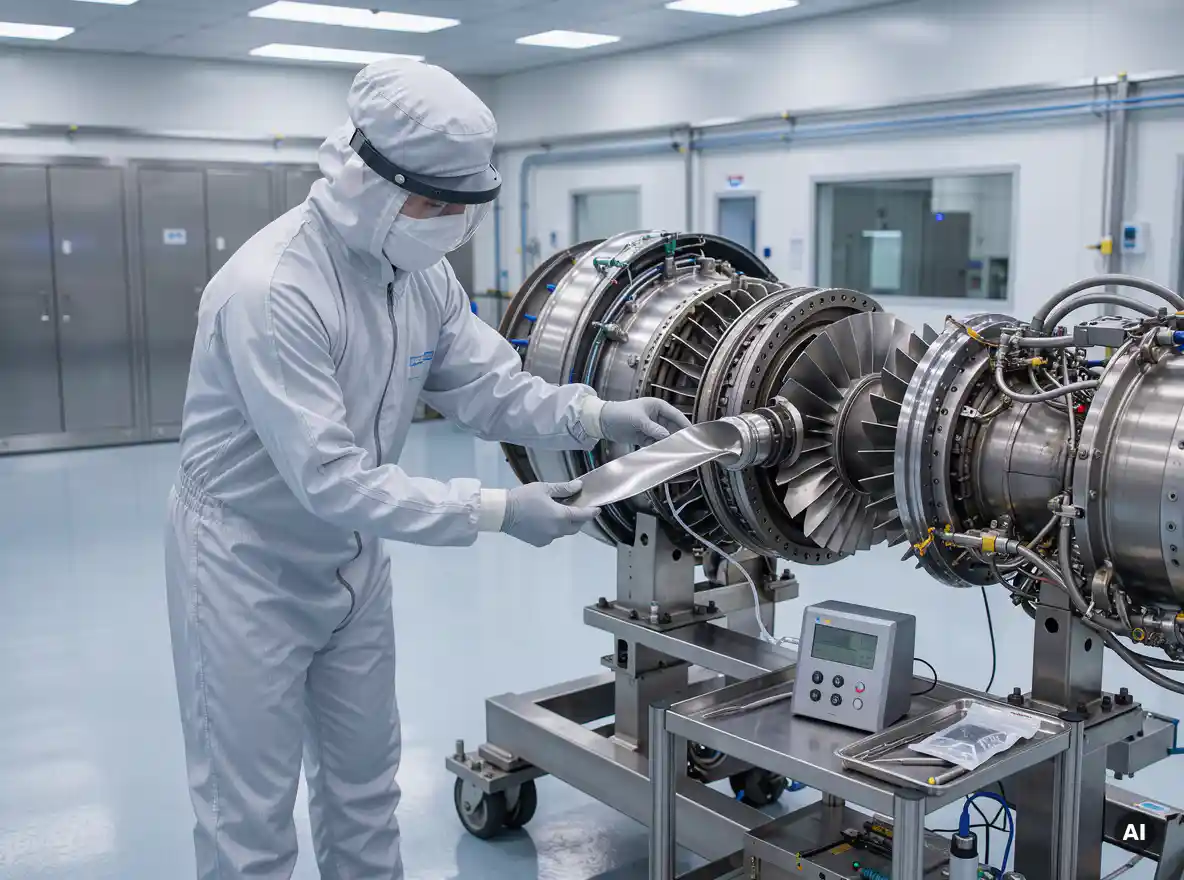
Aerospace manufacturers control particulate contamination during precision assembly through layered controls: classified cleanrooms or controlled assembly areas, filtered air, gowning and cleaning procedures, strict foreign object debris (FOD) management, and floor-level protection at every entry point. No single measure is enough, because particulates arrive on people, wheels, tools, and materials.
The right level of control depends on the assembly process and the tolerance of the component involved. The sections below cover which processes are most sensitive, which standards apply, where particulates originate, and how facilities stop, prevent, and verify contamination, including the role of aerospace mats at the point of entry.
Which aerospace assembly processes are most sensitive to particulates?
The most particulate-sensitive aerospace processes are those involving tight tolerances, bonded or sealed joints, optical surfaces, and fluid or electronic systems. Examples include satellite and spacecraft assembly, avionics and sensor integration, hydraulic and fuel system assembly, optical payload work, and adhesive bonding or coating operations.
Each process fails in a different way. Particles trapped in a bond line can weaken adhesion. Debris in a hydraulic valve can cause sticking or scoring. Dust on an optical element degrades performance and can be difficult to remove without damage. In electronics, conductive particles can create short circuits or intermittent faults that are hard to trace after assembly.
The consequences are also amplified by the product’s operating life. A spacecraft cannot be serviced once launched, and aircraft components are expected to perform reliably for decades. This makes prevention far more cost-effective than late-stage rework or failure investigation.
What cleanliness standards apply to aerospace precision assembly?
ISO 14644-1 is the primary framework for classifying cleanroom air cleanliness by particle concentration, and many aerospace facilities use it to define controlled assembly environments. ISO 14644-2 covers the monitoring and periodic testing needed to show a room continues to meet its class. Beyond airborne limits, aerospace programmes typically add customer, agency, and product-specific requirements for surface cleanliness, FOD control, and materials handling.
It is important to separate these layers. ISO 14644-1 classifies the air in a room; it does not by itself define how clean a component surface must be. Surface and fluid cleanliness are usually governed by separate specifications, often set by the prime contractor, space agency, or the component’s own drawings. Examples include product cleanliness levels for hardware and contamination limits for hydraulic fluid.
Not every aerospace operation requires a classified cleanroom. Many facilities use controlled assembly areas with defined housekeeping, access, and FOD rules, reserving ISO-classified space for the most sensitive operations such as spacecraft, optics, and precision instrumentation. Requirements vary by programme and customer, so facilities should confirm what applies to their specific work rather than assuming one standard covers everything.
Where do particulates in aerospace cleanrooms come from?
Particulates in aerospace cleanrooms come from people, footwear and wheels, materials and packaging, tools and equipment, the manufacturing process itself, and air entering from adjacent areas. Of these, floor-level transfer is among the most persistent because every person and wheeled item crossing a threshold can carry particles inward.
The main sources break down as follows:
- Personnel: skin flakes, fibres from clothing, and particles shed during movement.
- Footwear and wheels: dust, soil, and debris carried in from corridors, loading areas, and the outdoors on shoes, trolleys, carts, and tooling.
- Materials and packaging: cardboard, paper, and shrink wrap that shed fibres and fragments.
- Process generation: machining, drilling, sanding, and fastening can produce chips, swarf, and fine dust.
- Air and pressure leakage: unfiltered air moving through doors and openings when the facility’s pressure strategy is not maintained.
Dycem’s own guidance notes that a large share of contaminants enter controlled environments at floor level, which is why entry points deserve focused attention before particles ever reach assembly stations.
How do manufacturers stop contaminants at facility entry points?
Manufacturers stop contaminants at entry points by combining gowning and de-gowning procedures, airlocks, pressure control, and floor-level contamination control that captures particles from footwear and wheels before they cross into the controlled zone. The aim is to remove as much contamination as possible at each transition, rather than relying on the cleanroom to cope with it.
A typical layered entry strategy includes:
- Zoned access: clear boundaries between uncontrolled, transitional, and controlled areas.
- Gowning rooms and airlocks: defined procedures for changing garments and footwear.
- Pressure control: air flow direction and pressure differentials set according to the facility’s contamination control needs, typically from cleaner to less clean areas to limit ingress.
- Floor-level capture: contamination control flooring at thresholds, gowning rooms, and corridors.
- Cleaning regimes: scheduled, validated cleaning of floors and surfaces.
For the floor-level step, reusable polymeric mats are a practical alternative to disposable sticky mats. Dycem CleanZone is designed for pedestrian and light-wheeled traffic at points such as gowning rooms, cleanroom entrances, corridors, and airlocks. Where heavier equipment moves between zones, WorkZone is intended for forklifts and pallet trucks. Dycem reports that its mats capture and retain up to 99.9% of particulates from footwear and wheels under tested conditions; results in a given facility will depend on traffic, cleaning, and maintenance. The mats are washable and reusable, which avoids the repeated waste and peel-off maintenance associated with sticky mats.
Mats complement, and never replace, gowning discipline, HEPA filtration, HVAC design, and validated cleaning. Their value is in reducing the particulate load that those other controls must manage. Dycem’s range of aerospace contamination control solutions is built around this layered approach.
How is foreign object debris prevented during assembly?
Foreign object debris (FOD) is prevented through disciplined housekeeping, tool and hardware accountability, controlled materials, and clean-as-you-go practices at the workstation. FOD refers to any loose item, such as a fastener, wire clipping, tool, or fragment, that is left in or near a product and could cause damage or failure.
Effective FOD prevention typically relies on a combination of measures:
- Tool control: shadow boards, tool counts before and after work, and check-in and check-out systems.
- Hardware management: issuing only the fasteners required and reconciling the count afterwards.
- Workstation discipline: clean-as-you-go rules, covers over open assemblies when unattended, and no loose personal items.
- Material rules: approved wipes, paper, and packaging suitable for the zone.
- Inspection: visual and borescope checks before closing panels, enclosures, and fluid systems.
Particulate and FOD control overlap but are not identical. FOD is usually larger, discrete items controlled by procedure, while particulates are microscopic and controlled through environment and cleaning. At the bench, reusable bench mats can support precision assembly by providing a non-slip, cleanable work surface that helps hold small parts in place and reduces particle transfer. They support, rather than replace, FOD procedures.
How do aerospace facilities monitor and verify contamination levels?
Aerospace facilities verify contamination control through airborne particle counting, surface cleanliness checks, scheduled inspections, and trend analysis against defined limits. The goal is to confirm that controls work in practice and to detect drift before it affects the product.
Common verification activities include:
- Airborne particle counting: routine and periodic testing against the room’s ISO classification, following the monitoring and testing approach set out in ISO 14644-2 and the measurement methods in ISO 14644-1. Where microbial control also matters, readers can learn more about viable and non-viable particle monitoring.
- Surface sampling: tape lifts, swabs, and visual inspection, sometimes under UV or oblique light, to check hardware and work surfaces.
- Cleanliness verification of components: solvent extraction and particle counting where the product specification requires it.
- Trend review: tracking excursions by location, shift, and activity to identify sources.
Monitoring should also cover the controls themselves. Floor-level contamination control only performs if it is cleaned and maintained correctly, so facilities should follow the recommended cleaning procedures for Dycem mats and review mat condition as part of routine inspection. Where an existing installation needs validating, particle collection efficiency testing can assess how well mats in service are performing.
Controlling particulates in aerospace precision assembly is a matter of stacking controls: classified or controlled space, disciplined entry, strong FOD practice, and measurable verification. Floor-level capture is one of the most practical places to reduce the contamination load. To assess where your facility’s entry points and traffic routes are most exposed, you can arrange a complimentary site survey with a Dycem contamination control specialist.
Frequently Asked Questions
Do we need a full ISO-classified cleanroom for all aerospace assembly work?
Not necessarily. Many operations can be carried out in controlled assembly areas with defined housekeeping, access restrictions, and FOD rules. ISO-classified space is usually reserved for the most sensitive work, such as spacecraft, optics, and precision instrumentation. Check your customer, prime contractor, or agency requirements and the component drawings to determine the level that applies to each process.
What should I do if particle counts spike or exceed limits?
First, confirm the reading by repeating the measurement and checking that the instrument is calibrated. Then investigate recent activity in that area, including maintenance, deliveries, unusual traffic, process changes, or HVAC and pressure issues. Review trend data by location, shift, and activity to trace the source, apply corrective cleaning or controls, and re-test to verify the area has returned to within limits.
Can floor-level contamination control work in areas with wheeled equipment like carts and pallet trucks?
Yes, but the product must be matched to the load. Light-wheeled traffic such as trolleys and carts is suited to pedestrian-grade solutions, while forklifts and pallet trucks need heavy-duty options designed for that weight. Place the mats where wheels and footwear must cross, such as airlocks, corridors, and threshold transitions, and make sure the route forces contact with the surface.