

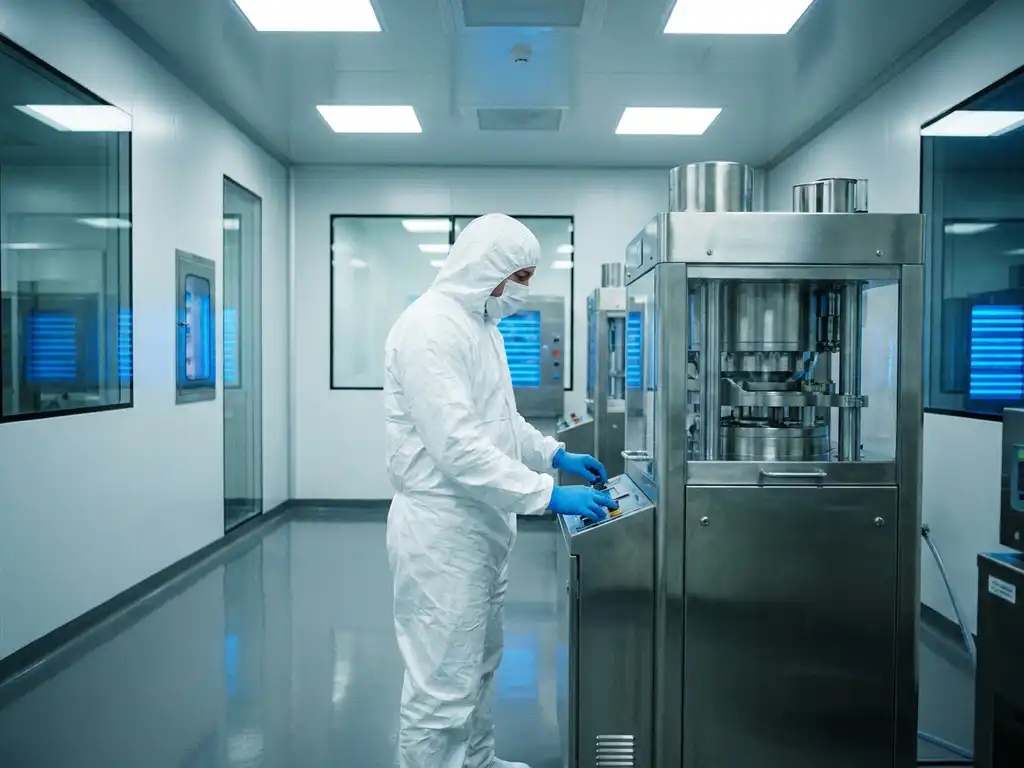
Controlling contamination during tablet pressing requires a layered approach that combines environmental controls, personnel protocols, equipment hygiene, and validated entry-point management. The process begins before a single tablet is pressed, starting at the facility’s access points, and extends through every stage of production. The sections below address the most common questions manufacturers face when building or reviewing their contamination control strategy.
What are the main sources of contamination in tablet pressing?
The main sources of contamination in tablet pressing are personnel, equipment, raw materials, the facility environment, and cross-contamination from adjacent processes. Of these, personnel and the surrounding environment are the most difficult to control because they introduce contaminants continuously throughout a production shift, not just at a single point in the process.
Raw material contamination typically involves residual moisture, microbial load, or foreign particulates introduced during weighing and blending. Equipment contamination arises from inadequate cleaning between batches, worn seals, or lubricant migration. However, airborne and floor-level particulates generated by human movement represent a persistent and often underestimated risk. Industry experience consistently shows that the majority of particulates entering controlled manufacturing areas are carried in at floor level, either on footwear or on the wheels of trolleys and transfer equipment.
Cross-contamination between active pharmaceutical ingredients is a separate but related concern, particularly in multi-product facilities where shared equipment or adjacent production suites create the potential for API transfer. GMP frameworks address this through dedicated equipment, pressure differentials, and strict gowning protocols, all of which depend on the integrity of the facility’s broader contamination control system.
How does personnel movement spread contamination in tablet manufacturing?
Personnel movement spreads contamination in tablet manufacturing primarily through footwear, garments, and skin particles. Every time a person moves through a facility, they shed microscopic particles and carry environmental contaminants from one zone to another. In a tablet pressing environment, this creates a direct pathway from uncontrolled areas into the production suite.
The mechanism is straightforward. Shoes pick up particulates from floors in corridors, warehouses, changing areas, and external environments. When those shoes enter a cleanroom or controlled manufacturing zone, the particles are transferred to the floor surface and subsequently become airborne through foot traffic and air movement. Research in controlled environment design consistently identifies floor-level transfer as the dominant contamination pathway, accounting for the vast majority of particulates that enter critical zones.
Garments contribute similarly. Operators who move between zones without following correct gowning change-out procedures carry fibres, dust, and microbial contamination on their clothing. Skin shedding is an unavoidable biological reality, which is why pharmaceutical cleanrooms require full gowning, including gloves, hair nets, and face coverings, in addition to controlled entry procedures. The effectiveness of these measures depends heavily on how well the entry points themselves are managed.
What contamination control measures are required under GMP for tablet pressing?
Under Good Manufacturing Practice, contamination control measures for tablet pressing must include environmental monitoring, validated cleaning procedures, controlled personnel access, appropriate facility design, and documented contamination control protocols. Regulatory frameworks including EU GMP Annex 1, FDA 21 CFR Part 211, and ICH Q10 all require manufacturers to demonstrate that contamination risks are identified, assessed, and actively managed.
Key GMP requirements relevant to tablet pressing environments include:
- Facility design: Defined clean zones with appropriate pressure differentials, HEPA-filtered air handling, and clearly delineated entry and exit points
- Personnel controls: Gowning procedures, personnel hygiene training, and restricted access to critical areas
- Equipment qualification: Cleaning validation for tablet presses, granulators, and ancillary equipment between product changeovers
- Environmental monitoring: Regular particle counts, microbial surface sampling, and air quality testing with documented results
- Entry-point controls: Measures at all access points to prevent particulates from being carried into controlled zones on footwear and wheeled equipment
- Change control: Documented procedures for any modification to the contamination control system
Auditors reviewing GMP compliance will look for evidence that each of these controls is not only in place but validated and consistently applied. Gaps at entry points are a common audit finding, particularly where facilities rely on controls that are difficult to verify, such as verbal reminders to staff or visual checks of footwear.
What’s the difference between disposable sticky mats and reusable contamination control mats?
The key difference between disposable sticky mats and reusable contamination control mats is performance consistency, total cost of ownership, and environmental impact. Disposable sticky mats use an adhesive surface to trap particles, but their effectiveness degrades rapidly with each layer peeled away and can be easily overwhelmed by heavy foot traffic. Reusable polymer mats maintain consistent particulate capture performance across their full operational lifespan.
Disposable sticky mats present several practical limitations in a pharmaceutical manufacturing context:
- Adhesive performance drops significantly after the first few passes, meaning contamination capture is inconsistent across a production shift
- Frequent layer removal generates substantial single-use plastic waste, creating both a cost burden and an ESG concern for regulated facilities
- Staff compliance is variable because the mats require active engagement to peel and replace layers
- Sticky residue can transfer to footwear, potentially introducing a new contamination vector
Reusable contamination control mats, by contrast, are engineered from polymeric materials that capture and retain particulates through mechanical adhesion rather than a degrading adhesive layer. They are washable, maintain performance across a lifespan of three to five years, and can be validated as part of a documented contamination control programme. For facilities under GMP scrutiny, the ability to demonstrate consistent, validated performance is a significant compliance advantage. The sustainable nature of reusable mats also aligns with the ESG commitments that procurement and operations leaders are increasingly required to report against.
Where should contamination control mats be placed in a tablet press facility?
Contamination control mats should be placed at every transition point between uncontrolled and controlled zones in a tablet press facility. The most critical locations are cleanroom and production suite entrances, gowning room exits, airlock entry and exit points, and any corridor or access route used by wheeled transfer equipment. These are the points where contamination is most likely to be carried in.
A systematic placement strategy should consider both pedestrian and wheeled traffic routes separately, as they carry different contamination loads and require different mat specifications. Pedestrian entry points such as gowning room exits benefit from mats sized to capture particulates from multiple footsteps, ensuring that each foot contacts the mat surface at least once before the operator enters the critical zone. Wheeled equipment routes, including those used by tablet transfer trolleys and materials handling equipment, require mats engineered to handle the mechanical load of repeated heavy-wheeled traffic without deforming or losing performance.
Secondary placement considerations include:
- Weigh booth and dispensary entrances, where raw material handling creates additional particulate risk
- Equipment access corridors used during maintenance and cleaning activities
- Visitor and contractor access routes, which are often overlooked in contamination control planning
- Packaging area entry points, where finished product integrity must be protected
The goal is to ensure that no person or piece of equipment can enter a controlled zone without passing over a validated contamination control surface.
How do you validate that your contamination control system is working?
Validating a contamination control system requires baseline measurements, ongoing environmental monitoring, and documented evidence that entry-point controls are performing to specification. For tablet pressing facilities operating under GMP, validation is not optional. It is a regulatory expectation that the controls in place are demonstrably effective and consistently applied.
A practical validation approach includes the following steps:
- Establish a baseline: Conduct particle counts and microbial surface sampling before implementing or upgrading contamination control measures to create a reference point
- Define acceptance criteria: Set measurable thresholds for particulate levels, microbial counts, and mat surface contamination load based on your facility’s classification requirements
- Monitor at entry points: Sample floor surfaces and air quality in the immediate vicinity of entry-point controls to assess whether particulates are being captured effectively
- Review mat performance: Inspect and clean reusable mats according to a documented schedule, recording condition and any performance observations
- Trend analysis: Review environmental monitoring data over time to identify patterns, seasonal variation, or process changes that affect contamination levels
- Audit readiness: Maintain complete documentation of all monitoring activities, cleaning records, and any corrective actions taken in response to out-of-specification results
Facilities that use reusable contamination control mats with consistent cleaning protocols find it significantly easier to build a defensible validation record than those relying on disposable solutions, where performance variability makes trending difficult. Any change to the contamination control system, including mat replacement, repositioning, or the introduction of new traffic routes, should be managed through the facility’s change control procedure to maintain the integrity of the validated state.
How Dycem helps control contamination in tablet pressing facilities
Dycem’s reusable contamination control mats are designed specifically for the demands of pharmaceutical manufacturing environments, where compliance, consistency, and audit readiness are non-negotiable. Rather than relying on adhesive-based solutions that degrade with use, Dycem’s polymer mat technology delivers validated particulate capture performance across a lifespan of three to five years, supporting GMP compliance at every entry point in your facility.
Dycem’s product range addresses the full range of contamination control needs in a tablet pressing facility:
- Dycem CleanZone: Engineered for pedestrian and light-wheeled traffic at cleanroom entrances, gowning room exits, and airlocks, delivering high-performance particulate capture at the most sensitive transition points
- Dycem WorkZone: Built for heavy-wheeled traffic including forklifts, pallet trucks, and materials handling equipment, maintaining contamination control in demanding production and logistics environments
- Dycem Floating Mats: Flexible, repositionable mats for facilities that need non-fixed contamination control across variable or temporary zones, including contractor access routes and seasonal production areas
- Dycem Bench Mats and Access Panels: Workstation-level solutions that extend contamination control beyond the floor and into the wider controlled environment
All Dycem mats incorporate built-in Biomaster antimicrobial protection, are manufactured to ISO 9001 and 14001 standards, and are customisable in size, format, and colour to suit any facility layout. Explore the full range of contamination control mats or contact a Dycem specialist to arrange a free site survey and find the right solution for your tablet pressing facility.