

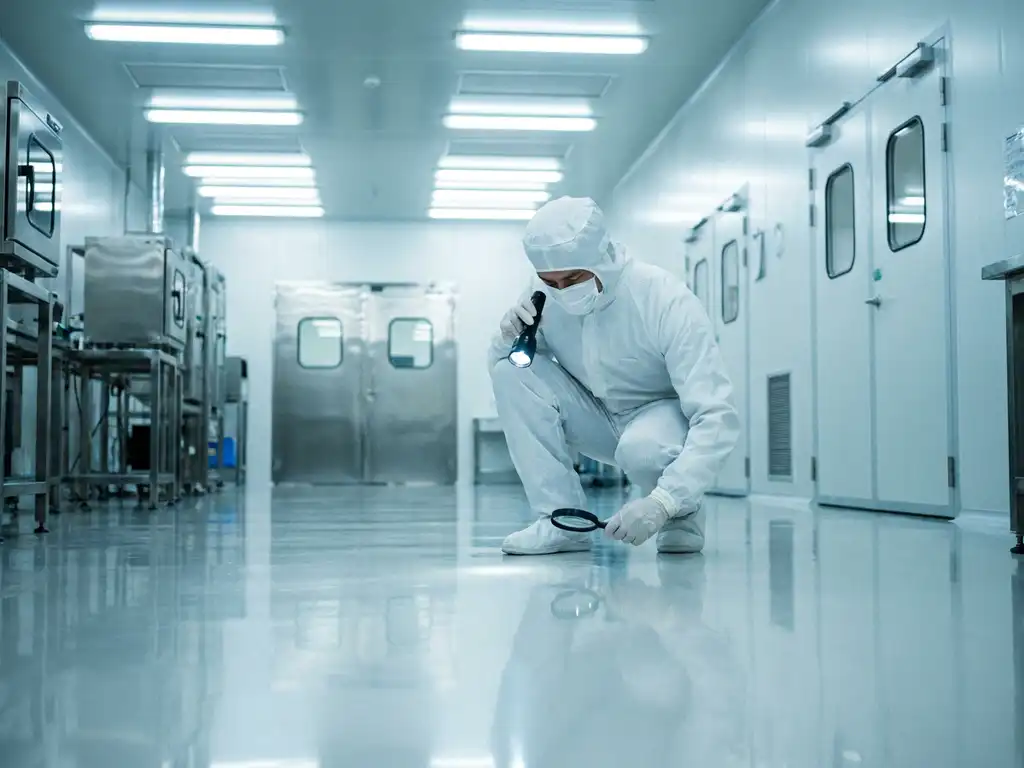
Investigating a contamination event under GMP requires a structured, documented process that begins with immediate containment, moves through root cause analysis, and concludes with corrective and preventive actions. Regulatory frameworks such as EU GMP Annex 15, FDA 21 CFR Part 211, and ICH Q10 all require that contamination incidents be investigated thoroughly, with findings documented and acted upon. The sections below address the most common questions quality and facilities teams face when managing a contamination event.
What are the required steps in a GMP contamination investigation?
A GMP contamination investigation follows a defined sequence: detect and report the event, contain the affected product or area, investigate the root cause, document all findings, implement corrective actions, and verify their effectiveness. Every step must be traceable and completed within the timeframe specified in your quality management system.
Regulators expect a logical, evidence-based progression through each stage. Skipping steps, or completing them out of order, is one of the most common observations raised during FDA inspections and EU GMP audits. The required steps typically include:
- Detection and immediate notification — the event is identified, reported to the quality team, and an initial risk assessment is performed
- Containment — affected batches, zones, or materials are quarantined to prevent further impact
- Investigation initiation — a formal investigation is opened, with a designated owner and defined scope
- Root cause analysis — the investigation team identifies the most probable cause using structured analytical tools
- Impact assessment — the potential effect on product quality, patient safety, and regulatory compliance is evaluated
- CAPA development and implementation — corrective and preventive actions are defined, assigned, and tracked
- Effectiveness verification — evidence is gathered to confirm that CAPAs have resolved the issue and that recurrence has been prevented
- Closure and documentation — the investigation is formally closed with a complete, signed record
What counts as a contamination event under GMP regulations?
Under GMP regulations, a contamination event is any incident where a product, surface, material, or environment is exposed to a substance or organism that could compromise product quality, safety, or efficacy. This includes microbial contamination, particulate matter, cross-contamination between products, and chemical contamination from cleaning agents or raw materials.
The scope is broader than many teams assume. A contamination event does not require a confirmed product failure to trigger an investigation. Deviations from environmental monitoring limits, unexpected particulate counts in a cleanroom, a breach of gowning procedure, or the detection of an unknown organism in a sterile environment all qualify as reportable events under most GMP quality systems.
In pharmaceutical and medical device manufacturing, pharma contamination events must be assessed for their potential impact on batch disposition. In food and beverage or healthcare settings, the threshold for investigation may differ, but the principle remains the same: any event with the potential to compromise hygiene compliance or product integrity must be formally reviewed.
How do you identify the root cause of a contamination event?
Root cause identification in a GMP contamination investigation relies on structured analytical methods applied to physical evidence, process data, and environmental monitoring records. The most widely used tools are fishbone (Ishikawa) diagrams, the 5 Whys technique, and fault tree analysis. The goal is to move beyond the immediate symptom and identify the underlying systemic failure.
Effective root cause analysis considers multiple contributing factors simultaneously. Investigators should examine:
- Personnel — gowning compliance, training records, movement patterns within controlled spaces
- Materials — incoming raw material testing, container integrity, transfer procedures
- Equipment — cleaning validation status, maintenance history, filter integrity
- Environment — HVAC performance, pressure differential logs, environmental monitoring trends
- Processes — deviations from standard operating procedures, recent process changes
- Facility entry points — foot traffic patterns, wheel traffic routes, and the condition of contamination control measures at zone boundaries
Industry experience consistently shows that contamination events in cleanrooms and controlled environments are rarely caused by a single factor. A thorough investigation will often uncover a combination of process gaps, equipment wear, and procedural non-compliance acting together. Documenting the reasoning behind the identified root cause is as important as the conclusion itself.
What documentation is required during a GMP contamination investigation?
GMP contamination investigations require a contemporaneous, complete record that captures every decision, finding, and action taken from detection through to closure. At minimum, documentation must include the initial deviation or incident report, the investigation plan, all evidence gathered, the root cause conclusion with supporting rationale, the CAPA plan, and the effectiveness check results.
Regulators place particular weight on the quality of documentation rather than simply its existence. Records must be attributable, legible, contemporaneous, original, and accurate — the ALCOA principles that underpin GMP data integrity requirements. Specific documents that should form part of the investigation file include:
- The original deviation or out-of-specification (OOS) report
- Batch records, environmental monitoring data, and equipment logs relevant to the timeframe
- Photographs or physical samples where applicable
- Interview records or witness statements from personnel involved
- The root cause analysis with the analytical method used
- The CAPA plan with owners, due dates, and completion evidence
- The effectiveness verification report
- Formal sign-off from the quality unit
Incomplete or retrospectively altered documentation is one of the most serious findings an inspector can make. Investigations should be conducted and recorded in real time wherever possible.
What CAPA actions are most effective after a contamination event?
The most effective CAPA actions after a contamination event are those that address the verified root cause directly, are measurable, and include a defined effectiveness check. Generic CAPAs such as “retrain staff” or “remind operators of procedures” are consistently criticised by regulators because they do not address systemic failures and cannot be objectively verified.
High-impact CAPAs tend to fall into one or more of the following categories:
- Engineering controls — physical changes to the facility, equipment, or environment that reduce contamination risk regardless of human behaviour
- Process redesign — revising SOPs, transfer procedures, or gowning protocols to eliminate the conditions that allowed the event to occur
- Monitoring enhancements — increasing the frequency or scope of environmental monitoring at identified risk points
- Supplier or material controls — tightening incoming material testing or changing supplier qualification criteria
- Facility upgrades — improving contamination control at entry points, zone boundaries, or high-traffic routes
Effectiveness checks are non-negotiable. A CAPA is not closed until there is objective evidence that the corrective action has worked and that the contamination event has not recurred. This evidence should be documented and reviewed by the quality unit before the investigation is formally closed.
How can contamination entry points be controlled before an event occurs?
Controlling contamination entry points before an event occurs means applying validated physical barriers at the locations where contaminants are most likely to enter a controlled environment. Research and facility data consistently show that approximately 80% of contaminants in cleanrooms and controlled spaces are introduced at floor level, through shoe and wheel traffic at entry points and zone transitions.
Proactive contamination control at entry points typically involves a layered approach:
- Defining clear zone boundaries with documented entry and exit protocols
- Installing validated contamination control mats at all pedestrian and wheeled traffic entry points
- Maintaining gowning room and airlock disciplines with regular procedural audits
- Implementing environmental monitoring programmes that include entry point locations
- Reviewing contamination trends periodically to identify emerging risk points before they result in events
The logic here is straightforward: every contamination event that is prevented is an investigation that does not need to be conducted. Facilities that invest in robust entry point controls reduce both the frequency of contamination incidents and the regulatory burden associated with investigating them.
How Dycem contamination control mats support GMP compliance
Dycem’s reusable contamination control mats are engineered specifically to address the floor-level entry point risk that underpins a significant proportion of contamination events in regulated facilities. Used by pharmaceutical, medical device, aerospace, and healthcare manufacturers worldwide, Dycem mats provide a validated, evidence-based layer of protection at the points where contamination is most likely to enter a cleanroom or sterile environment.
Key features that support hygiene compliance and GMP audit readiness include:
- Up to 99.9% capture of shoe and wheel contaminants at facility entry points and zone transitions
- Built-in Biomaster antimicrobial protection that continuously inhibits microbial growth on the mat surface
- Reusable, washable construction with a 3 to 5 year lifespan, reducing single-use plastic waste compared to disposable peel-off alternatives
- ISO-certified manufacturing in compliance with EN ISO 9001 and 14001, supporting supplier qualification and audit documentation
- A range of formats to suit every environment: CleanZone, WorkZone, and Floating Mats for pedestrian, heavy-wheeled, and flexible-zone applications
Whether you are reviewing your contamination prevention programme following an investigation, preparing for a regulatory inspection, or looking to replace inefficient disposable mats with a more sustainable and cost-effective solution, Dycem’s contamination control specialists can help. Contact the Dycem team to arrange a free site survey and consultation.