

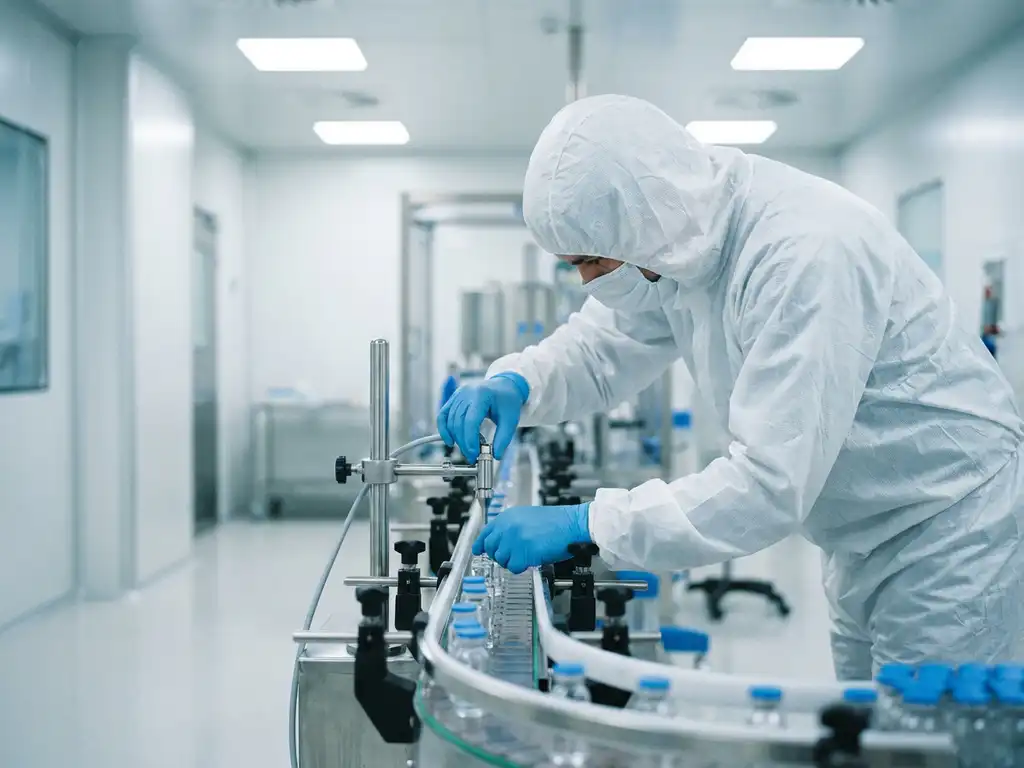
Fill and finish operations require a multi-layered contamination control strategy that addresses personnel, equipment, materials, and the environment simultaneously. At its core, prevention depends on rigorous gowning protocols, validated cleaning procedures, controlled airflow management, and robust entry-point hygiene — particularly at floor level, where the majority of particulate contamination enters. The sections below address the most critical questions around contamination sources, regulatory requirements, and practical control measures for fill and finish environments.
What are the main sources of contamination in fill and finish operations?
The main sources of contamination in fill and finish operations are personnel, equipment surfaces, raw materials, air handling systems, and facility entry points. Personnel are consistently identified as the highest-risk vector, shedding skin particles, fibres, and microorganisms throughout the production environment. Equipment, packaging components, and product contact surfaces introduce further risk if cleaning validation is inadequate.
Fill and finish is among the most contamination-sensitive stages in pharmaceutical manufacturing because it involves direct product exposure during filling, stoppering, and sealing. Any particulate or microbial ingress at this stage can compromise sterility, trigger batch failures, and create serious patient safety risks.
Beyond personnel and equipment, facility infrastructure plays a significant role. Air handling systems that are poorly maintained or inadequately designed can redistribute particles rather than remove them. Consumables and components entering the cleanroom from external environments carry surface contamination that must be addressed before they reach the critical zone. Floor-level contamination, tracked in on footwear and wheeled equipment, is a persistent and often underestimated contributor to overall bioburden.
How do floor-level contaminants enter fill and finish cleanrooms?
Floor-level contaminants enter fill and finish cleanrooms primarily through footwear and wheeled equipment carrying particulate matter, microorganisms, and chemical residues from less controlled areas into the cleanroom environment. With an estimated 80% of contamination entering controlled environments at floor level, this pathway represents one of the most significant and manageable contamination risks in any facility.
Every time personnel walk from a corridor, gowning room, or airlock into a cleanroom, the soles of their footwear act as a transport mechanism. Dust, fibres, and biological material adhere to shoe soles and are deposited directly onto the cleanroom floor with each step. Once on the floor, these particles become mobile again through air turbulence, foot traffic, and equipment movement.
Wheeled traffic compounds the problem. Trolleys, pallet trucks, and transfer carts used to move materials between zones carry contamination on their wheels from lower-grade areas into higher-grade ones. Without a dedicated decontamination step at each transition point, this cross-zone transfer is continuous and cumulative. The result is a gradual build-up of particulate load that challenges air filtration systems and increases the risk of product exposure.
What contamination control measures are required at cleanroom entry points?
Contamination control measures required at cleanroom entry points include gowning protocols, airlocks or ante-rooms, personnel and equipment decontamination steps, and physical barrier systems such as contamination control mats. Each entry point into a classified zone must be treated as a potential contamination pathway and managed accordingly.
Effective entry-point control operates in layers. Airlocks create a physical and pressure-differential buffer between uncontrolled and controlled spaces, preventing unfiltered air from entering the cleanroom. Gowning rooms provide a structured environment for personnel to don cleanroom-appropriate attire before proceeding, minimising the particulate burden they carry in.
At floor level specifically, contamination control mats positioned at entry thresholds capture particles from footwear and wheels before they can be transferred into the classified environment. This is a critical step that complements — rather than replaces — other entry controls. Shoe covers and overshoes, while commonly used, do not eliminate the risk of tracked contamination; they reduce it. A mat system provides an additional capture layer that addresses the residual risk these measures leave behind.
Material entry points require equal attention. Components and packaging materials entering the cleanroom should pass through a decontamination or transfer hatch, and any external packaging should be removed before entry. Combining these measures creates a robust, multi-stage barrier that significantly reduces the contamination load entering the controlled space.
How do reusable contamination control mats work in pharmaceutical environments?
Reusable contamination control mats work by using a high-tack polymeric surface to physically capture and retain particulate matter, fibres, and microorganisms from the soles of footwear and the wheels of equipment as they pass over the mat. Unlike disposable sticky mats that are peeled away and discarded, reusable mats are cleaned in place and continue to perform over a lifespan of three to five years or more.
The mechanism relies on the adhesive properties of the mat’s polymer construction, which grips and holds contaminants rather than simply deflecting them. This means particles are removed from the contact surface rather than redistributed. Mats with built-in antimicrobial protection — such as those incorporating Biomaster silver-ion technology — also inhibit the growth of bacteria on the mat surface between cleaning cycles, reducing the risk of the mat itself becoming a contamination source.
In pharmaceutical environments, these mats are typically positioned at cleanroom entrances, gowning room exits, airlock thresholds, and any transition point between classified zones. Their effectiveness depends on correct sizing relative to the entry point — a mat that is too narrow allows personnel to step around or over it, defeating its purpose. Mats should span the full width of the entry corridor to ensure complete foot contact with every pass.
Reusable mats are also compatible with standard cleanroom cleaning regimes. They can be mopped, wiped, or cleaned using validated disinfectants without degrading their performance, making them straightforward to integrate into existing cleaning schedules and documentation systems.
What GMP and regulatory standards apply to fill and finish contamination control?
GMP and regulatory standards that apply to fill and finish contamination control include EU GMP Annex 1 (Manufacture of Sterile Medicinal Products), FDA 21 CFR Part 211, and ISO 14644 for cleanroom classification and monitoring. These frameworks collectively define the environmental standards, personnel controls, and contamination prevention measures required for sterile pharmaceutical manufacturing.
EU GMP Annex 1, revised in 2022, places particular emphasis on a holistic Contamination Control Strategy (CCS) — a documented, facility-wide approach that identifies contamination risks and defines the controls in place to manage them. Under Annex 1, organisations must demonstrate that every element of their facility design and operational practice contributes to contamination prevention, not just individual measures in isolation.
ISO 14644 standards define cleanroom classifications by particle count and set requirements for ongoing environmental monitoring. Facilities operating Grade A and Grade B environments for aseptic filling must demonstrate consistent compliance with these limits, which requires both robust physical controls and rigorous monitoring programmes.
FDA guidance similarly requires that contamination sources be identified, controlled, and documented as part of current Good Manufacturing Practice. Audit readiness in 2026 increasingly depends on facilities being able to demonstrate not just that controls exist, but that they are validated, monitored, and reviewed regularly. Entry-point contamination control measures, including floor-level systems, should be documented within the CCS and supported by cleaning records and performance data.
When should contamination control mats be cleaned or replaced in fill and finish facilities?
Contamination control mats in fill and finish facilities should be cleaned according to a validated schedule aligned with the facility’s overall cleaning programme — typically daily or after high-traffic periods — and replaced when the mat surface shows visible degradation, loss of tack, or physical damage that compromises performance. Routine cleaning maintains capture efficiency; replacement is a long-term consideration governed by the mat’s condition rather than a fixed calendar interval.
For facilities operating under GMP, cleaning frequency and method should be documented and validated. The cleaning record for contamination control mats forms part of the broader environmental hygiene documentation that supports regulatory inspection readiness. Mats should be cleaned using disinfectants compatible with the mat material, and the cleaning method should be consistent with the validated approach to avoid unintended degradation of the surface.
Visual inspection at each cleaning cycle is a practical way to assess mat condition. Signs that a mat requires replacement include surface cracking, permanent compression, loss of adhesive tack, or discolouration that cannot be removed through cleaning. A reusable mat with a lifespan exceeding three years, maintained correctly, offers a significantly lower total cost of ownership than disposable alternatives that require frequent replacement regardless of their actual condition.
Facilities with high wheeled traffic should assess mats in those zones more frequently, as heavy loads accelerate surface wear. Keeping a replacement schedule based on inspection findings rather than arbitrary timelines ensures mats are always performing at the level required by the cleanroom grade they protect.
How Dycem CleanZone supports contamination control in fill and finish operations
Dycem CleanZone is a reusable polymeric contamination control mat engineered specifically for the entry points that matter most in pharmaceutical and sterile manufacturing environments. For quality and facilities managers responsible for fill and finish operations, it provides a validated, low-maintenance floor-level control that integrates directly into a documented Contamination Control Strategy.
- High-capture performance: Captures up to 99.9% of shoe and wheel contaminants at cleanroom entry thresholds, gowning room exits, and airlock transitions
- Built-in Biomaster antimicrobial protection: Inhibits bacterial growth on the mat surface between cleaning cycles, reducing the risk of the mat becoming a secondary contamination source
- GMP-compatible cleaning: Washable and compatible with standard pharmaceutical disinfectants, supporting validated cleaning schedules and audit documentation
- Long service life: A lifespan exceeding three years reduces procurement frequency and total cost of ownership compared to disposable sticky mat programmes
- Customisable sizing: Available in formats that span full entry widths, ensuring complete foot and wheel contact with every pass
- Sustainable alternative: Reusable construction eliminates the single-use plastic waste associated with peel-off mat systems, supporting ESG and waste reduction commitments
Dycem’s full range of contamination control mat solutions also includes WorkZone mats for heavy wheeled traffic and Floating Mats for flexible or temporary zones. To discuss your facility’s specific requirements or arrange a free site survey, contact a Dycem specialist today.