

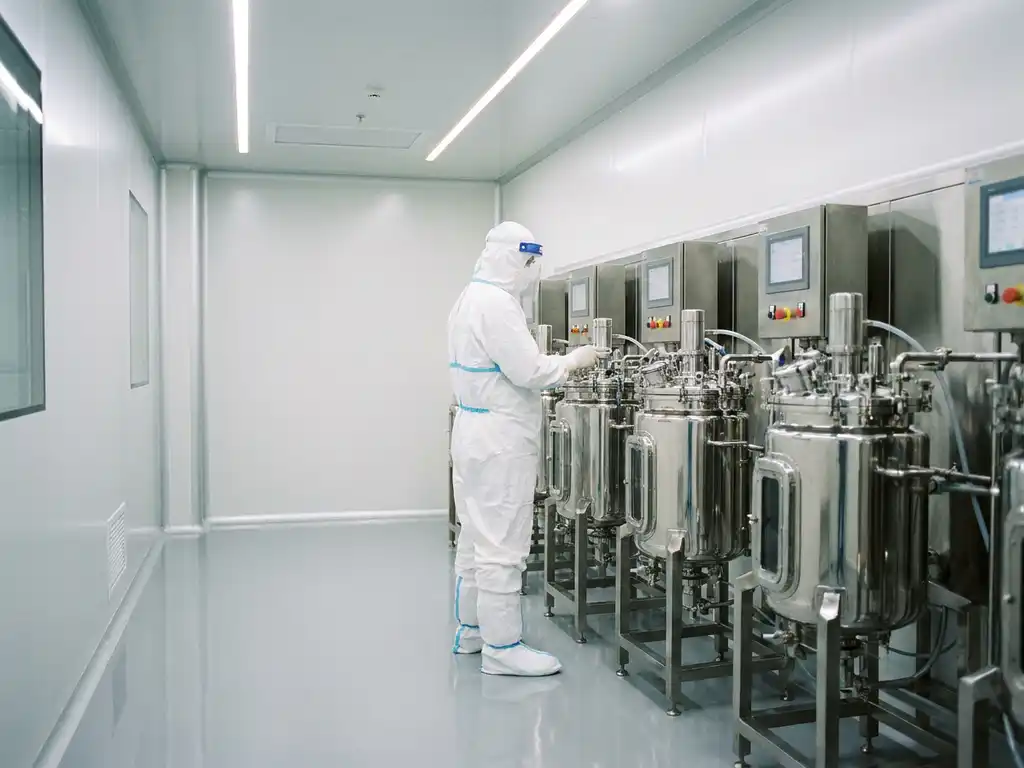
Biologics manufacturing operates under some of the most rigorous contamination control requirements in any regulated industry. Because biologics are derived from living organisms, they are inherently sensitive to microbial, particulate, and cross-contamination risks that can compromise product safety and patient outcomes. The sections below address the key questions that quality, EHS, and facilities managers face when designing or auditing contamination control programmes in biologics facilities.
What regulatory standards govern contamination control in biologics manufacturing?
Contamination control in biologics manufacturing is governed by a combination of international GMP frameworks, national regulatory requirements, and ISO cleanroom standards. The primary frameworks include EU GMP Annex 1 (revised in 2023), FDA 21 CFR Parts 210 and 211, and ICH Q10. Together, these define the environmental conditions, monitoring obligations, and contamination prevention strategies that biologics manufacturers must maintain.
EU GMP Annex 1 introduced the concept of a Contamination Control Strategy (CCS), a documented, facility-wide approach that requires manufacturers to identify contamination risks, assign controls, and demonstrate ongoing effectiveness. This is not a checklist exercise. It demands that every control measure, from air handling to floor-level hygiene, is justified and validated.
ISO 14644 standards provide the technical classifications for cleanroom environments, defining acceptable airborne particulate limits by grade. For biologics specifically, microbial contamination limits are equally important, and these are addressed through EU GMP Grade classifications (A through D) and their FDA equivalents. Regulatory inspectors from the EMA, FDA, and national competent authorities routinely assess whether contamination control measures are proportionate to the risk profile of the product being manufactured.
What are the main contamination risks specific to biologics production?
The main contamination risks in biologics production are microbial contamination, cross-contamination between products or batches, and particulate introduction from personnel and equipment. Because biologics rely on living cell systems, even low levels of microbial ingress can compromise culture integrity, affect product yield, or introduce endotoxins that are difficult to remove from the final product.
Unlike small-molecule pharmaceuticals, biologics cannot always be terminally sterilised. This makes upstream contamination prevention critical rather than optional. The risks include:
- Microbial ingress from personnel movement, equipment transfer, and facility entry points
- Particulate contamination carried in on shoes, wheels, and clothing
- Cross-contamination between different biological agents or production batches
- Endotoxin introduction from gram-negative bacterial contamination
- Viral contamination, particularly relevant in mammalian cell culture facilities
Personnel remain the single largest source of contamination in controlled environments. Every entry and exit point represents a potential pathway for contaminants to migrate from uncontrolled areas into classified zones. Robust entry-point protocols are therefore a foundational element of any biologics contamination control programme.
How are cleanroom classifications applied in biologics facilities?
Cleanroom classifications in biologics facilities are applied according to the activity performed and the risk it presents to the product. EU GMP Grades A through D correspond to specific operations, with Grade A reserved for the highest-risk activities such as aseptic filling and open product handling, and Grade D used for preparatory or support operations with lower direct product exposure.
EU GMP Grade definitions for biologics
Grade A is the critical zone for aseptic processing, typically achieved within a laminar airflow workstation or isolator. Grade B is the background environment for Grade A operations. Grades C and D are used for less critical processing steps, including the preparation of materials that will undergo further sterilisation.
ISO 14644 classifications and their relationship to GMP grades
ISO 14644-1 classifications run from ISO Class 5 (equivalent to EU Grade A/B) through to ISO Class 8 (broadly equivalent to Grade D). Biologics facilities must map their operations against both classification systems, particularly when supplying products to both EU and US markets, where regulatory expectations may be expressed differently but are broadly aligned in practice.
Classification is not a one-time designation. Facilities must demonstrate ongoing compliance through environmental monitoring programmes that track airborne particulates, viable organisms, and surface contamination across all classified zones.
How does floor-level contamination enter biologics cleanrooms?
Floor-level contamination enters biologics cleanrooms primarily through footwear and wheeled equipment carrying particles, microorganisms, and debris from less controlled areas. Research and industry experience consistently indicate that up to 80% of contamination entering controlled environments arrives at floor level, making entry-point floor hygiene a critical and often underestimated control measure.
In a biologics facility, the pathways for floor-level contamination include:
- Personnel walking from corridors, gowning rooms, or external areas into classified zones
- Trolleys, carts, and equipment wheels transferring contamination across zone boundaries
- Material transfer routes where packaging or containers are moved between areas of different classification
The challenge is that floor-level contamination is often invisible. Particles and microorganisms carried on shoe soles or wheel surfaces are not detectable without monitoring, yet they can migrate across zone boundaries and settle on critical surfaces or into open product. This is why the floor at every entry point to a classified zone requires an active, validated control measure, not simply a visual inspection protocol.
What contamination control measures are required at facility entry points?
At facility entry points, contamination control measures typically include gowning procedures, airlocks or change rooms, and physical decontamination of footwear and wheels before personnel or equipment enter classified zones. The specific measures required depend on the grade of the zone being entered and the risk assessment documented in the facility’s Contamination Control Strategy.
For pedestrian entry points into Grade C and D areas, high-performance contamination control mats are a validated and widely adopted solution. These mats capture particulate and microbial contamination from shoe soles before personnel cross into the controlled environment. For wheeled equipment, equivalent solutions must be applied at transfer points to prevent wheel-borne contamination from bypassing other controls.
Footbaths and disposable sticky mats have historically been used at entry points, but both have limitations. Footbaths introduce a liquid contamination risk and require careful management to remain effective. Disposable sticky mats lose adhesive performance rapidly under heavy traffic, generate significant single-use plastic waste, and provide inconsistent results across a shift. Reusable polymeric contamination control mats address these limitations by maintaining consistent particle capture performance over an extended lifespan, with built-in antimicrobial protection that inhibits microbial growth on the mat surface itself.
How should contamination control systems be validated and monitored in biologics plants?
Contamination control systems in biologics plants should be validated by demonstrating that each measure performs as intended under representative operating conditions, and monitored through ongoing environmental monitoring programmes that detect deviations before they affect product quality. EU GMP Annex 1 requires that the CCS is not only implemented but continuously reviewed and updated based on monitoring data and trend analysis.
Validation of entry-point contamination control measures, including floor mats, should include evidence of particle capture performance, antimicrobial efficacy, and durability under the traffic volumes typical of the facility. Monitoring should then track whether environmental contamination levels in classified zones remain within specification, with any excursions triggering root cause investigation.
Key elements of an effective monitoring programme include:
- Regular surface sampling at entry points and within classified zones to detect microbial contamination
- Airborne particulate monitoring at defined locations and frequencies according to ISO 14644-2
- Trend analysis to identify gradual deterioration in environmental performance before a formal excursion occurs
- Periodic requalification of contamination control measures following changes to facility layout, traffic patterns, or product
Documentation is equally important. Regulators expect to see not only that controls are in place, but that their effectiveness has been demonstrated and is being maintained. A well-documented CCS, supported by monitoring data, is one of the strongest indicators of a mature quality culture during an inspection.
How Dycem supports contamination control in biologics facilities
Dycem’s reusable contamination control mat systems are used by leading biologics and pharmaceutical manufacturers worldwide to address the entry-point contamination risks described throughout this article. With over 60 years of industry expertise, Dycem provides validated, evidence-based solutions that integrate directly into a facility’s Contamination Control Strategy.
Dycem’s contamination control mat range addresses the full range of entry-point scenarios in biologics facilities:
- Dycem CleanZone captures up to 99.9% of shoe and wheel contaminants at pedestrian and light-traffic entry points, including cleanroom entrances, gowning rooms, and airlocks
- Dycem WorkZone handles heavy-wheeled traffic including forklifts and pallet trucks, maintaining contamination control at material transfer points without disrupting operations
- Dycem Floating Mats provide flexible, repositionable coverage for facilities with variable or temporary zone configurations
- All Dycem mats incorporate Biomaster antimicrobial protection, a 3 to 5 year lifespan, and ISO-certified manufacturing, supporting validation requirements and audit readiness
- Dycem mats are a more sustainable alternative to disposable sticky mats, significantly reducing single-use plastic waste across a facility
Dycem’s contamination control specialists offer a consultative approach, starting with a free site survey to assess your facility’s specific risk profile and entry-point requirements. To discuss your biologics facility’s contamination control needs, contact a Dycem specialist today.