

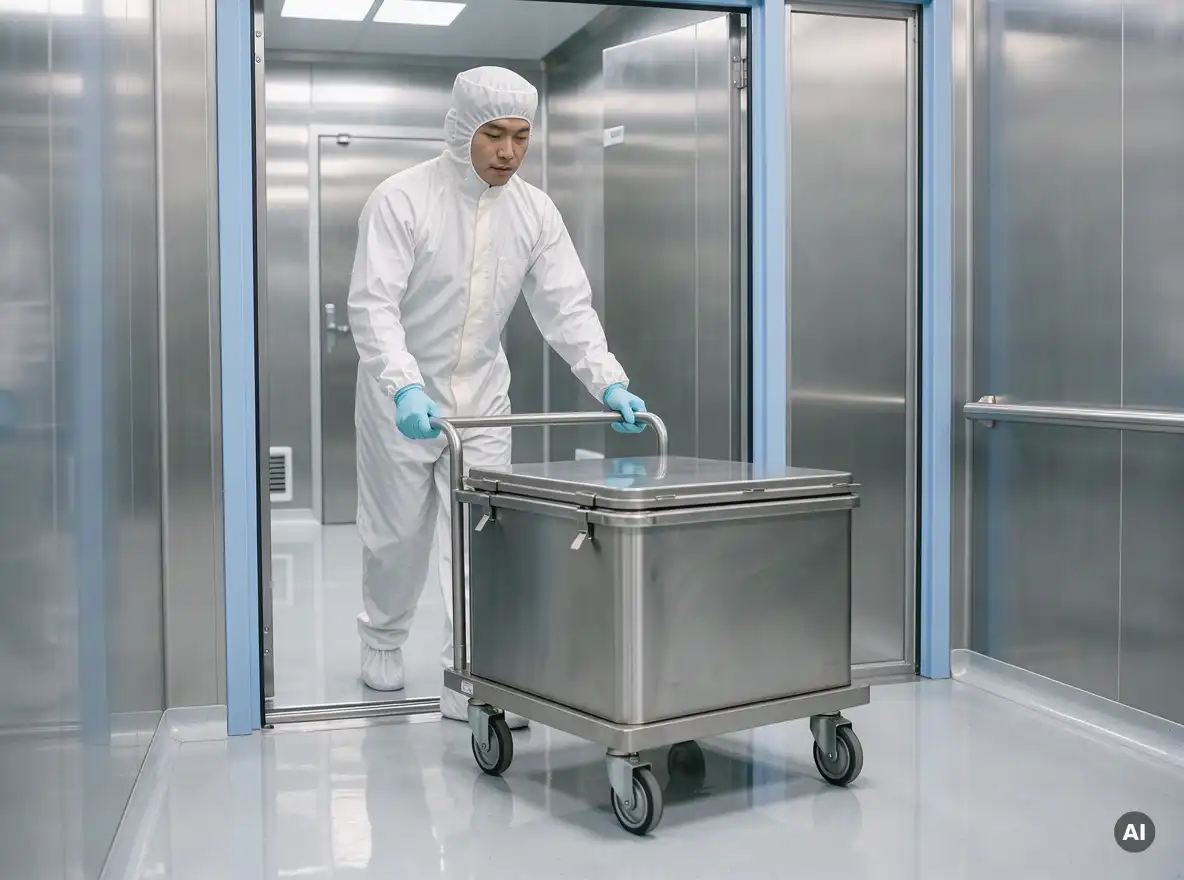
Pharma contamination in material airlocks is mostly a transfer problem. Particles ride in on cartons, pallets, trolleys and operators, and the airlock either contains them or passes them on to the next grade. The questions below cover each pathway in turn.
Where do particles enter a material airlock?
Particles enter a material airlock through four main routes: the surfaces of incoming materials and their packaging, the wheels of trolleys and pallet trucks, operators’ footwear and garments, and air movement when doors are opened or cycled incorrectly. Most of these routes meet at floor level.
Incoming goods carry dust from warehouses, shipping cartons, pallet wood and outer wrapping. Wheeled equipment is often overlooked, yet every trolley wheel picks up particulate from the less clean side and deposits it on the airlock floor, where it is redistributed by the next movement. Operators add fibres and floor-borne dirt from their shoes. Pressure differentials and door interlock failures can then allow particulate to move across the boundary.
Understanding the distinction between contamination and cross-contamination helps frame the risk here. The article on contamination versus cross-contamination in pharma explains why a material airlock is a critical point for both.
How should materials be decontaminated before entering the airlock?
Materials should be decontaminated in stages: remove outer shipping packaging and transit debris in a lower-grade area, wipe or spray remaining surfaces with a validated disinfectant or sporicidal agent, allow the specified contact time, then transfer items through the airlock onto clean carriers. Each step should follow a written, validated procedure.
Practical points that improve results:
- Strip outer layers early. Cardboard and wood shed fibres and should not enter higher-grade areas. Transfer products into cleanroom-suitable containers or double-bagged packaging where the process allows.
- Match the agent to the grade. Sterile disinfectants and sterile wipes are typically expected where materials move toward Grade A or B areas. Agent rotation, where used, should follow your contamination control strategy and be supported by validation data.
- Respect contact time. Wiping and walking away is not decontamination. The agent must remain wet on the surface for its validated duration.
- Use dedicated carriers. Moving items from a dirty trolley to a clean trolley inside the airlock prevents wheel-borne particulate from crossing the barrier.
For sterile manufacturing, the approach should align with your site’s contamination control strategy. Dycem’s guide to a contamination control strategy under EU GMP Annex 1 sets out how individual measures fit together. Annex 1 applies specifically to sterile medicinal product manufacturing; non-sterile facilities should follow the requirements relevant to their own operations.
What airlock design features limit particle transfer?
The most effective airlock design features are interlocked doors that cannot open simultaneously, a pressure strategy that directs airflow in line with contamination control and containment needs, smooth and cleanable surfaces, a clear division between dirty and clean zones, and enough dwell space to complete decontamination without rushing.
Design choices worth reviewing include:
- Interlocks and visual indicators. Interlocks prevent open-door conditions, while door status lights and alarms help operators follow the sequence.
- Pressure differentials. A defined pressure cascade between grades usually keeps air moving from the cleaner area toward the less clean area. The right strategy depends on your product, process and any containment requirements, so there is no single universal value. Pressure should be monitored and alarmed, not assumed.
- Cleanable construction. Coved corners, sealed joints and non-shedding wall and ceiling finishes remove places where particulate can accumulate.
- Pass-through options. Where volumes justify it, a pass-through hatch or dedicated material airlock reduces the number of personnel and pieces of equipment entering the clean side.
- Appropriate classification. The airlock grade should suit the rooms on either side. For background on grade definitions, see the difference between Grade A and Grade B cleanroom environments. EU GMP grades and ISO 14644-1 classes are related but not interchangeable.
Design controls manage airflow and surfaces, but they do not remove particulate that arrives stuck to a wheel or shoe sole. That requires a dedicated floor-level measure.
How do you stop wheels from carrying contamination into the airlock?
You reduce wheel-borne contamination by placing a contamination control surface at the threshold that wheels must cross, so particulate is captured before it reaches the airlock floor. Complement this with dedicated trolleys for each side and a routine for cleaning wheels and carts.
Floor-level contamination is a major pathway into controlled spaces, and wheeled traffic is difficult to manage because wheels pick up particulate continuously. Two approaches are commonly compared.
Sticky peel-off mats
Disposable sticky mats capture particulate while their top sheet is fresh, but performance falls as layers fill and they must be peeled and replaced frequently. Used sheets create waste, and peeling introduces its own handling steps. Dycem’s overview of sticky mats compares them with reusable alternatives.
Reusable polymeric contamination control flooring
Reusable polymeric mats attract and retain particulate from footwear and wheels and are cleaned in place rather than discarded. Dycem CleanZone is designed for pedestrian and light-wheeled traffic at entry points such as gowning rooms, cleanroom entrances, corridors and airlocks, which suits most trolley-based material transfer. Dycem reports that its mats capture up to 99.9% of particles from footwear and wheels under its own test conditions; results in a given facility will vary with traffic, cleaning routine and conditions of use. The surface also carries Biomaster silver-ion antimicrobial protection. Antimicrobial protection supports hygiene but does not replace cleaning, disinfection or environmental monitoring, and a contamination control mat does not by itself ensure regulatory compliance.
Where airlocks handle pallet trucks or forklifts, heavy-wheeled industrial traffic needs a different specification, and a site assessment should confirm the right product for the load.
What cleaning and monitoring routines keep the airlock under control?
Keep a material airlock under control with scheduled cleaning of floors, walls and surfaces using validated agents, regular cleaning of contamination control mats, and environmental monitoring that tracks particles and microbial counts against alert and action limits. Routines must be documented, taught and reviewed against trends.
A workable routine includes:
- Define frequencies by risk. High-traffic airlocks may need cleaning at the end of each shift or after defined volumes of movement, with deeper cleaning on a set schedule. Frequencies should be justified by risk assessment and monitoring data rather than assumed.
- Clean top to bottom, clean to dirty. Work from ceilings and walls down to the floor, and from the cleaner side toward the less clean side.
- Maintain mats to specification. Reusable mats retain their performance only when cleaned as instructed. Follow the manufacturer’s Dycem cleaning guidance and schedule.
- Monitor airborne and microbial contamination. Non-viable particle counts show airborne particulate, while viable monitoring, such as active air sampling, settle plates and surface sampling, detects microbial contamination. Active air sampling and settle plates are complementary rather than interchangeable. The difference is explained in viable versus non-viable particle monitoring.
- Review trends, not just results. A gradual rise in counts near the airlock often points to a procedural or maintenance issue before a limit is breached.
Where a facility already uses contamination control mats and wants evidence of how they are performing, particle collection efficiency testing provides objective data rather than visual judgement.
What are the most common airlock procedural mistakes?
The most common procedural mistakes in pharmaceutical material airlocks are overriding or bypassing interlocks, skipping disinfectant contact time, moving the same trolley between dirty and clean sides, overloading the airlock, and letting cleaning of floors and mats slip when production is busy.
Other frequent errors include:
- Propping doors or opening both at once to speed up deliveries, which removes the pressure and interlock protection.
- Stacking incoming materials so that cartons block airflow or cleaning access.
- Leaving packaging in the airlock because disposal is inconvenient.
- Treating a mat as maintenance-free. A contamination control surface that is overdue for cleaning will not perform as intended.
- Inconsistent training. Temporary staff and contractors often receive less instruction than permanent operators, yet they frequently move materials.
- Ignoring near misses. Minor alarms and small excursions are early warnings that should feed into deviation and trend reviews.
Most of these mistakes are driven by time pressure, so procedures should be realistic for the throughput the airlock actually handles. If throughput has grown, the airlock layout and routines should be reassessed rather than stretched.
Reducing particle transfer through a material airlock depends on layering controls: clean materials in, a well-designed airlock, a captured floor-level pathway, disciplined cleaning and meaningful monitoring. Facilities planning a new airlock or reviewing an existing one can arrange a complimentary Dycem site survey to map traffic flow, identify transfer points and recommend where floor-level contamination control fits within the wider strategy.
Frequently Asked Questions
What should I do if environmental monitoring shows a rise in particle counts near the airlock?
Treat it as an early warning and investigate before an action limit is breached. Check pressure differentials, interlock function, recent changes in material volume, cleaning records, and the condition of mats and trolley wheels. Review the trend alongside viable and non-viable data, record any deviation, and implement corrective actions such as retraining or increased cleaning frequency.
Can I use the same trolleys on both sides of the airlock if I clean the wheels?
It is best avoided. Cleaning wheels is helpful, but it is hard to verify that every wheel and axle is consistently decontaminated, especially under time pressure. Using dedicated trolleys for each side and transferring goods onto clean carriers inside the airlock is a more reliable control. If shared equipment is unavoidable, validate the wheel-cleaning procedure and combine it with a threshold contamination control surface.
How can I keep temporary staff and contractors compliant with airlock procedures?
Include airlock behaviours in induction training, and require sign-off before anyone moves materials unsupervised. Use clear visual aids at the airlock, such as sequence diagrams, door status lights, and floor markings showing clean and less clean zones. Review deviations involving temporary staff during trend meetings and refresh training when patterns emerge.