

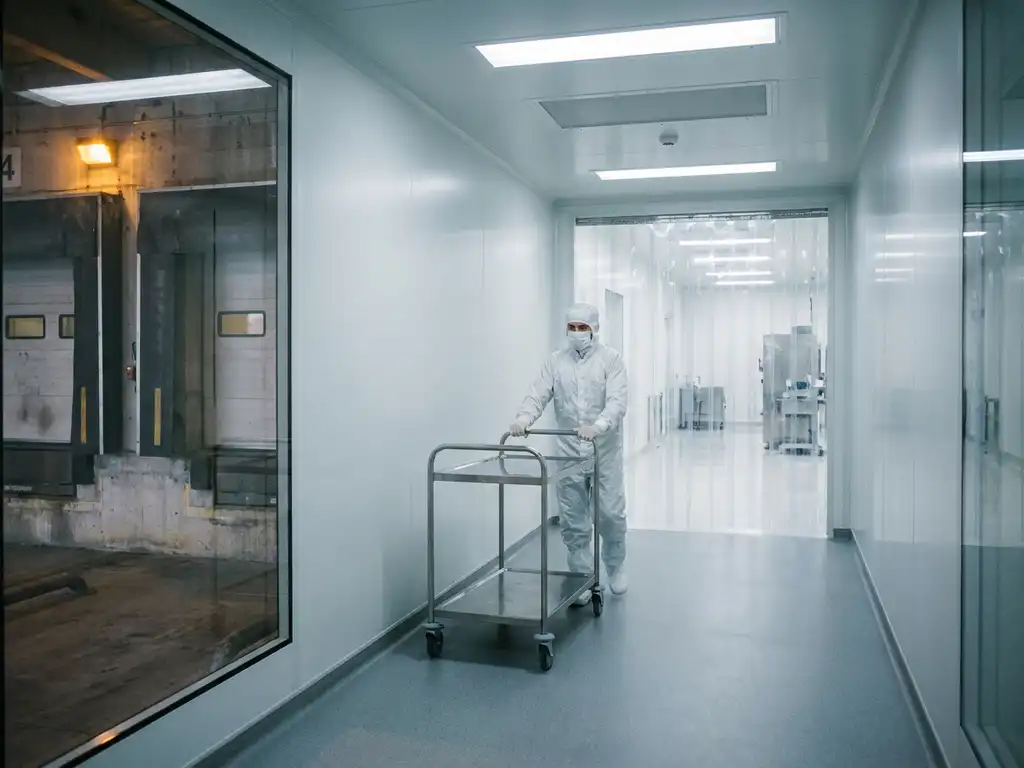
Contamination travels from loading docks to cleanroom floors through a chain of physical transfer events driven almost entirely by foot and wheel traffic. Particles picked up at the dock attach to shoe soles, cart wheels, pallet trucks, and packaging materials, then migrate inward through corridors, staging areas, gowning rooms, and airlocks until they reach the most sensitive zones in your facility. Understanding each link in that chain is the first step toward breaking it.
Where do contaminants actually enter a facility?
The primary contamination entry points in any facility are loading docks, personnel access doors, raw material intake areas, and utility access points. Of these, loading docks represent the highest-risk zone because they combine high traffic volume, external exposure, and frequent movement of large equipment, all of which introduce particles from the outside environment in significant quantities.
Loading docks are open to the external environment for extended periods. During deliveries, dock doors remain raised, exposing the interior to outdoor air, vehicle exhaust particulates, and debris carried in on tyres and pallets. Personnel moving between the dock and internal areas carry that contamination with them on every step they take. Raw materials and packaging arriving from external suppliers also introduce particles, microorganisms, and chemical residues that were never part of your controlled environment.
Personnel entry doors present a secondary but persistent risk. Staff arriving for shifts, contractors, and visitors all bring outdoor contamination directly into reception and staging areas. Without structured decontamination protocols at these points, the facility’s internal environment is constantly refreshed with external particles.
How do contaminants move from loading docks toward cleanrooms?
Contaminants move from loading docks toward cleanrooms primarily through mechanical transfer, meaning particles are physically carried inward on shoe soles, wheel surfaces, clothing, and packaging. Each footstep or wheel rotation deposits some particles and picks up others, creating a progressive contamination pathway that follows the most-travelled routes through a facility.
The mechanism is straightforward but easy to underestimate. A forklift collecting goods from the dock carries dock-floor contamination on its tyres into the warehouse. A warehouse operative then walks through the same area, picking up particles on their shoes. That person may then enter a staging corridor, a changing room, or a pre-cleanroom area before any decontamination step occurs. At each transition, contamination migrates further inward.
Airborne dispersion compounds the problem. When personnel and equipment move quickly through corridors, they disturb settled particles, lifting them back into the air where they can travel further before resettling. High-traffic periods, such as shift changes and delivery windows, create repeated disturbance events that sustain airborne particle counts well above baseline levels throughout the day.
What types of contaminants are most commonly tracked in from docks?
The most common contaminants tracked in from loading docks are particulate matter, including dust, soil, and grit; biological contaminants such as bacteria, mould spores, and allergens; and chemical residues from vehicle exhaust, packaging materials, and external surfaces. The specific mix depends on the facility’s geographic location, the nature of incoming materials, and the season.
Particulate contamination is the most consistent threat. Outdoor environments contain a broad range of particle sizes, and the coarser particles that settle on dock floors are exactly those most efficiently transferred by shoe soles and wheel treads. Soil and grit are abrasive and can also damage sensitive equipment if they reach production areas.
Biological contamination is a particular concern for pharmaceutical, food and beverage, and medical device manufacturers. Mould spores and bacteria are present in outdoor air and on packaging that has been stored in warehouses or transported in non-controlled conditions. Once inside a facility, these organisms can colonise surfaces and persist even after standard cleaning routines.
Chemical residues, including lubricants, cleaning agents from supplier facilities, and exhaust particulates, are less visible but equally problematic in precision manufacturing and electronics environments, where even trace contamination can compromise product integrity.
Why are corridor and gowning room floors critical contamination vectors?
Corridor and gowning room floors are critical contamination vectors because they are the last transition zones before a controlled environment and the points where contamination is most concentrated before personnel enter cleanrooms. If particles are not captured at these surfaces, they are carried directly onto cleanroom floors on shoe soles, gowning equipment, and equipment wheels.
Corridors function as the primary transport route for contamination moving inward from the dock. Every person and piece of equipment that travels this path deposits particles and redistributes those already present. Without active capture at the floor level, corridors accumulate contamination that is then redistributed with every subsequent pass.
Gowning rooms present a specific challenge because personnel change their footwear or don overshoes at this point, creating a direct transfer risk. The floor of a gowning room receives contamination from outdoor or warehouse footwear and, without effective control measures, that contamination transfers to the clean footwear or overshoes being applied. The result is that personnel effectively carry contamination into the cleanroom on the very items designed to protect it.
Industry experience consistently shows that up to 80% of contaminants entering controlled environments arrive at the floor level. This makes corridor and gowning room floors not a secondary concern but the primary battleground for contamination control.
What contamination control measures are used at facility entry points?
Facilities use a layered combination of physical barriers, procedural controls, and surface-level capture systems at entry points to interrupt contamination pathways. Common measures include sticky mat systems, antimicrobial contamination control mats, air showers, footwear change protocols, and gowning procedures, typically deployed in sequence across multiple transition zones.
Physical capture systems
Floor-level contamination capture is the most direct and consistently effective intervention. Reusable polymeric mats, such as those used in high-compliance environments, are engineered to remove particles from shoe soles and wheel surfaces through adhesion and mechanical entrapment. Placed at dock exits, corridor entry points, and gowning room floors, they intercept contamination before it progresses further inward. Unlike disposable peel-off sticky mats, which require frequent replacement and generate significant single-use plastic waste, reusable alternatives offer a more sustainable and cost-effective approach over a three-to-five-year lifespan.
Procedural and environmental controls
Air showers at cleanroom entry points use high-velocity filtered air to dislodge loose particles from gowning before personnel enter. Footwear change protocols enforce a physical break between external and internal footwear. Positive pressure differentials within cleanrooms prevent unfiltered air from flowing inward when doors are opened. These measures work most effectively when combined with floor-level capture systems, because no single control eliminates all contamination on its own.
How can facilities validate that contamination pathways are controlled?
Facilities validate contamination pathway control through a combination of environmental monitoring, particle counting, surface sampling, and periodic audits of entry point protocols. Validation is not a one-time exercise but an ongoing programme that confirms controls remain effective as traffic patterns, materials, and personnel change over time.
Environmental monitoring typically involves regular air particle counts at defined locations throughout the facility, from dock to cleanroom. Comparing particle counts at successive monitoring points reveals whether contamination is being captured at each transition zone or is migrating further inward than expected. A well-controlled facility will show a clear reduction in particle counts at each successive zone moving toward the cleanroom.
Surface sampling, including contact plates and swabs taken from floor surfaces, gowning room benches, and mat surfaces, provides evidence of biological contamination levels and confirms whether antimicrobial controls are functioning. Sampling data taken before and after contamination control measures are introduced provides a baseline for measuring the impact of specific interventions.
Audits of entry point protocols ensure that procedural controls are followed consistently. Even well-designed physical systems are undermined by inconsistent gowning practices, propped-open doors, or equipment bypassing decontamination zones. Regular observation and documented review of compliance with entry protocols is an essential part of any validated contamination control programme.
How Dycem helps control cleanroom contamination pathways
Dycem’s reusable contamination control mats are engineered to intercept contamination at every critical point along the pathway from loading dock to cleanroom floor. Where contamination pathways are most active, Dycem mats provide a validated, high-performance capture layer that reduces particulate and biological transfer before it reaches controlled environments. Key features include:
- Up to 99.9% capture of shoe and wheel contaminants, addressing the floor-level transfer that accounts for the majority of contamination entering controlled environments
- Built-in Biomaster antimicrobial protection across all mat formats, providing continuous suppression of biological contamination between cleaning cycles
- Purpose-built formats for every zone — Dycem CleanZone for gowning rooms, airlocks, and cleanroom corridors; Dycem WorkZone for dock exits and heavy-wheeled traffic routes; and Dycem Floating Mats for flexible or temporary decontamination zones
- Reusable construction with a three-to-five-year lifespan, replacing the ongoing cost and waste of disposable sticky mat programmes
- ISO-certified manufacturing aligned with GMP, FDA, and ISO cleanroom compliance requirements
Dycem’s contamination control specialists work with Quality, EHS, and Facilities teams to map contamination entry points, recommend the right mat configuration for each zone, and support validation programmes with documented performance data. Explore the full range of contamination control mat solutions or contact a Dycem specialist to arrange a free site survey and consultation.