

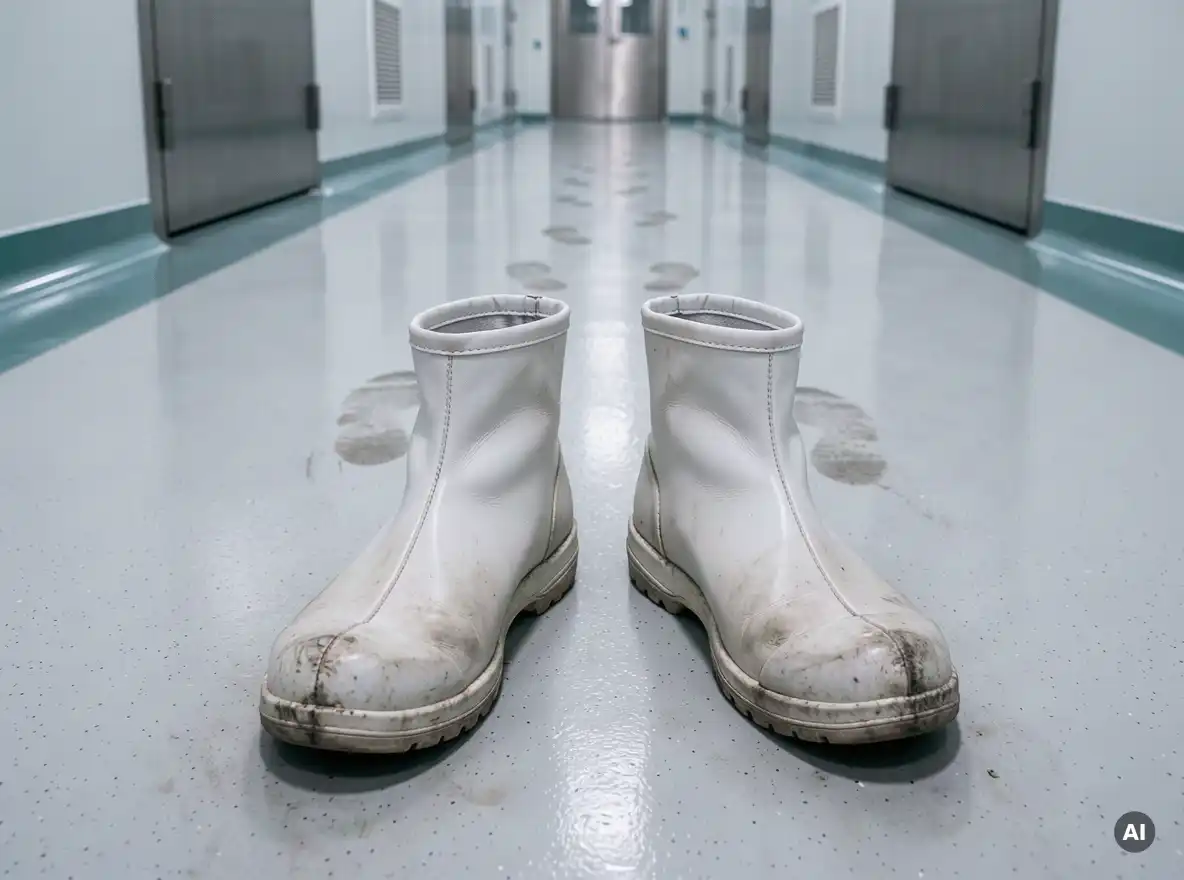
Dirt buildup reduces the performance of reusable contamination control mats because captured particles cover the polymer surface, leaving fewer exposed sites to attract and retain new contaminants from footwear and wheels. A saturated mat captures less and, if left uncleaned, can transfer material back onto passing traffic. Regular, correct cleaning exposes fresh polymer and restores capture performance.
Why do mats lose tackiness as particles accumulate?
Reusable polymeric mats lose tackiness because captured particles physically cover the polymer surface. Once the contact area is occupied by dust, fibres and debris, fewer sites remain to attract and hold new particles from shoes and wheels. Capture efficiency falls as the surface fills, even though the underlying material is unchanged.
Polymeric contamination control mats work by contact. Particles carried on footwear or wheels touch the surface and are retained there instead of being tracked further into the facility. This mechanism depends on exposed polymer. Each captured particle takes up a small area of that surface, and over time a layer of contaminants builds up and screens the polymer beneath.
Several factors determine how quickly this happens:
- Traffic volume: more footfall and wheeled movement deliver more particles to the surface in a shorter time.
- Contaminant type: fine dust, fibres and oily residues cover the surface differently, and sticky or greasy films can reduce effectiveness faster than dry dust.
- Upstream conditions: the cleanliness of adjacent corridors and uncontrolled areas determines how much load reaches the mat.
- Cleaning routine: inconsistent or ineffective cleaning allows residues to accumulate and compound.
This is a cleaning matter, not a sign of product failure. The reusable design means the captured layer can be removed to expose the polymer again. That is a key difference from disposable sticky mats, where the only way to refresh the surface is to peel off a sheet and discard it.
What are the warning signs of a saturated mat?
A saturated mat typically shows visible dirt coverage across the surface, a dull or discoloured appearance, and debris that is no longer retained but lifts or spreads. Footprints and wheel tracks may appear beyond the mat’s edge, which indicates it is no longer stopping contamination at the point of entry.
Visual inspection is the first line of defence. Look for these indicators during routine walk-rounds:
- A heavy, uniform layer of dust or debris covering the surface.
- Visible discolouration compared with a freshly cleaned mat.
- Debris on the floor immediately beyond the mat, suggesting particles are passing through the entry point.
- Footprints or wheel marks continuing onto the clean side after crossing the mat.
- A surface that appears less responsive to light contact than it did after its last clean.
Visual checks are useful but subjective. For facilities with formal contamination control strategies, mat condition can also be reviewed alongside environmental monitoring results, since a rise in particulate counts near an entry point may point to a saturated surface. Airborne particle counts are only an indirect indicator, however, and they do not measure the mat’s own capture performance. Where objective evidence is needed, particle collection efficiency testing can measure how well an in-service mat is still performing.
Can a dirty mat become a contamination source?
Yes. A mat saturated with contaminants and left uncleaned can stop capturing new particles and may allow material already on its surface to be transferred onto passing shoes or wheels. A neglected mat therefore stops protecting the area behind it and can contribute to floor contamination instead.
The risk is straightforward. A mat is a collection point, and a collection point that is never emptied eventually stops functioning as intended. Once the surface is covered, additional traffic can pick up loose debris and carry it further into the facility, which defeats the purpose of placing the mat at the entrance.
There is an important distinction between particulate loading and microbial growth. Dycem mats incorporate Biomaster silver-ion technology, which inhibits microbial growth on the mat surface. Antimicrobial protection does not replace cleaning, disinfection or environmental monitoring, however. It is a supplementary feature, and a heavily soiled mat still needs to be cleaned and, where appropriate, disinfected as part of the facility’s validated procedures. Understanding this relationship is also central to broader thinking about contamination and cross-contamination in regulated environments.
How do you clean a reusable mat to restore performance?
Clean a reusable polymeric mat by following the manufacturer’s cleaning guidance: apply a suitable cleaning solution, agitate the surface, remove the dissolved dirt, rinse, and allow the mat to dry before returning it to service. A correct clean exposes fresh polymer and restores capture performance.
Cleaning procedures should always follow the specific instructions for the product and the facility’s own approved methods. A typical sequence looks like this:
- Prepare the area: arrange the cleaning so that traffic is managed and the mat can be fully treated without being walked on mid-process.
- Apply the approved cleaning solution: use the agent recommended for the mat and compatible with the facility’s requirements.
- Agitate the surface: use a suitable soft brush or pad to loosen embedded particles without damaging the polymer.
- Remove the dirt: lift away the dirty solution using a wet vacuum, mop or equivalent method acceptable in the controlled area.
- Rinse and dry: remove cleaning residues and allow the surface to dry completely before use.
- Inspect: confirm that the surface is visibly clean and restored before putting the mat back into service.
Dycem publishes detailed guidance on cleaning Dycem mats, and facilities should treat it as the reference point. Cleaning chemistry, tools and methods inside cleanrooms and other regulated areas should also be consistent with the site’s own validated procedures.
How often should mats be cleaned in busy facilities?
Mats in busy facilities typically need cleaning more frequently than those in low-traffic areas, and the right interval depends on traffic volume, contaminant load and the sensitivity of the area. There is no single universal schedule or regulatory requirement for mat cleaning frequency, so facilities should set it based on observation and risk assessment.
Rather than relying on a fixed calendar alone, build the schedule around evidence from the site:
- Start with a baseline: choose an initial frequency based on expected traffic and the criticality of the entry point.
- Observe the surface: record how quickly the mat shows visible loading between cleans.
- Adjust by zone: entrances from uncontrolled areas and high-traffic corridors usually need shorter intervals than internal low-traffic locations.
- Link to monitoring: use environmental monitoring trends and audit findings to confirm the interval is effective.
- Document the routine: include mat cleaning in standard operating procedures so it is consistent and auditable.
Entry points to sensitive areas, such as gowning rooms, airlocks and cleanroom entrances, are typically where a disciplined routine matters most. For a structured view of how floor-level controls sit within a wider framework, see this overview of a contamination control strategy under EU GMP Annex 1, which applies specifically to sterile medicinal product manufacture. Contamination control mats support such a strategy but do not replace other essential measures, and they do not on their own ensure regulatory compliance.
Does cleaning frequency differ for CleanZone and WorkZone mats?
Yes, cleaning frequency can differ because the two products serve different traffic types. CleanZone is designed for pedestrian and light-wheeled traffic, while WorkZone is built for heavy-wheeled industrial traffic such as forklifts and pallet trucks. The heavier and more varied loads in WorkZone areas often mean different contaminant levels and different cleaning demands.
Dycem CleanZone is typically installed at critical entry points such as gowning rooms, cleanroom entrances, corridors and airlocks. Contamination here is dominated by particles carried on footwear and light trolleys, and the cleaning schedule is usually driven by the sensitivity of the area behind the mat.
Dycem WorkZone operates in logistics and production areas where heavy wheels deposit larger volumes and a wider range of debris. These areas can load a surface faster, so cleaning routines may need to be more frequent or more robust, and the specific method should follow product guidance.
Product specifications and cleaning instructions are not identical across ranges, so treat each mat type on its own terms. The most reliable approach is to agree a schedule with a contamination control specialist who can assess traffic patterns and recommend an appropriate routine for each zone.
Keeping floor protection consistent over time
Dirt buildup lowers the effectiveness of reusable contamination control mats, but it is a manageable and reversible condition. Knowing the warning signs, cleaning using the correct method, and matching frequency to traffic keep floor protection dependable and support hygiene objectives across the facility.
If you are unsure whether the mats currently in your facility are still performing as intended, arrange particle collection efficiency testing to get measured evidence of in-service performance.
Frequently Asked Questions
What should I do if a mat still looks dirty or feels less effective after cleaning?
First check that the correct cleaning solution and a suitable soft brush or pad were used, and that all dissolved dirt and cleaning residues were fully removed and the surface dried. Oily or greasy films can need a second pass or a different approved agent, so consult the manufacturer’s cleaning guidance. If performance remains poor after a thorough clean, particle collection efficiency testing can show whether the mat is still working as intended.
What are the most common mistakes when maintaining contamination control mats?
Common mistakes include relying on a fixed schedule without checking how fast the mat actually loads, cleaning only when the mat looks obviously filthy, using non-approved chemicals or tools, and letting the mat go back into service before it is fully dry. Another frequent error is treating antimicrobial properties as a substitute for cleaning, when a soiled mat still needs to be cleaned regardless. Documenting the routine and reviewing it against monitoring results helps avoid all of these.
Should cleaning frequency change if traffic patterns or processes in my facility change?
Yes. A new production line, higher forklift or trolley movement, building work nearby, or a change in the cleanliness of adjacent corridors can all increase the load reaching the mat. Review your schedule whenever these changes occur, and use observation of how quickly the surface loads, along with monitoring data, to decide whether to shorten the interval for that zone.