

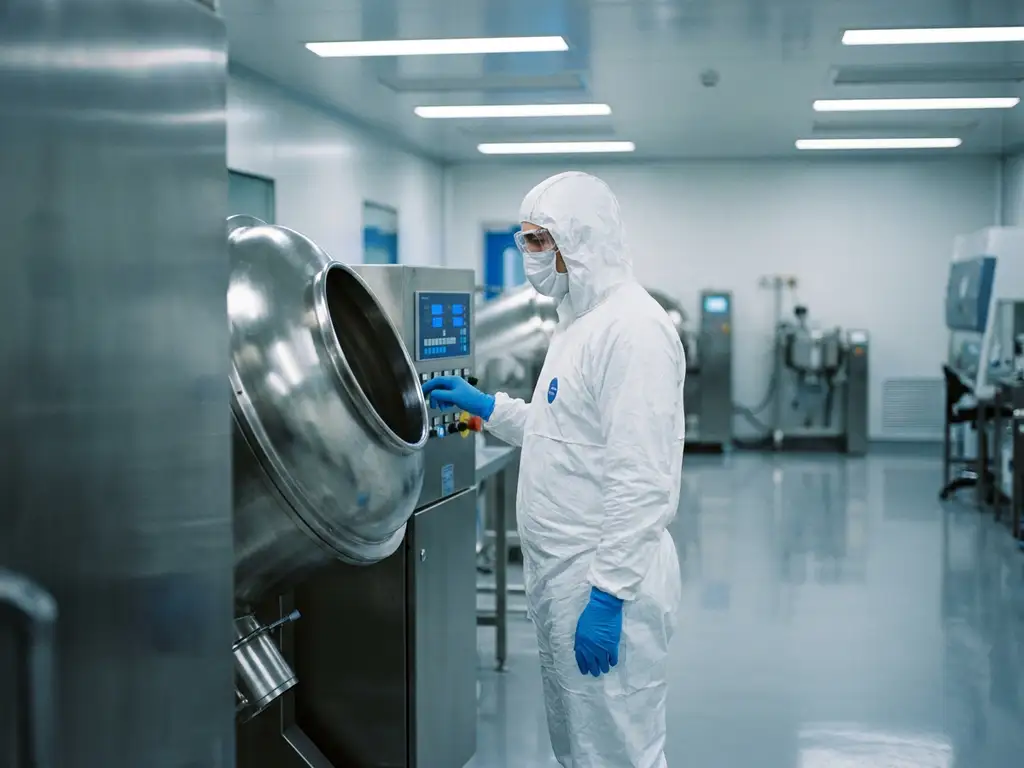
Granulation is one of the highest-risk stages in solid dose pharmaceutical manufacturing for contamination. The process involves size reduction, wet or dry agglomeration, and drying — each step generating fine particulate matter, aerosols, and residual active pharmaceutical ingredients (APIs) that can migrate beyond the immediate processing area. Solid dose facilities operating under GMP must treat granulation suites as active contamination sources, not passive spaces, and manage them accordingly. The questions below address the specific contamination risks that arise at each stage of the granulation process and the controls that reduce them.
What types of contaminants are introduced during granulation?
Granulation introduces several categories of contaminants into a manufacturing environment, including residual API particles, excipient dust, microbial matter, and equipment-derived debris. These contaminants are generated by the mechanical and thermal processes involved and can become airborne, settle on surfaces, or transfer via personnel and equipment movement.
The primary contamination types in granulation suites fall into three broad categories:
- Particulate contamination: Fine API dust and excipient particles generated during milling, blending, and drying stages. These particles are often sub-micron in size and remain airborne for extended periods before settling on floors, equipment, and gowning surfaces.
- Microbial contamination: Wet granulation processes introduce moisture, which creates conditions where microbial growth is possible if equipment is not thoroughly cleaned and dried between batches. Personnel entering and exiting the suite are a primary vector for introducing microorganisms.
- Chemical cross-contamination: Residual APIs or solvents from previous batches that have not been fully removed during cleaning. Even trace amounts of a potent compound can compromise product quality or patient safety in subsequent runs.
In high-potency API (HPAPI) manufacturing, particulate contamination carries particularly serious implications. Operators and quality teams must account for the fact that granulation equipment surfaces, air handling systems, and floor-level areas all accumulate contaminants simultaneously, requiring a coordinated approach to environmental monitoring and cleaning validation.
How does cross-contamination occur between granulation batches?
Cross-contamination between granulation batches occurs when residual material from one batch transfers into a subsequent batch through shared equipment, air circulation, or personnel movement. The most common pathways are inadequate equipment cleaning, insufficient airlock pressure differentials, and the physical transfer of particles on shoes, wheels, and clothing.
Granulation suites that process multiple products or formulations face the highest cross-contamination risk. Between-batch cleaning procedures must account for all contact surfaces, including the interior of granulators, mills, and fluid bed dryers, as well as the surrounding floor area and gowning zones. Cleaning validation data should confirm that residual API levels fall below established acceptable daily exposure (ADE) or permitted daily exposure (PDE) thresholds.
Air management is another critical factor. If pressure differentials between the granulation suite and adjacent corridors are not maintained correctly, airborne particles can migrate outward during door openings or equipment transfers. Facilities should verify that their HVAC systems sustain appropriate differential pressures throughout operational periods, not just under static conditions.
Equipment design also plays a role. Granulators with complex geometries or worn seals are harder to clean completely, increasing the likelihood that residual material survives cleaning cycles. Scheduled maintenance and equipment qualification programmes are essential components of a robust cross-contamination prevention strategy.
Why is personnel movement a contamination risk in granulation suites?
Personnel movement is a contamination risk in granulation suites because people are the most active and unpredictable vector for transporting particles into and out of controlled environments. Every time an operator enters or exits a granulation suite, they carry potential contaminants on their footwear, clothing, and skin, and they disturb settled particles through movement and air displacement.
Research across pharmaceutical manufacturing environments consistently identifies floor-level contamination as a dominant pathway for particulate ingress, with a significant proportion of contaminants entering controlled spaces via footwear. In granulation suites, this risk is compounded by the volume of fine dust generated during processing, which settles rapidly on floor surfaces and is then tracked outward by personnel.
Gowning procedures are designed to mitigate this risk, but their effectiveness depends entirely on consistent compliance. Operators who rush through gowning, re-enter suites after brief absences without fully regowning, or fail to use entry decontamination measures correctly can undermine even well-designed contamination control programmes. Training frequency, gowning audits, and observable compliance checks are all necessary to maintain standards in practice rather than only on paper.
The transition zones between uncontrolled and controlled areas — airlocks, gowning rooms, and corridor entry points — are where personnel-borne contamination is most effectively intercepted. These are the locations where floor-level decontamination measures have the greatest impact on reducing the particle burden carried into the granulation environment.
What are the regulatory consequences of granulation contamination?
Contamination identified during or after granulation can result in batch rejection, regulatory citations, manufacturing shutdowns, and, in serious cases, product recalls. Regulatory bodies including the FDA, EMA, and MHRA hold pharmaceutical manufacturers to strict contamination prevention standards under GMP frameworks, and granulation suites are subject to direct scrutiny during inspections.
FDA 483 observations and warning letters frequently cite inadequate contamination control procedures, particularly where cross-contamination between potent APIs and standard formulations is a concern. Facilities that cannot demonstrate validated cleaning procedures, effective environmental monitoring programmes, or documented personnel hygiene controls are at significant risk of enforcement action.
Beyond direct regulatory penalties, contamination events carry substantial commercial consequences. A single out-of-specification batch caused by cross-contamination can trigger investigations that halt production lines for days or weeks. If contamination is identified post-release, the costs of a recall, regulatory notification, and remediation are considerably higher than the investment required to prevent the event in the first place.
In 2026, regulatory expectations around contamination control documentation have continued to tighten, with agencies placing greater emphasis on risk-based approaches to contamination prevention. Facilities that can demonstrate proactive, evidence-based contamination management — rather than reactive responses to identified failures — are better positioned during inspections and audits.
How can entry point contamination control reduce granulation risk?
Entry point contamination control reduces granulation risk by intercepting particles at the boundary between uncontrolled and controlled areas before they can enter the processing environment. Effective decontamination at floor level, in airlocks, and at gowning room transitions significantly reduces the particle burden that personnel and equipment carry into granulation suites.
The floor is the primary accumulation point for particulate contamination in any manufacturing environment. Particles generated during granulation that escape the immediate processing area settle on corridor and gowning room floors, where they are then transferred inward by subsequent personnel movements. Addressing this pathway at the point of entry is more effective than relying solely on air handling systems or cleaning schedules to manage the cumulative particle load.
Contamination control mats positioned at critical entry points — including gowning room exits, airlock transitions, and granulation suite doorways — capture particles from footwear before they cross into controlled zones. This approach works in parallel with gowning protocols and HVAC management, creating a layered defence rather than a single point of control.
Wheel-borne contamination from carts, trolleys, and material handling equipment is an equally important consideration. Equipment moving between warehousing, dispensary, and granulation areas can carry significant particulate loads on wheels and frames. Entry point controls that address wheeled traffic as well as pedestrian movement provide more comprehensive risk reduction across the full range of contamination vectors.
What contamination control measures are best practice for granulation facilities?
Best practice contamination control in granulation facilities combines environmental monitoring, validated cleaning procedures, personnel hygiene protocols, and physical decontamination measures at controlled zone entry points. No single measure is sufficient on its own; effective contamination management requires all of these elements to function consistently and in coordination.
The following measures represent the established standard for granulation suite contamination control:
- Environmental monitoring programmes: Regular air and surface sampling to establish baseline contamination levels and detect deviations early. Monitoring should cover both operational and at-rest conditions.
- Cleaning validation: Documented, validated cleaning procedures for all granulation equipment, with residue limits based on ADE or PDE calculations for each API handled in the suite.
- Pressure differential management: Maintained and regularly verified pressure differentials between the granulation suite and adjacent spaces to prevent airborne particle migration.
- Gowning compliance: Structured gowning procedures with regular audits and training to ensure consistent application by all personnel, including visitors and maintenance staff.
- Entry point decontamination: Physical contamination control measures at all entry points to the controlled zone, targeting both footwear and wheeled equipment as primary particle transfer vectors.
- Waste and material flow management: Defined routes for raw materials, in-process goods, and waste to prevent uncontrolled movement between clean and less-controlled areas.
Facilities should review their contamination control programmes against current GMP guidance on a regular basis and incorporate findings from internal audits, deviations, and inspection outcomes into continuous improvement plans.
How Dycem supports contamination control in granulation facilities
Dycem’s reusable contamination control mat systems are designed to address the floor-level and entry point risks that contribute directly to granulation suite contamination. As part of a layered contamination control strategy, Dycem mats provide consistent, validated particle capture at the transitions where contamination is most effectively intercepted.
Dycem’s contamination control products are engineered specifically for the demands of pharmaceutical and regulated manufacturing environments:
- Dycem CleanZone mats are suited to pedestrian entry points including gowning rooms, airlocks, and critical corridor transitions — capturing fine particulate from footwear before it crosses into controlled zones.
- Dycem WorkZone mats handle heavy-wheeled traffic from carts, pallet trucks, and material handling equipment, addressing the wheel-borne contamination pathway that gowning protocols alone cannot manage.
- Dycem Floating Mats provide flexible, repositionable coverage for facilities with variable or temporary controlled zones, including those undergoing process changes or capacity expansion.
- All Dycem mats incorporate built-in Biomaster antimicrobial protection, are reusable across a 3 to 5 year lifespan, and are manufactured to ISO 9001 and 14001 standards — supporting both compliance documentation and sustainability objectives.
Unlike disposable sticky mats, Dycem’s reusable polymer construction eliminates the recurring cost and waste associated with peel-off mat programmes, offering a more sustainable and cost-effective solution over the long term. To understand how Dycem can be integrated into your granulation facility’s contamination control programme, speak to a contamination control specialist and arrange a free site survey.