

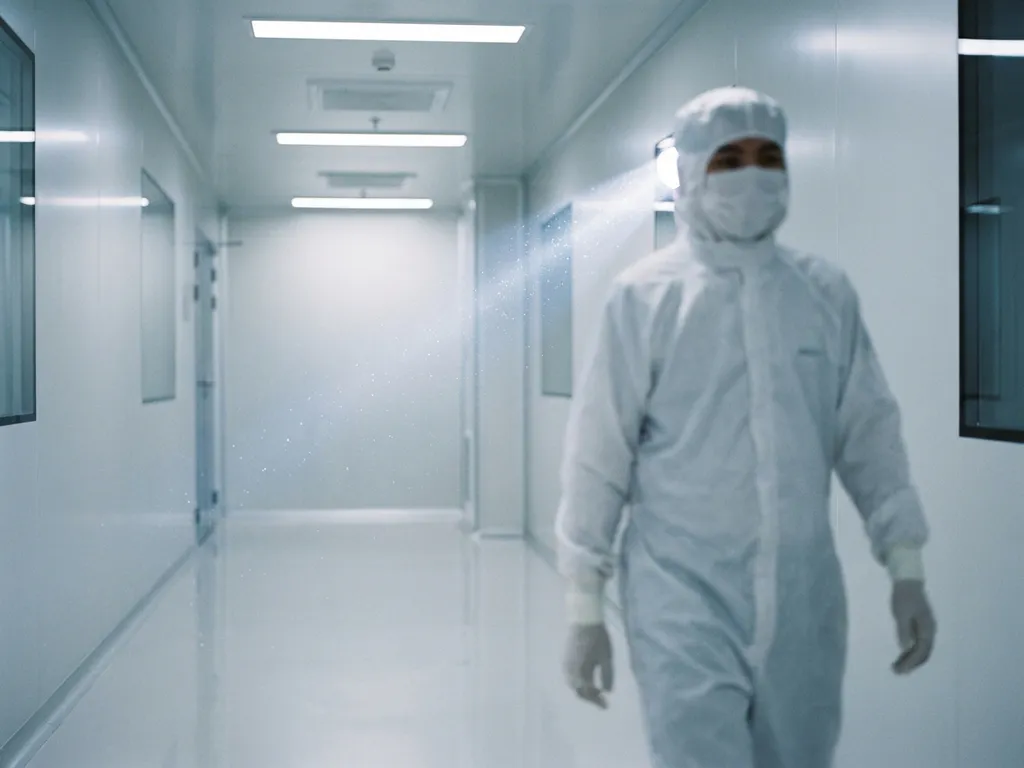
Particle shedding in pharmaceutical environments occurs when physical movement, equipment operation, and environmental disturbances release microscopic particles into the surrounding air and onto surfaces. These particles can originate from personnel, packaging materials, equipment, and the building fabric itself. Understanding the mechanisms behind particle release is essential for quality managers, EHS professionals, and facilities teams working to maintain cleanroom standards and meet regulatory requirements.
What are the main sources of particle shedding in pharmaceutical facilities?
The main sources of particle shedding in pharmaceutical facilities are personnel, equipment, raw materials, packaging, and the building structure itself. Human activity consistently generates the highest particle load, but mechanical processes, HVAC systems, and even cleanroom surfaces contribute to the overall contamination burden in controlled environments.
Each source introduces particles through a different mechanism, which is why effective contamination control requires a layered approach rather than a single intervention. Personnel shed skin cells, fibres from clothing, and respiratory particles continuously. Equipment generates wear debris, lubricant aerosols, and vibration-induced dust. Raw materials and packaging introduce external contaminants at every transfer point. Even the walls, floors, and ceilings of a facility can shed particulate matter over time as surfaces degrade or are subjected to cleaning processes.
In pharmaceutical manufacturing, where product sterility and purity are non-negotiable, identifying and managing each of these sources is a core function of the contamination control strategy. Regulatory frameworks such as EU GMP Annex 1 and ISO 14644 require facilities to demonstrate that particle levels remain within defined limits, making source identification a compliance requirement as much as an operational one.
How does human movement cause particle release in cleanrooms?
Human movement causes particle release in cleanrooms because the body continuously sheds skin cells, hair, and respiratory particles, while clothing fibres are dislodged with every motion. A person at rest generates tens of thousands of particles per minute; that figure increases dramatically with activity such as walking, reaching, or handling equipment.
The act of walking is particularly significant. Each footstep creates a pressure wave that disturbs settled particles on the floor and re-suspends them into the air. At the same time, the soles of footwear carry contaminants from one zone to another, transferring particulate matter across critical boundaries with every step taken.
Gowning discipline plays a major role in managing personnel-generated contamination. Poorly fitting cleanroom garments, incorrect donning procedures, or garments that have exceeded their usable life all increase the rate of fibre shedding. Training, gowning qualification programmes, and regular garment audits are standard measures in regulated pharmaceutical environments to address this risk at its source.
Why does floor-level contamination pose such a high risk in pharmaceutical environments?
Floor-level contamination poses such a high risk in pharmaceutical environments because up to 80% of contaminants enter controlled spaces at floor level, carried in on footwear and wheeled equipment. Once deposited on the floor, particles can be re-suspended into the air by foot traffic and airflow, reaching product surfaces, open containers, and critical processing zones.
The floor is the highest-traffic surface in any facility and the one most consistently exposed to external environments. Personnel and wheeled equipment cross the boundary between uncontrolled and controlled zones multiple times throughout a shift, each crossing representing an opportunity for contamination ingress. Unlike airborne particles, which HVAC and filtration systems are designed to manage, floor-borne contamination enters the controlled environment before those systems have any opportunity to act.
This is why entry point management is a critical component of any cleanroom contamination control strategy. Mats, gowning protocols, and decontamination procedures at transition zones are designed specifically to intercept contaminants at this high-risk boundary before they migrate further into the facility.
What types of particles are most commonly found in pharmaceutical cleanrooms?
The most commonly found particles in pharmaceutical cleanrooms include skin cells and biological debris from personnel, fibres from garments and packaging materials, dust and soil tracked in from external areas, and process-generated particles such as powder residues and equipment wear debris. Microbial contaminants, including bacteria and fungal spores, are also a critical concern in sterile manufacturing environments.
Particle classification in pharmaceutical cleanrooms is typically defined by size, measured in micrometres. ISO 14644-1 and EU GMP Annex 1 both specify maximum allowable concentrations of particles at 0.5 microns and 5 microns, the sizes most relevant to product and process risk. Particles in the sub-micron range are particularly challenging to control because they remain airborne for extended periods and are not easily captured by conventional surface cleaning.
Microbial contamination deserves particular attention in sterile product manufacturing. Viable particles, those capable of biological activity, represent a distinct risk category from non-viable particulate matter. Both must be monitored and controlled, but viable contamination carries direct product safety implications that can result in batch failures, regulatory action, and patient harm if not managed effectively.
How do regulatory standards address particle shedding control?
Regulatory standards address particle shedding control by setting maximum permissible particle concentrations for different cleanroom classifications, mandating monitoring programmes, and requiring documented contamination control strategies. EU GMP Annex 1, ISO 14644, and FDA guidance all establish frameworks that pharmaceutical manufacturers must follow to demonstrate environmental control.
EU GMP Annex 1, which was substantially revised in 2022, introduced the requirement for a formal Contamination Control Strategy (CCS) as a documented, holistic approach to managing all sources of contamination across a sterile manufacturing facility. This requirement elevated contamination control from a set of individual practices to a site-wide, risk-based programme that must be regularly reviewed and updated.
ISO 14644-1 provides the international classification system for cleanrooms and associated controlled environments, defining particle count limits for each ISO class from ISO Class 1 through to ISO Class 9. Compliance with these classifications requires both the physical design of the environment and the operational procedures within it to be validated and maintained over time.
Regulatory inspectors from agencies such as the FDA and EMA assess contamination control during site inspections, reviewing monitoring data, deviation records, and the adequacy of the CCS. Gaps in particle control documentation or evidence of inadequate entry point management are common inspection findings that can result in warning letters or remediation requirements.
What contamination control measures are most effective at reducing particle ingress?
The most effective contamination control measures for reducing particle ingress in pharmaceutical environments combine physical barriers at entry points, disciplined personnel and material flow procedures, robust environmental monitoring, and validated cleaning protocols. No single measure is sufficient on its own; the strongest outcomes come from layered strategies that address contamination at every stage of entry and movement.
Entry point management is consistently identified as one of the highest-impact areas for intervention, given that the majority of contamination enters at floor level through footwear and wheeled equipment. Effective measures at these transition zones include:
- Contamination control mats positioned at cleanroom entrances, gowning rooms, and airlocks to capture particulate from shoe soles and wheels before entry
- Gowning protocols that require personnel to change footwear or don overshoes at defined transition points
- Airlock and pressure cascade designs that prevent uncontrolled air movement between zones
- Strict material transfer procedures that minimise packaging and external contamination entering the controlled area
Environmental monitoring programmes, including particle counting and microbial sampling at defined locations and frequencies, provide the data needed to detect control failures early and demonstrate ongoing compliance. When monitoring data trends upward, it signals that one or more control measures require review before a breach occurs.
Cleaning and disinfection validation is another critical layer. Surfaces must be cleaned with validated agents and methods that genuinely reduce bioburden rather than simply redistributing particles. Floors in particular require regular attention, as they accumulate contamination from every person and vehicle that crosses them.
How Dycem helps reduce particle shedding at critical entry points
Dycem’s reusable contamination control mats are engineered specifically to address the floor-level contamination risk that accounts for the majority of particle ingress in pharmaceutical and other regulated environments. Positioned at cleanroom entrances, gowning areas, airlocks, and transition corridors, Dycem mats capture up to 99.9% of shoe and wheel contaminants before they cross into controlled spaces.
Key features that make Dycem mats effective in pharmaceutical hygiene compliance include:
- Reusable polymer construction that captures and retains particulate matter from both foot and wheeled traffic, outperforming disposable sticky mat alternatives without generating single-use plastic waste
- Built-in Biomaster antimicrobial protection that inhibits microbial growth on the mat surface, supporting sterile environment management
- A product lifespan exceeding three years, delivering a lower total cost of ownership and a more sustainable option compared to peel-off mat programmes
- ISO-certified manufacturing in compliance with EN ISO 9001 and 14001, supporting audit-ready documentation and supplier qualification
- Customisable sizes, formats, and colours to suit any facility layout, from pedestrian-only gowning corridors to heavy-wheeled forklift routes
Whether the requirement is for cleanroom contamination control mats at sensitive entry points or robust solutions for high-traffic logistics areas, Dycem’s range covers the full spectrum of pharmaceutical facility needs. To discuss your facility’s specific contamination challenges and arrange a free site survey, contact the Dycem team directly.