

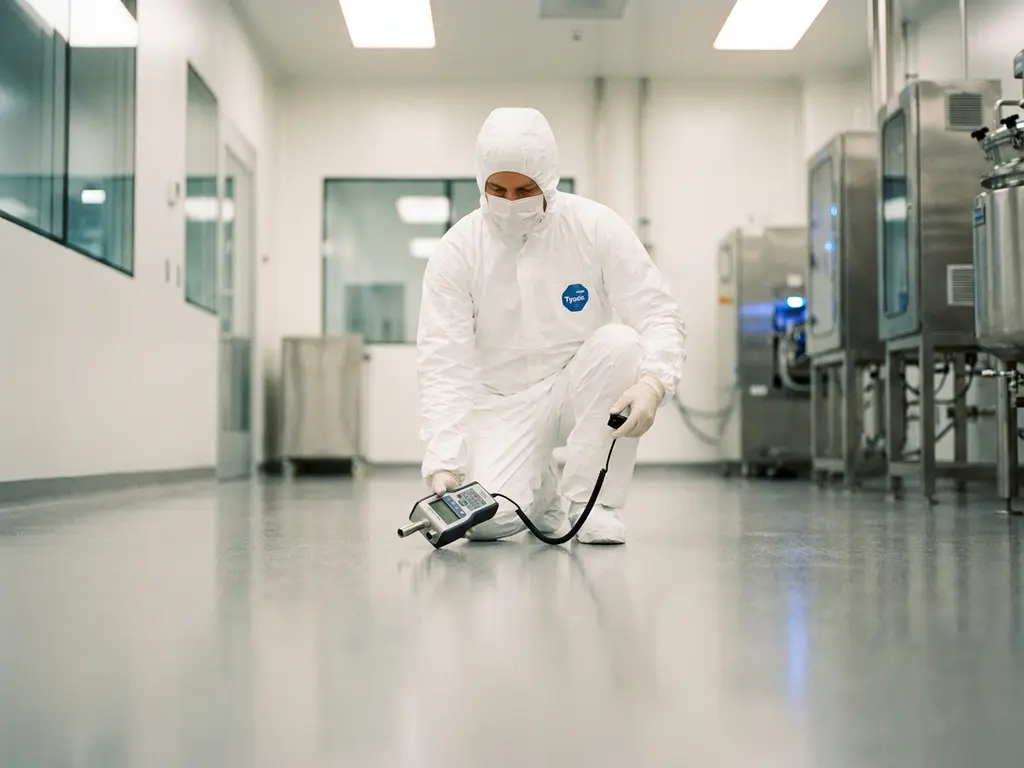
Particle size is one of the most critical factors in contamination risk because smaller particles travel further, stay airborne longer, and are harder to capture at the point of entry. In controlled environments, particles ranging from sub-micron to visible debris all pose distinct risks depending on the industry, the process, and the cleanliness classification required. The sections below address the most important questions about particle size, floor-level contamination, and what that means for your contamination control strategy.
Which particle sizes pose the greatest contamination risk in controlled environments?
Particles in the range of 0.1 to 5 microns pose the greatest contamination risk in controlled environments. This size range is small enough to remain suspended in air for extended periods, allowing particles to migrate deep into cleanrooms and critical zones, yet large enough to carry biological or chemical agents that can compromise product integrity or patient safety.
Larger particles, those above 10 microns, tend to settle relatively quickly under gravity and are more readily captured by conventional barriers at entry points. While they still represent a contamination risk, their behaviour is more predictable and easier to manage. Sub-micron particles, by contrast, follow airflow rather than gravity, making them far more difficult to intercept once they have been disturbed from a surface.
The International Organization for Standardization classifies cleanrooms partly on the basis of particle concentration at specific size thresholds, typically 0.1, 0.2, 0.3, 0.5, 1, and 5 microns. This classification system reflects the real-world understanding that even a modest concentration of fine particles can render a controlled environment non-compliant and put processes, products, or patients at risk.
How do particles travel from floors into cleanroom air?
Particles travel from floors into cleanroom air primarily through mechanical disturbance. Foot traffic, wheeled equipment, and air turbulence generated by movement all dislodge settled particles from floor surfaces and re-entrain them into the breathing zone and beyond. Once airborne, fine particles can remain suspended for minutes or hours before settling again.
This re-entrainment process is one of the most underestimated contamination pathways in controlled environments. A floor surface that appears clean to the naked eye may still carry a significant load of fine particles that are displaced with every footstep. HVAC and air handling systems, designed to maintain positive pressure and directional airflow, can inadvertently carry these disturbed particles further into the facility rather than filtering them out at the source.
The critical implication for facility managers is that contamination control cannot rely on air filtration alone. If particles are being introduced at floor level with every entry event, the upstream solution is to capture them before they are disturbed in the first place.
What types of particles are most commonly found at floor entry points?
At floor entry points, the most commonly found particles include fibres from clothing and footwear, skin cells, dust and soil tracked in from outside, lubricant residues from wheeled equipment, and microbial particles such as bacteria and fungal spores. These particles vary widely in size, from visible debris down to sub-micron biological material.
Footwear is a particularly significant vector. The soles of shoes and boots accumulate particles from every surface they contact, and those particles are then transferred directly to the cleanroom floor at the point of entry. Wheeled equipment such as trolleys, pallet trucks, and forklifts compounds this problem by covering more floor area and applying greater pressure, which can embed particles into floor surfaces or scatter them across a wider zone.
The composition of particles at entry points also varies by industry. In pharmaceutical manufacturing, the concern centres on particulate matter that could contaminate drug products or introduce microbial risk. In electronics and semiconductor facilities, metallic and dielectric particles from external environments are a primary concern. In food and beverage production, biological contaminants including mould spores and allergen particles are the priority.
Why are sub-micron particles harder to capture at floor level?
Sub-micron particles are harder to capture at floor level because they do not behave like larger debris. Rather than settling predictably under gravity, particles below 1 micron follow Brownian motion and respond to air currents, making them highly mobile and difficult to intercept with standard physical barriers or adhesive surfaces.
Most conventional floor-level contamination control methods, including disposable sticky mats and footbaths, are designed primarily to capture larger particles through direct contact and adhesion. These methods are less effective against very fine particles because the contact forces required to retain sub-micron particles are significantly higher, and the probability of a particle making sufficient contact with the capture surface decreases as particle size falls.
This does not mean sub-micron particles cannot be managed at floor level, but it does mean that the choice of material and surface engineering matters considerably. High-performance polymeric surfaces that maximise contact area and generate consistent adhesive force across the full sole of a shoe or the full width of a wheel are better positioned to capture fine particles than materials that rely on a single adhesive layer or a liquid medium.
How does particle size influence contamination outcomes by industry?
Particle size influences contamination outcomes differently depending on the industry, because each sector has distinct sensitivity thresholds, regulatory requirements, and product vulnerability profiles. A particle that is inconsequential in a warehouse environment can cause a batch failure in pharmaceutical manufacturing or a yield loss in semiconductor production.
Pharmaceuticals and medical devices
In pharmaceutical and medical device manufacturing, particles above 10 microns are a visible and direct contamination concern for injectable products, where even a single foreign particle can trigger a product recall or regulatory action. However, sub-micron biological particles, including viable organisms, represent an equally serious risk because they can survive on surfaces and multiply over time. GMP guidelines and ISO 14644 standards set strict limits on both particle counts and microbial contamination, meaning facilities must manage the full particle size spectrum.
Electronics and semiconductors
In electronics manufacturing, the damage threshold can be as small as a fraction of the feature size being produced. As circuit geometries have continued to shrink, even particles in the 0.1 to 0.3 micron range can cause defects in chip production. Cleanroom classifications in this sector are among the most stringent globally, and floor-level contamination control is a foundational element of maintaining those standards.
Aerospace and automotive
In aerospace and precision automotive environments, the concern is less about sub-micron particles and more about particles in the 5 to 50 micron range that can cause surface defects, interfere with coatings, or introduce contamination into precision assemblies. Floor-level control at entry points and around wheeled equipment routes is particularly important in these settings.
What floor-level contamination control methods are most effective for fine particles?
The most effective floor-level contamination control methods for fine particles combine high-contact-area capture surfaces with consistent maintenance protocols. Reusable polymeric contamination control mats designed to maximise surface contact across the full footprint of a shoe sole or wheel are among the most reliable options, particularly when combined with regular cleaning to restore capture performance.
Disposable sticky mats can capture larger particles but have recognised limitations with very fine particulate. Their adhesive layers degrade quickly, and the act of peeling away used sheets can itself generate particles. Footbaths are ineffective against dry particulate contamination and introduce liquid management challenges. Shoe covers reduce the transfer of particles from footwear but do not address wheeled equipment and require consistent compliance from all personnel.
The most robust approach treats floor-level contamination control as a system rather than a single intervention:
- Position capture mats at every controlled zone entry point, including gowning rooms, airlocks, and critical corridors
- Ensure mats cover the full stride length of pedestrian traffic so both feet make full contact
- Use appropriately rated mats for wheeled equipment routes, where tyre contact pressure and load are significantly higher than foot traffic
- Establish a cleaning and maintenance schedule that maintains capture performance over time
- Validate the solution against your facility’s specific particle size concerns and ISO classification requirements
The goal is to intercept the maximum possible particle load before it enters the controlled environment, reducing the burden on air filtration systems and lowering the overall contamination risk at the source.
How Dycem helps with floor-level particulate contamination control
Dycem’s reusable polymeric contamination control mats are engineered to capture up to 99.9% of shoe and wheel-borne contaminants at the point of entry, making them one of the most effective tools available for managing floor-level particulate contamination across the full particle size spectrum. The range is built to address the specific demands of different facility zones and traffic types:
- Dycem CleanZone is designed for pedestrian and light-wheeled traffic areas including cleanroom entrances, gowning rooms, and airlocks, delivering high-performance particulate capture at the most sensitive entry points
- Dycem WorkZone is engineered for heavy-wheeled traffic including forklifts and pallet trucks, providing reliable contamination control in demanding industrial and logistics environments
- Dycem Floating Mats offer flexible, repositionable coverage for facilities with variable or temporary controlled zones
- All mats include built-in Biomaster antimicrobial protection, addressing microbial particle risk alongside physical particulate capture
- ISO-certified manufacturing and a product lifespan of three to five years make Dycem a more sustainable and cost-effective alternative to disposable sticky mats
If you are reviewing your facility’s contamination control strategy in 2026, Dycem’s contamination control specialists can provide a free site survey and consultation tailored to your environment. Explore the full Dycem product range or contact the team to discuss your specific requirements.