

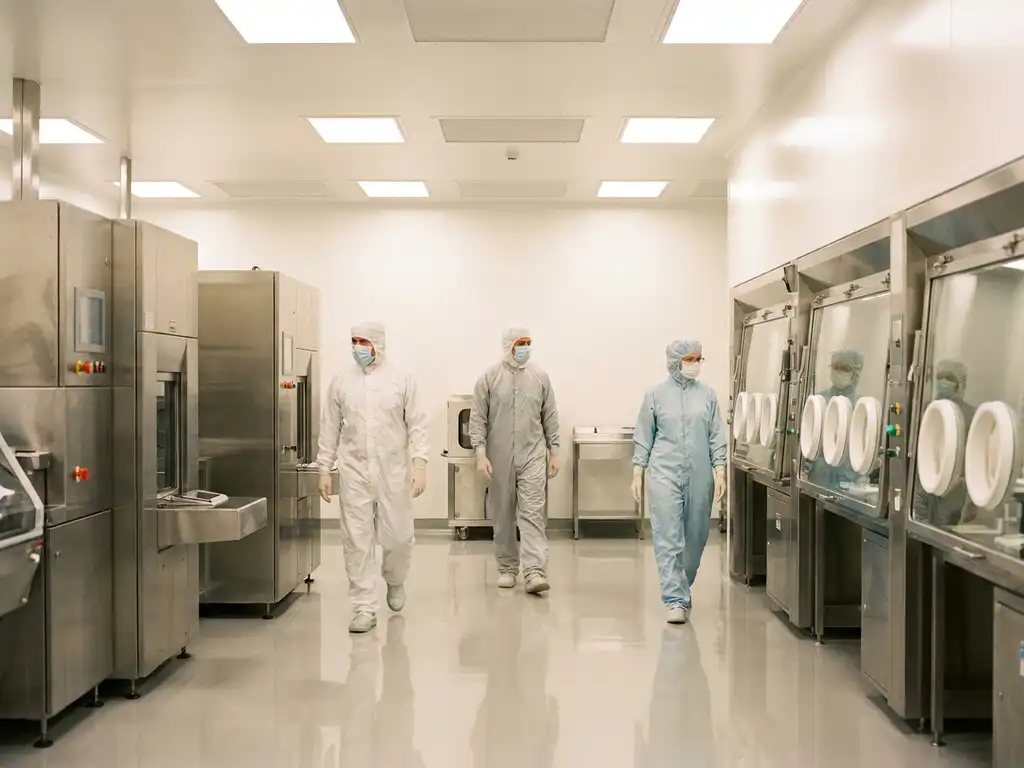
Van der Waals forces are weak, short-range intermolecular attractions that cause particles to adhere to surfaces without any chemical bonding or mechanical fastening. These forces arise from temporary fluctuations in electron distribution across molecules, generating momentary dipoles that attract neighbouring molecules. In contamination control, Van der Waals adhesion explains both why particles cling stubbornly to surfaces inside cleanrooms and how certain mat technologies are engineered to exploit that same mechanism to capture contaminants before they spread.
Understanding the physics behind particle adhesion helps quality and facilities managers make more informed decisions about contamination control strategy. The sections below address the most common questions about Van der Waals forces and their practical implications for controlled environments.
How do Van der Waals forces cause particles to stick to surfaces?
Van der Waals forces cause particles to stick to surfaces through temporary, fluctuating electrical attractions between molecules. Even in non-polar materials with no permanent charge, electrons are in constant motion. At any given instant, this movement creates a momentary imbalance, producing a weak dipole that induces a corresponding dipole in a neighbouring molecule. The result is a net attractive force that holds particles against a surface.
Although each individual Van der Waals interaction is extremely weak, the cumulative effect across the contact area between a particle and a surface can be significant. Smaller particles, which have a higher surface-area-to-mass ratio, experience proportionally stronger adhesion relative to their weight. This is why fine particulates do not simply fall away from surfaces under gravity, and why removing them requires either a mechanical force that exceeds the adhesion energy or a surface engineered to attract particles more strongly than the surrounding environment does.
The strength of Van der Waals adhesion depends on the materials involved, the smoothness of the contact surfaces, and the distance between molecules. Rough surfaces reduce the number of molecular contact points, lowering adhesion, while smooth, compliant surfaces maximise contact area and therefore increase the attractive force. This material-level behaviour is directly relevant to how contamination control products are designed.
Why are Van der Waals forces a problem in cleanrooms and controlled environments?
Van der Waals forces are a problem in cleanrooms because they allow microscopic particles to adhere tenaciously to shoes, wheels, clothing, and equipment surfaces, making contaminants extremely difficult to dislodge through routine movement. Once particles enter a controlled environment via personnel or wheeled traffic, Van der Waals adhesion keeps them attached to surfaces and floors, where air currents, vibration, or activity can later re-suspend them into the controlled zone.
Industry experience consistently shows that the floor level is the primary entry route for particulate contamination in controlled environments, with a substantial proportion of contaminants introduced on the soles of shoes and the wheels of trolleys and carts. The challenge is that Van der Waals forces make these particles invisible and persistent. They do not announce themselves, and they resist casual cleaning methods. In pharmaceutical manufacturing, semiconductor fabrication, or medical device assembly, even a low concentration of particulates can compromise product integrity, trigger failed audits, or result in costly batch rejections.
The same physics that causes particles to cling to shoes also causes them to cling to floors and equipment inside the cleanroom once transferred. This makes prevention at the point of entry far more effective than remediation after contamination has occurred.
What types of particles are most affected by Van der Waals adhesion?
The particles most affected by Van der Waals adhesion are fine, dry particulates in the submicron to low-micron size range, including skin cells, textile fibres, dust, polymer fragments, and metallic debris. At these scales, gravitational forces acting on a particle are negligible compared to the surface adhesion forces, which means Van der Waals attraction dominates the particle’s behaviour entirely.
Several particle categories are particularly relevant in industrial cleanroom settings:
- Biological particles: Skin flakes and hair fragments shed continuously by personnel and adhere strongly to floor surfaces and shoe soles through Van der Waals contact.
- Textile fibres: Released from clothing, gowning, and cleaning materials, these elongated particles have large contact areas that amplify Van der Waals adhesion.
- Inorganic dust and process debris: Metal particles, ceramic fragments, and mineral dust generated by manufacturing processes adhere readily to both hard surfaces and polymeric materials.
- Polymer particles: Fragments from packaging, tubing, or equipment components are common in pharmaceutical and food environments and exhibit strong Van der Waals behaviour due to their smooth surfaces.
Larger particles, while still subject to Van der Waals forces, are more likely to be dislodged by gravity or air movement. It is the fine particulate fraction that represents the greatest contamination risk precisely because molecular adhesion keeps it anchored until a disturbance re-suspends it.
How do contamination control mats exploit Van der Waals forces to capture particles?
Contamination control mats exploit Van der Waals forces by presenting a surface engineered to generate stronger molecular adhesion than the shoe soles or wheel surfaces that carry contaminants into a facility. When footwear or wheels pass over a high-performance polymeric mat, the mat’s surface material makes intimate contact with contaminant particles, and the resulting Van der Waals attraction transfers those particles from the incoming surface to the mat.
The effectiveness of this mechanism depends on two material properties: surface energy and compliance. A mat material with high surface energy creates stronger Van der Waals interactions with a wider range of particle types. A compliant, slightly deformable surface maximises the contact area at the molecular level, increasing the number of simultaneous adhesion points and therefore the total capture force. This is why purpose-engineered polymeric mats outperform hard floor surfaces or standard rubber matting for contamination capture.
Reusable polymer mats designed for cleanroom entry points are built to sustain this performance over time. Cleaning and maintenance protocols restore the surface’s adhesive properties by removing the accumulated particle load, allowing the mat to continue generating Van der Waals-driven capture across its service life. The Dycem contamination control mat range is engineered specifically around this principle, with surface chemistry optimised to maximise particulate capture at entry points where contamination risk is highest.
What’s the difference between Van der Waals adhesion and sticky mat mechanisms?
The key distinction is that Van der Waals adhesion relies on molecular-level surface energy interactions, while traditional sticky or peel-off mats rely on pressure-sensitive adhesive coatings, typically acrylic or rubber-based, that bond mechanically to contaminants on contact. Both mechanisms capture particles, but they differ significantly in durability, performance consistency, and practical application.
Van der Waals-based polymeric mats
Polymeric contamination control mats engineered around Van der Waals principles maintain their capture performance through surface energy rather than a consumable adhesive layer. They can be cleaned, restored, and reused across a multi-year service life. Their adhesion is consistent across the mat surface and does not degrade in the way that a tacky coating does once its top layer is saturated with contaminants. This makes them particularly well-suited to high-traffic entry points where consistent performance is a compliance requirement.
Pressure-sensitive sticky mats
Disposable peel-off mats use a pressure-sensitive adhesive that provides strong initial tack but diminishes rapidly as the surface becomes loaded with particles. Once the top sheet is saturated, it must be peeled away and discarded, exposing a fresh adhesive layer underneath. This creates a continuous stream of single-use plastic waste and introduces the operational burden of frequent replacement. In high-traffic environments, the cost and disruption of this cycle accumulates quickly, and there is inherent inconsistency in contamination control performance between sheet changes.
From a compliance standpoint, the predictable and measurable performance of Van der Waals-based reusable mats is easier to validate and document than the variable performance of a consumable system. For organisations managing GMP audits or ISO-certified cleanroom standards, that consistency carries real operational value.
When do Van der Waals forces become insufficient for contamination control?
Van der Waals forces become insufficient for contamination control when the adhesion energy between a mat surface and incoming particles is lower than the adhesion energy between those particles and the shoe sole or wheel surface carrying them. This can occur when the mat surface is overloaded with captured particles, when the mat material has degraded, or when the particle type or size falls outside the range that the surface chemistry is optimised to capture.
Several conditions can reduce the effectiveness of Van der Waals-based capture in practice:
- Surface saturation: A mat that has not been cleaned within its recommended maintenance cycle will have its adhesive surface sites occupied, reducing available capture capacity for new particles.
- Surface contamination with oils or liquids: Lubricants, process chemicals, or moisture can form a film over the mat surface, reducing direct molecular contact between the mat and incoming particles.
- Incompatible surface energies: Certain particle types, particularly those with very low surface energy themselves, may not interact as strongly with the mat material, reducing capture efficiency for those specific contaminants.
- Insufficient contact time or pressure: Fast-moving wheeled traffic or very rigid shoe soles may limit the contact area and dwell time needed for Van der Waals forces to transfer particles effectively.
This is why contamination control at entry points should never rely on a single mechanism. Combining high-performance mat systems with appropriate gowning protocols, air pressure differentials, and regular maintenance schedules provides the layered defence that regulated environments require. Van der Waals-based mats are a critical component of that system, but their performance is directly tied to correct installation, maintenance frequency, and traffic management.
How Dycem contamination control mats put Van der Waals forces to work
Dycem mats are engineered to maximise Van der Waals-driven particle capture at the most critical entry points in any controlled environment. Rather than relying on consumable adhesive coatings, Dycem’s reusable polymer surfaces are formulated to generate high surface energy contact with a broad range of particulate types, capturing up to 99.9% of shoe and wheel contaminants before they enter the controlled zone.
Key features of the Dycem system include:
- Reusable polymer construction that sustains surface energy performance across a 3 to 5 year service life, eliminating the waste and inconsistency of disposable alternatives
- Built-in Biomaster antimicrobial protection that inhibits microbial growth on the mat surface, supporting hygiene standards in pharmaceutical, healthcare, and food environments
- ISO-certified manufacturing in compliance with EN ISO 9001 and 14001, providing the documented quality assurance that regulated facilities require
- Format options for every traffic type, from CleanZone mats at pedestrian entry points and gowning rooms to WorkZone mats designed for forklift and pallet truck traffic in demanding logistics areas
- Customisable sizing and layout to match any facility footprint, including repositionable Floating Mats for variable or temporary controlled zones
For facilities currently using disposable peel-off mats, the switch to a reusable system based on consistent Van der Waals adhesion represents a more sustainable and often more cost-effective approach over the product’s full service life. To find out which Dycem solution is right for your facility, contact a contamination control specialist to arrange a free site survey and consultation.