

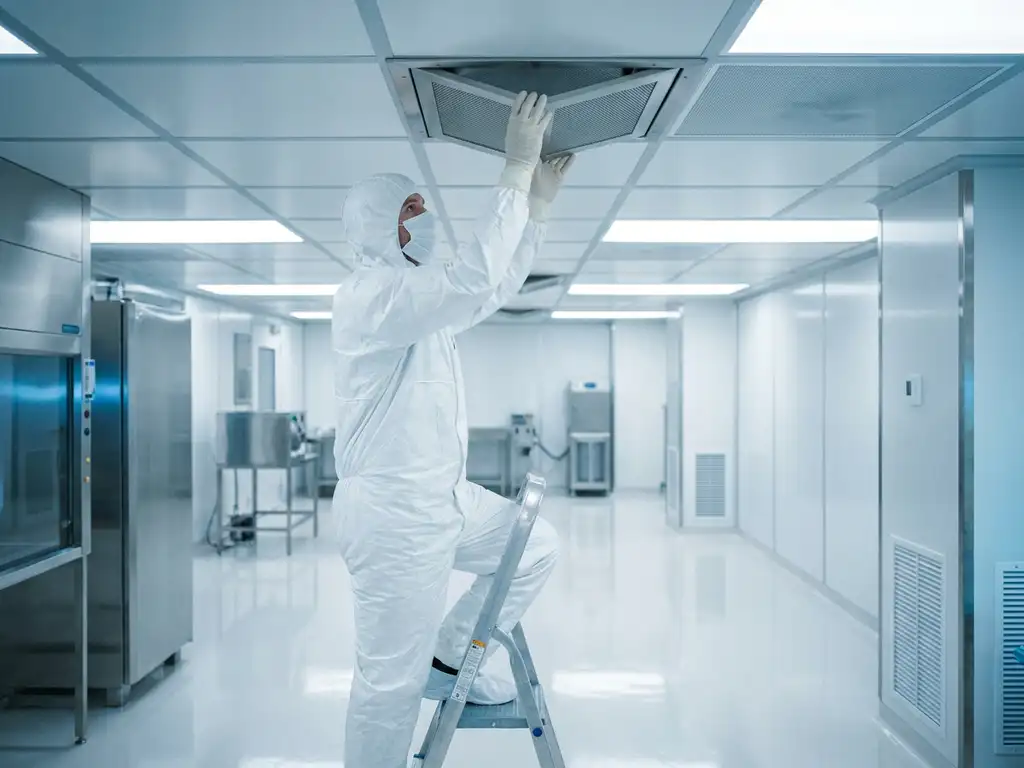
HVAC systems and contamination control are directly connected: HVAC systems manage airborne particulates, temperature, humidity, and pressure differentials to maintain cleanroom air quality, making them a foundational element of contamination control in regulated environments. However, HVAC filtration alone cannot address all contamination pathways, particularly those introduced at floor level through foot and wheel traffic. The questions below unpack how HVAC systems work, where their limitations lie, and why a layered contamination control strategy delivers more reliable protection.
How do HVAC systems actually control contamination?
HVAC systems control contamination in cleanrooms and controlled environments by filtering, pressurising, and circulating air to remove particulates and prevent unfiltered air from entering critical zones. The core mechanism is High Efficiency Particulate Air (HEPA) or Ultra Low Penetration Air (ULPA) filtration, which captures microscopic particles before they can settle on surfaces, products, or personnel.
Beyond filtration, HVAC systems contribute to contamination control in several ways:
- Positive pressure differentials: Cleanrooms are typically maintained at a higher air pressure than surrounding areas, so air flows outward when doors open rather than drawing in unfiltered air from corridors or adjacent spaces.
- Air change rates: Regulated environments require a defined number of air changes per hour to continuously dilute and remove airborne particles generated by personnel, equipment, and processes.
- Temperature and humidity control: Stable environmental conditions reduce static charge, microbial growth, and condensation, all of which can contribute to contamination events.
- Directional airflow: Unidirectional (laminar) airflow in ISO Class 5 environments or above directs particles away from critical work zones and toward exhaust points.
Together, these functions make HVAC an indispensable part of cleanroom air quality management and a key compliance requirement under GMP, ISO 14644, and FDA guidelines.
What contaminants can HVAC systems not prevent?
HVAC systems cannot prevent contaminants that enter a controlled environment at floor level, on personnel, or on equipment surfaces. While HVAC filtration addresses airborne particles already circulating in the air, it has no mechanism to stop contamination from being physically carried into a cleanroom on shoes, wheels, clothing, or materials before those particles become airborne.
This is a significant gap. Industry experience consistently shows that the majority of contamination entering controlled environments does so at floor level, introduced by foot traffic and wheeled equipment moving between uncontrolled and controlled zones. Once particles are deposited on the floor inside a cleanroom, routine activity, airflow, and vibration can re-suspend them into the air, where HVAC systems then have to manage the resulting burden.
Other contamination pathways that HVAC systems do not address include:
- Microbial contamination transferred on hands, gloves, or garments
- Particulates embedded in packaging materials or raw goods entering the facility
- Chemical residues tracked in from adjacent production or maintenance areas
- Cross-contamination between zones caused by personnel movement during shift changes
These entry points require physical barriers, procedural controls, and surface-level contamination management that HVAC design alone cannot provide.
Why do cleanrooms need both HVAC and floor-level controls?
Cleanrooms need both HVAC systems and floor-level controls because contamination enters through multiple pathways simultaneously, and no single system can address all of them. HVAC manages the airborne environment, but it cannot intercept particles before they are introduced. Floor-level controls stop contamination at the point of entry, reducing the total particulate load that HVAC systems then have to manage.
This layered approach is the basis of an effective contamination control strategy. Regulatory frameworks including GMP guidelines and ISO 14644 standards recognise that cleanroom classification depends on maintaining particle counts within defined limits. When floor-level contamination is left unmanaged, the volume of particles being re-suspended into the air can exceed what HVAC systems are designed to handle, putting ISO classification and audit compliance at risk.
From an operational standpoint, the two systems are complementary rather than interchangeable. A cleanroom with excellent HVAC filtration but no entry-point contamination control is still vulnerable to contamination events every time a door opens or a pallet truck crosses the threshold. Conversely, floor-level controls alone cannot maintain the air quality standards required for pharmaceutical fill-finish, semiconductor fabrication, or sterile device assembly. Both layers must be present and functioning to deliver a reliably controlled environment.
What floor-level contamination control options work alongside HVAC?
Floor-level contamination control options that work alongside HVAC systems include reusable polymeric mats, tacky mats, footbaths, and shoe cover programmes. Each intercepts particles at entry points before they can be tracked into controlled zones, reducing the particulate burden that HVAC filtration must then manage in the air.
Among these options, reusable polymeric mats are widely regarded as the most consistent and cost-effective long-term solution. Unlike disposable peel-off sticky mats, which lose effectiveness quickly and generate significant single-use plastic waste, reusable mats provide continuous, validated particulate capture across high-traffic entry points. Footbaths and shoe cover programmes introduce their own operational challenges, including inconsistent application, compliance gaps, and ongoing consumable costs.
When evaluating floor-level options, facilities teams typically consider:
- Traffic type: Pedestrian-only zones have different requirements from areas handling forklifts or pallet trucks
- Cleanroom classification: Higher ISO classifications demand more rigorous entry-point controls
- Maintenance burden: Solutions that require frequent replacement or manual intervention introduce compliance risk during changeover
- Total cost of ownership: Reusable solutions with a multi-year lifespan consistently outperform disposable alternatives over time
Dycem’s contamination control mat range is designed to address each of these variables, with solutions engineered for pedestrian zones, heavy-wheeled traffic, and flexible or temporary controlled areas.
Which industries rely most on combined HVAC and contamination control systems?
The industries that rely most on combined HVAC and contamination control systems are those operating under regulatory frameworks that mandate defined environmental standards. Pharmaceuticals, medical devices, semiconductor manufacturing, aerospace, food and beverage production, and healthcare facilities all require validated cleanroom or controlled environments where both air quality and surface-level contamination are actively managed.
Pharmaceuticals and medical devices
Pharmaceutical manufacturing and medical device production operate under GMP and FDA regulations that specify cleanroom classifications, air change rates, and particulate limits. Contamination events in these environments carry direct patient safety implications, making layered contamination control a compliance requirement rather than a best practice. HVAC systems maintain ISO-classified air quality while entry-point controls prevent the introduction of particles and microbes that could compromise sterile products.
Semiconductors and electronics
Semiconductor fabrication requires some of the most stringent cleanroom environments in any industry, with ISO Class 1 to 5 classifications common in wafer production. Even microscopic particles can cause defects that render components non-functional. HVAC systems with ULPA filtration manage airborne particle counts, while floor-level controls at gowning areas and airlocks prevent personnel from introducing contamination during entry.
Aerospace and defence
Aerospace manufacturers working on precision components, optical systems, or avionics assemblies rely on controlled environments to prevent particulate contamination that could affect component integrity. Combined HVAC and floor-level contamination control systems are standard in facilities producing for clients such as Airbus, Lockheed Martin, and Rolls Royce.
Food and beverage facilities, automotive paint shops, and hospital operating theatres similarly depend on this combined approach, each with its own regulatory drivers and contamination risk profiles.
How Dycem supports contamination control alongside HVAC systems
Dycem provides the floor-level layer of contamination control that HVAC systems cannot deliver on their own. Where HVAC manages the airborne environment, Dycem mats intercept particles, fibres, and microbes at the point of entry, preventing them from ever reaching the controlled zone. This directly reduces the particulate burden on HVAC filtration and helps facilities maintain their ISO classification between validation cycles.
Dycem’s product range addresses every entry point and traffic type within a controlled environment:
- Dycem CleanZone: Designed for cleanroom entrances, gowning rooms, and airlocks where pedestrian and light-wheeled traffic require high-performance particulate capture
- Dycem WorkZone: Engineered for heavy-duty areas where forklifts, pallet trucks, and large carts cross between uncontrolled and controlled zones
- Dycem Floating Mats: Repositionable mats for facilities with variable or temporary controlled zones that need flexible contamination management
- Dycem Bench Mats and Access Panels: Workstation-level solutions that extend contamination control beyond the floor and into the wider controlled environment
All Dycem mats are reusable, built with Biomaster antimicrobial protection, and manufactured to ISO 9001 and 14001 standards, making them a more sustainable and cost-effective alternative to disposable sticky mats over their three-to-five year lifespan. To discuss your facility’s contamination control requirements and arrange a free site survey, contact a Dycem specialist today.