

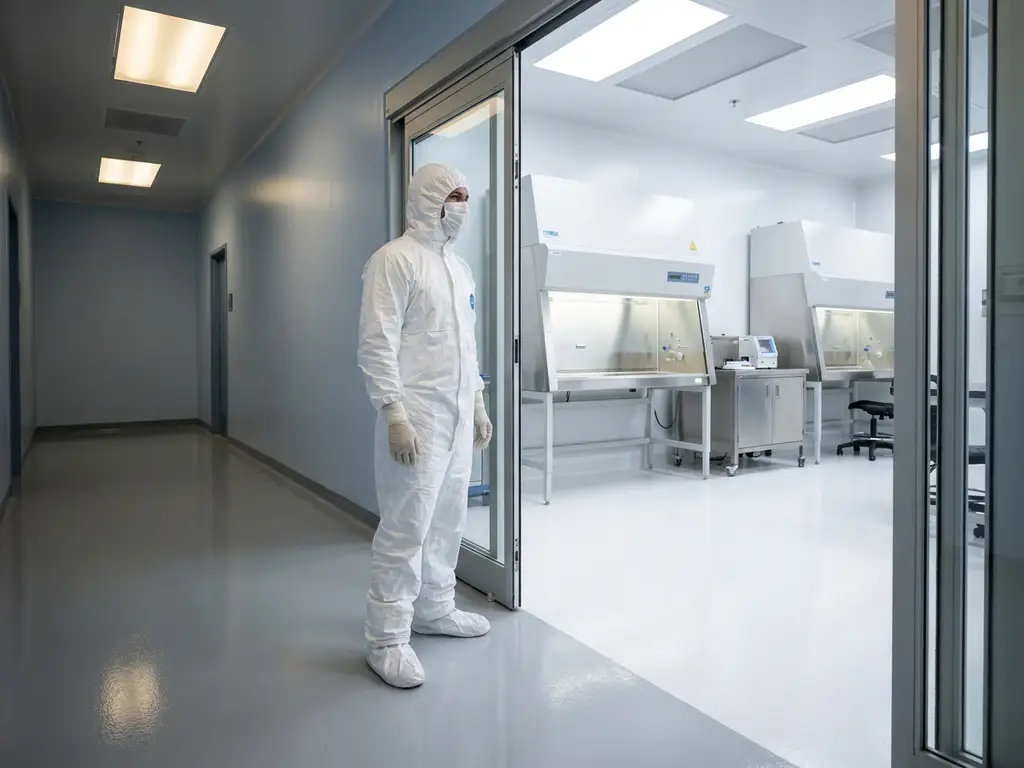
Contamination control strategy differs significantly between sterile and non-sterile manufacturing because the consequences of failure are not equal. In sterile environments, a single contamination event can compromise patient safety, trigger batch recalls, and result in regulatory action. Non-sterile facilities still require rigorous contamination control, but the risk thresholds, regulatory frameworks, and technical measures applied at each stage differ considerably.
The following sections address the most common questions facility managers, quality leads, and EHS professionals ask when evaluating or upgrading their contamination control approach across both environment types.
What are the key regulatory requirements for sterile vs. non-sterile manufacturing environments?
Sterile manufacturing environments are governed by stricter regulatory requirements than non-sterile facilities, reflecting the higher patient risk associated with injectable drugs, implants, and sterile medical devices. Non-sterile manufacturing still operates within defined GMP contamination control frameworks, but the classification thresholds, monitoring obligations, and validation requirements are less demanding by comparison.
In sterile manufacturing, the EU GMP Annex 1 (revised in 2022 and now fully enforced) and FDA 21 CFR Part 211 set the baseline for cleanroom classification, environmental monitoring, and contamination prevention. These regulations require facilities to demonstrate a Contamination Control Strategy (CCS) as a documented, holistic system, not a collection of isolated measures. Cleanrooms must meet defined ISO classifications (typically ISO 5 through ISO 8), with particle counts, microbial limits, and pressure differentials all subject to ongoing validation.
Non-sterile pharmaceutical and food manufacturing environments operate under GMP guidelines that still mandate particulate management, personnel hygiene controls, and defined entry procedures, but without the same intensity of environmental monitoring or the requirement for a formally documented CCS. That said, regulatory expectations for non-sterile facilities have tightened in recent years, and inspectors increasingly expect evidence-based contamination management regardless of sterility classification.
How does contamination risk differ between sterile and non-sterile facilities?
In sterile facilities, contamination risk is binary in practical terms: any viable microbial contamination of a product can render an entire batch unsafe. In non-sterile facilities, contamination risk is still real but is generally managed through bioburden limits rather than zero-tolerance thresholds. The nature, source, and consequence of contamination differ substantially between the two environment types.
Sterile manufacturing environments face risk from both particulate and microbial contamination. A particle introduced during aseptic filling can carry microorganisms directly into the product. Personnel, equipment, and entry points are all considered potential vectors, and contamination control measures must address each systematically. The consequences of failure include product recalls, regulatory warning letters, facility shutdowns, and, most critically, patient harm.
Non-sterile environments face contamination risk primarily in terms of cross-contamination between products, foreign body introduction, and bioburden accumulation that could compromise product quality or shelf life. In food and beverage manufacturing, allergen cross-contact is an additional contamination risk category with serious safety and legal implications. While the stakes are lower than in sterile manufacturing, a contamination event in a non-sterile facility can still result in recalls, customer harm, and significant reputational damage.
What contamination control measures are unique to sterile manufacturing?
Several contamination control measures are specific to sterile manufacturing and are not typically required in non-sterile environments. These include aseptic technique training and validation, isolator or RABS technology for product protection, continuous environmental monitoring programmes, and the formal documentation of a Contamination Control Strategy as required under EU GMP Annex 1.
The revised Annex 1 guidance introduced the CCS as a mandatory framework, requiring sterile manufacturers to identify contamination risks holistically, from raw material intake through to final product release. This means every element of the facility, including entry points, gowning procedures, HVAC design, equipment cleaning, and personnel behaviour, must be assessed, documented, and periodically reviewed as part of a single integrated strategy.
Sterile facilities also apply more rigorous gowning protocols, including full cleanroom suits, sterile gloves, and face masks, with gowning qualification required for personnel entering Grade A and B zones. Pressure cascade systems are designed to prevent airborne contamination migrating from lower-grade to higher-grade areas. These controls have no direct equivalent in most non-sterile environments, where entry procedures are simpler and gowning requirements less demanding.
Which contamination control practices apply to both sterile and non-sterile environments?
Several core contamination control practices are applicable across both sterile and non-sterile manufacturing environments. Entry-point contamination management, personnel hygiene protocols, surface cleaning programmes, and zoning strategies all feature in both environment types, even if the specific standards and validation requirements differ.
Floor-level contamination control is a universal priority. Industry data consistently indicates that the majority of particulate contamination enters controlled environments at floor level, carried in on footwear and wheeled equipment. This applies whether the facility is a Grade B pharmaceutical cleanroom or a food production area with defined hygiene zones. Controlling what enters at the threshold is foundational to any contamination control strategy.
Other shared practices include:
- Zoning and segregation: Defining clean and less-clean areas with clear physical or procedural boundaries is standard in both environment types.
- Gowning and PPE requirements: Both sterile and non-sterile facilities require personnel to change into appropriate clothing before entering controlled zones, though the level of protection varies.
- Cleaning and disinfection schedules: Regular, documented cleaning of surfaces, floors, and equipment is a GMP requirement across manufacturing types.
- Visitor and contractor controls: Managing the movement of non-regular personnel through controlled areas is a shared risk management practice.
- Training and competency records: Personnel working in any controlled environment must be trained in contamination awareness and hygiene practices.
How should entry-point contamination control be adapted for each environment type?
Entry-point contamination control should be more intensive and formally validated in sterile environments than in non-sterile facilities. The entry sequence, materials used, and monitoring applied at airlocks, gowning rooms, and cleanroom thresholds must reflect the classification of the zone being protected and the level of risk associated with any contamination breach.
In sterile manufacturing, entry points into Grade B and C areas typically involve multiple stages: removal of outer garments, hand washing, application of sterile or cleanroom-grade gowning, and passage through an airlock with a positive pressure differential. Floor-level contamination control at these entry points must be capable of capturing fine particulates from both footwear and wheeled equipment before they enter the controlled zone.
In non-sterile manufacturing, entry-point controls are still essential but are generally less staged. A defined gowning area, footwear change or overshoe requirement, and a floor-level decontamination mat at the threshold typically form the entry sequence. The goal is to reduce the particulate and microbial load being carried into the facility rather than achieve the near-sterile conditions required in aseptic manufacturing.
For both environment types, contamination control mats at entry points provide a validated, measurable layer of floor-level protection. In sterile facilities, mats positioned at airlock entries and gowning room thresholds capture residual particulates from footwear and light equipment before personnel enter critical zones. In non-sterile environments, mats at production area entrances reduce the volume of contamination carried in from warehouse, logistics, or outdoor areas.
When should a facility upgrade its contamination control strategy?
A facility should upgrade its contamination control strategy when existing measures can no longer demonstrate consistent performance, when regulatory requirements have changed, when the facility’s operations have expanded or been modified, or when contamination events signal that current controls are insufficient. Waiting for a failed audit or a contamination incident to trigger a review is a reactive approach that carries significant commercial and compliance risk.
Specific triggers that warrant a strategic review include:
- Regulatory updates: The full enforcement of EU GMP Annex 1 in 2023 required many sterile manufacturers to formalise a documented CCS for the first time. Similar updates to FDA guidance, ISO standards, or sector-specific regulations may require facilities to revisit their current approach.
- Expansion or reconfiguration: Adding new production lines, changing facility layout, or increasing throughput can introduce new contamination pathways that existing controls were not designed to address.
- Persistent contamination trends: If environmental monitoring data shows recurring excursions or trending particulate levels, this signals that the current strategy has gaps that require investigation and remediation.
- Transition from disposable to reusable systems: Many facilities still rely on disposable sticky mats or single-use shoe covers that generate significant waste and offer inconsistent performance. Transitioning to validated, reusable contamination control systems is both a sustainability improvement and a performance upgrade.
- New product introductions: Manufacturing a new product category, particularly one with higher cleanliness requirements, may demand a higher classification zone and correspondingly more rigorous entry-point controls.
In 2026, regulatory scrutiny of contamination control practices remains high across pharmaceuticals, medical devices, and food manufacturing. Facilities that treat contamination control as a static checklist rather than a living strategy are increasingly exposed during inspections.
How Dycem supports contamination control strategy across sterile and non-sterile environments
Dycem’s reusable contamination control mat systems are engineered to address the entry-point contamination challenge that affects both sterile and non-sterile manufacturing facilities. With over 60 years of industry experience and a client base that includes leading pharmaceutical, aerospace, and electronics manufacturers, Dycem provides solutions that are validated, sustainable, and adaptable to the specific classification requirements of any controlled environment.
- Dycem CleanZone mats are designed for pedestrian and light-wheeled traffic at cleanroom entrances, gowning rooms, airlocks, and critical corridors, delivering high-performance particulate capture at the most sensitive entry points in sterile facilities.
- Dycem WorkZone mats handle heavy-wheeled traffic including forklifts and pallet trucks, making them suitable for non-sterile production and logistics areas where large equipment moves between zones.
- Dycem Floating Mats offer repositionable contamination control for facilities with variable or temporary zone requirements, providing flexibility without compromising performance.
- All Dycem mats incorporate built-in Biomaster antimicrobial protection, are reusable with a lifespan exceeding three years, and are manufactured to ISO 9001 and 14001 standards, supporting both compliance and sustainability objectives.
- Dycem’s contamination control specialists provide consultative support from initial site survey through to implementation, helping facilities align their entry-point controls with their broader contamination control strategy.
If your facility is reviewing its contamination control approach, whether ahead of a regulatory audit, a facility expansion, or a transition away from disposable sticky mats, contact Dycem’s specialists to arrange a free site survey and consultation.