

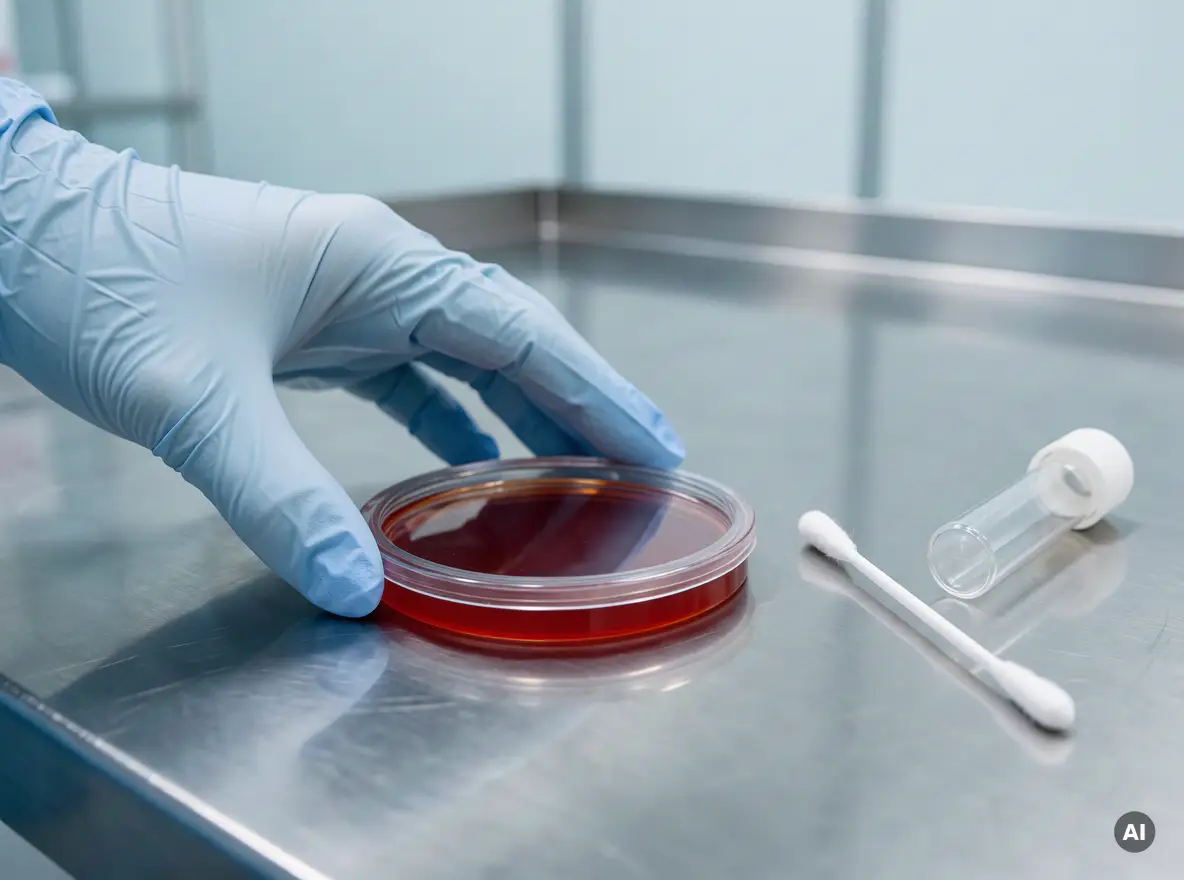
Contact plates are the better choice for flat, smooth, non-porous surfaces such as stainless steel benches, walls, floors, and equipment panels, where direct agar contact gives a colony count per defined surface area. Swabs are better suited to irregular, hard-to-reach, or small areas. Many facilities use both, depending on surface geometry and the environmental monitoring plan.
The right method follows the surface, the risk grade, and the sampling objective, not personal preference. This guide covers when each method fits, how to prevent false results, and how floor-level contamination control influences what your surface sampling finds in cleanroom environments.
What surface conditions favor contact plates over swabs?
Contact plates work best on flat, smooth, non-porous surfaces with a regular shape, such as stainless steel work surfaces, isolator walls, glove ports, cleanroom floors, and equipment panels. The raised agar meniscus makes full, even contact, which allows a standardized sampling area and a direct colony-forming unit (CFU) count.
Standard contact plates, often called RODAC plates, typically have a defined sampling area of around 25 cm², which makes results comparable between locations and over time. Contact plates are generally preferred when:
- The surface is flat, hard, and large enough for the full agar face to touch.
- The area is routinely monitored in higher-grade zones, where consistent, comparable CFU counts support trending.
- The surface has been cleaned and disinfected, and a neutralizing agar is needed to counteract disinfectant residue.
- You need a fast, ready-to-incubate method with fewer handling steps, which reduces the chance of introducing contamination during processing.
Because the agar is applied directly, contact plates also avoid the transfer step between swab and growth medium. That removes one source of variability in recovery.
When are swabs the better sampling choice?
Swabs are the better choice when a surface is curved, uneven, narrow, or too small for a contact plate to make full agar contact. Examples include pipework, valve bodies, corners, seams, gaskets, filling needles, and equipment crevices. A swab conforms to geometry that a rigid agar face cannot reach.
Swabs are also the practical option when:
- The surface is textured, porous, or has gaps where agar cannot make uniform contact.
- You want to sample a defined area larger than a contact plate covers, then concentrate the recovered material.
- The target is a specific location, such as a suspected contamination point, rather than a routine monitoring site.
- Sampling is part of a contamination investigation, where flexibility matters more than a standard area.
The trade-off is more variability. Swab recovery depends on the operator’s technique, pressure, swabbing pattern, and the elution step that transfers organisms from the swab to the medium. Procedures should therefore be standardized and operators trained.
How do contact plates and swabs compare side by side?
Contact plates offer a standardized area and simple handling but only suit flat surfaces. Swabs offer flexibility on complex geometry but introduce more operator-dependent variability and extra processing steps. Neither method recovers every organism from a surface, so consistent use of the same method at each location matters more than which one is chosen.
- Surface suitability: Contact plates suit flat, smooth, non-porous surfaces. Swabs suit curved, irregular, and hard-to-reach areas.
- Sampling area: Contact plates cover a fixed, defined area. Swabs let you define the area, which must then be documented.
- Repeatability: Contact plates generally give more consistent results between operators. Swab results vary more with technique.
- Handling steps: Contact plates are applied and incubated directly. Swabs require transfer, elution, or plating, adding steps where error can occur.
- Residue management: Both methods need neutralizing media or diluents when disinfectant residue is present.
- Best use: Contact plates for routine monitoring of accessible surfaces. Swabs for complex equipment, investigations, and difficult locations.
The monitoring plan should state which method applies to each location, along with alert and action limits appropriate to the cleanroom grade. For sterile medicinal product manufacture, EU GMP Annex 1 sets expectations for microbial monitoring, including recommended limits for surface contamination by grade. ISO 14644 addresses cleanroom classification and airborne particle limits rather than microbial surface limits, and ISO cleanroom classes are not automatically interchangeable with EU GMP Grades A–D. Your site’s contamination control strategy determines how those expectations translate into sampling locations and methods. For a deeper look at that framework, see this guide to a contamination control strategy under EU GMP Annex 1.
How do you avoid residue and false results with contact plates?
Avoiding residue and false results starts with using agar containing neutralizers suited to your disinfectants, applying the plate with consistent pressure, and cleaning the sampled surface afterward. Without these steps, disinfectant carry-over can suppress growth and produce falsely low counts, while the plate itself can leave agar residue on surfaces.
Practical controls include:
- Match the neutralizer to the disinfectant. Use media with neutralizing agents validated against the disinfectants and sporicides used in the area, so residual biocide does not inhibit recovery.
- Apply consistent pressure and contact time. Press the agar face evenly onto the surface without rolling or sliding, which can smear colonies and make counting unreliable.
- Remove agar residue after sampling. Wipe the sampled area with an appropriate disinfectant, often sterile 70% isopropyl alcohol, so nutrient residue does not support growth or leave a film.
- Use aseptic technique. Handle plates by the lid and edge, avoid touching the agar, and sample from the cleanest locations first.
- Incubate and read consistently. Follow validated incubation conditions and counting rules so results can be compared over time.
- Check for overgrowth. Dense growth that merges colonies understates the true count and may require a note or a repeat sample.
False positives often trace back to handling, so sampling personnel should be trained and, in aseptic areas, gowned to the standard of the zone they enter. Understanding what viable sampling does and does not detect also helps when interpreting results. This overview of viable versus non-viable particle monitoring explains the distinction.
Can contact plates and swabs be used together?
Yes. Many facilities combine both methods within one environmental monitoring programme, using contact plates for flat, accessible surfaces and swabs for irregular equipment and difficult locations. This approach covers more of the cleanroom while keeping each method where it performs best, provided each location is assigned one defined method.
A combined approach works well when you:
- Assign a fixed method to each sampling location, so trend data stays comparable.
- Use contact plates for routine monitoring of benches, floors, and walls.
- Reserve swabs for equipment geometry, corners, and investigations after an excursion.
- Document the method, area sampled, and neutralizer used in each record.
Avoid comparing a swab result directly with a contact plate result from the same location, because recovery efficiency differs between methods. Trend each method against its own history and limits. If you switch methods at a location, treat it as a change that needs justification and a new baseline.
How does floor-level contamination control affect surface sampling results?
Floor-level contamination control can affect surface sampling results because floors are a major entry route for contamination carried by footwear and wheels. Dycem cites an industry figure that around 80% of contaminants enter controlled environments at floor level. Reducing particles and microorganisms at entry points can therefore lower the burden that later reaches work surfaces and sampling locations.
Contamination tracked in from corridors, gowning areas, and airlocks does not stay on the floor. It can be transferred onto equipment, trolleys, and gloves, and recovered later during environmental monitoring. If entry points are poorly controlled, elevated counts on surfaces may reflect a pathway problem rather than a cleaning problem alone.
Reusable polymeric flooring at entry points is one layer of that control. Dycem CleanZone is designed for pedestrian and light-wheeled traffic at gowning rooms, cleanroom entrances, corridors, and airlocks, where it captures particles from footwear and wheels. Dycem reports that its mats can capture up to 99.9% of shoe and wheel contaminants under its test conditions; this is a manufacturer-reported figure, not a guarantee of performance in every facility. Mats also depend on regular cleaning to keep performing, as described in the guidance on cleaning Dycem.
Floor-level control does not replace HEPA filtration, validated cleaning and disinfection, gowning procedures, or environmental monitoring. It works alongside them, and swab and contact plate data remain the way to verify that the whole system is performing.
Choosing the right method for your cleanroom
Use contact plates for flat, smooth, accessible surfaces where a standardized area and repeatability matter, and swabs for curved, narrow, or complex locations. Combine them under a documented monitoring plan, validate neutralizers against your disinfectants, and treat floor-level entry points as part of the contamination pathway that your sampling results reflect.
If your monitoring data points to contamination arriving from outside the controlled area, a complimentary Dycem site survey can help you assess entry points and traffic flows as part of your wider contamination control approach.
Frequently Asked Questions
What should I do if my contact plate shows overgrowth or too many colonies to count?
Record the result as too numerous to count (TNTC) or overgrown according to your SOP, and do not estimate a number. Treat it as a potential excursion: confirm the sampling technique, check for handling errors, and consider a repeat sample after cleaning and disinfection. Identify the organisms recovered, since the species can help show whether the source is personnel, the environment, or an entry-point pathway.
How do I validate that my neutralizer is working against the disinfectants we use?
Run a method suitability or neutralizer efficacy test by comparing recovery of known challenge organisms on plates or swabs exposed to disinfectant residue against recovery on untreated controls. Acceptable recovery shows the neutralizer is not inhibiting growth. Repeat the check whenever you change disinfectants, rotate sporicides, or alter contact times.
If surface counts keep rising even after improving cleaning, what else should I investigate?
Look beyond the cleaning routine to how contamination is entering the area. Review gowning practices, material and equipment transfer, airflow, and floor-level entry points such as airlocks and corridors, where footwear and wheels can carry particles in. Mapping traffic flows and checking whether contamination control mats or other entry controls are in place and properly maintained can help determine whether you have a pathway problem.