

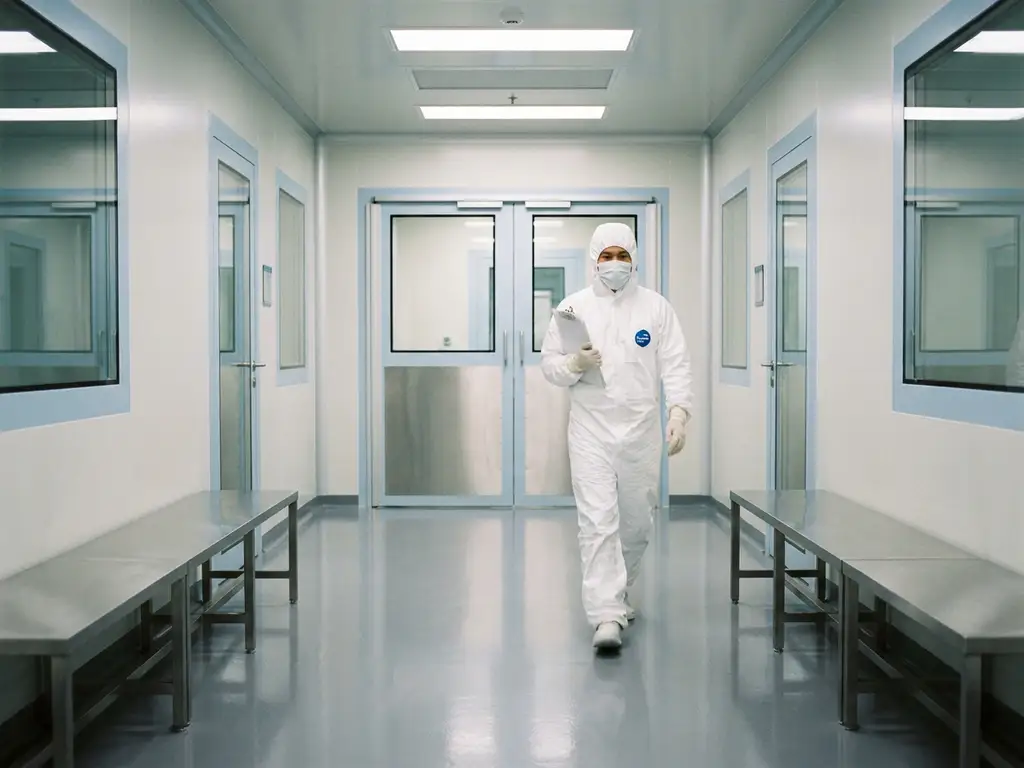
Reusable polymeric contamination mats that can be validated, cleaned in place, and documented within a quality management system meet EU GMP Annex 1 compliance requirements for floor-level contamination control. Disposable sticky mats, by contrast, present significant challenges under the revised Annex 1 framework because they generate particulates during use, require frequent handling, and are difficult to integrate into a traceable cleaning and monitoring programme. The sections below address the most common compliance questions facilities managers raise when evaluating their contamination mat strategy against Annex 1 expectations.
What does EU GMP Annex 1 require for floor-level contamination control?
EU GMP Annex 1, substantially revised in 2022, requires that all surfaces in classified cleanroom environments — including floors — are constructed, maintained, and managed in a way that minimises contamination risk and supports effective cleaning and disinfection. For floor-level contamination control, this means entry points to classified zones must have validated mechanisms that prevent the transfer of particulate and microbial contamination from lower-grade or unclassified areas.
The regulation does not prescribe a single product type, but it does set clear performance expectations. Any contamination control solution used at floor level must be compatible with the cleaning agents and disinfectants used in the facility, must not itself generate particles, and must be covered by documented procedures that include cleaning frequency, validation evidence, and change control records. The Contamination Control Strategy (CCS) — a formal requirement under the revised Annex 1 — must account for all sources and pathways of contamination, with floor-level entry points explicitly considered.
Facilities operating Grade A, B, C, or D environments must demonstrate that their chosen floor-level solution contributes meaningfully to the overall contamination prevention strategy, not simply that a mat is present at the door.
Do disposable sticky mats meet Annex 1 compliance standards?
Disposable sticky mats are increasingly difficult to justify under a rigorous Annex 1 Contamination Control Strategy. While they are widely used and not explicitly prohibited, they introduce several compliance risks: they shed adhesive residue and paper particles as layers are peeled away, they require frequent manual handling that itself becomes a contamination event, and they cannot be validated for consistent particulate capture performance across their lifespan.
From a documentation standpoint, sticky mats also present challenges. Each layer change is a potential gap in the contamination barrier, and the absence of a defined, measurable service life makes it difficult to establish validated change intervals within a quality management system. Regulators and auditors increasingly scrutinise whether a facility’s contamination control tools are evidence-based and reproducible. Sticky mats, by their nature, offer diminishing performance as layers are used, with no objective indicator of when efficacy has dropped below an acceptable threshold.
The environmental and operational costs compound the compliance concern. High-volume facilities can go through thousands of sticky mat layers annually, creating significant single-use plastic waste and an ongoing procurement burden, neither of which aligns with the broader sustainability and operational efficiency expectations that modern GMP frameworks and corporate ESG commitments increasingly reflect.
What types of reusable contamination mats are accepted in GMP-regulated facilities?
Reusable polymeric contamination mats are accepted in GMP-regulated facilities when they meet specific material and performance criteria. The mat must be constructed from a non-shedding, cleanroom-compatible material, must withstand repeated cleaning with pharmaceutical-grade disinfectants, and must demonstrate sustained particulate capture performance across its validated service life.
Mats incorporating built-in antimicrobial protection offer an additional compliance advantage by inhibiting microbial growth on the mat surface between cleaning cycles. This is particularly relevant for facilities operating under microbiological monitoring programmes, where surface contamination on cleaning aids and contamination control equipment is itself a risk factor.
Within a GMP facility, different zones have different traffic profiles, and the mat solution should reflect that. Pedestrian-only entry points such as gowning rooms, airlocks, and cleanroom corridors require a mat engineered for foot traffic and light equipment. Areas handling heavy wheeled equipment, including pallet trucks and trolleys, require a more robust solution capable of withstanding repeated mechanical stress without degrading or losing surface tack. Dycem’s contamination control mat range addresses both traffic types with purpose-engineered products that maintain performance across a three-to-five year validated lifespan.
How should contamination mats be positioned to satisfy Annex 1 zone requirements?
Contamination mats should be positioned at every defined transition point between classified zones, and between unclassified areas and controlled environments. Under Annex 1’s zoning framework, the risk of contamination transfer is highest at these boundaries, and the CCS must demonstrate that physical barriers and decontamination measures are in place at each one.
Effective mat placement follows a layered logic:
- At facility entry points, mats capture gross particulate contamination from outdoor footwear and wheeled equipment before personnel or goods enter any controlled area.
- At gowning room entrances and exits, mats prevent the transfer of contamination between the general facility and the gowning environment, where cleanroom garments are donned.
- At airlock thresholds, mats provide a final contamination barrier immediately before entry into classified Grade C or B environments.
- At internal zone transitions, particularly where Grade D areas connect to higher-grade environments, mats reinforce the contamination boundary without disrupting operational flow.
Mat sizing should cover the full width of the entry point and be deep enough that at least two full footsteps land on the mat surface during normal transit. This ensures adequate contact time for particulate capture. Facilities with variable or temporary zones may benefit from repositionable mat formats that can be adjusted as layout requirements change without requiring structural modification.
What validation and documentation does Annex 1 expect for contamination mat systems?
Annex 1 expects contamination mat systems to be covered by documented procedures that include performance qualification, cleaning validation, change control, and ongoing monitoring. The mat must be treated as part of the facility’s contamination control infrastructure, not as a consumable item outside the quality management system.
Key documentation requirements include:
- Performance qualification: Evidence that the mat captures particulate contamination to a defined standard under the facility’s actual traffic conditions.
- Cleaning and disinfection validation: Confirmation that the mat’s surface integrity and contamination capture performance are maintained following repeated cleaning with the facility’s approved disinfectants.
- Defined service life: A validated lifespan with objective criteria for replacement, integrated into the facility’s change control process.
- Standard operating procedures (SOPs): Written instructions covering mat placement, cleaning frequency, inspection criteria, and personnel responsibilities.
- Environmental monitoring integration: Records demonstrating that floor-level contamination at mat locations is tracked within the facility’s broader environmental monitoring programme.
Suppliers who provide technical data packages, cleaning compatibility data, and product-specific validation support make it significantly easier for quality teams to satisfy these documentation requirements without generating all evidence from scratch.
Which industries beyond pharma use Annex 1-aligned contamination mat standards?
Several industries beyond pharmaceutical manufacturing apply contamination control standards that align closely with EU GMP Annex 1 principles, even when they operate under different regulatory frameworks. The underlying logic is the same: classified or controlled environments require validated, documented contamination barriers at all transition points.
Medical device manufacturers operating under ISO 13485 and EU MDR requirements apply equivalent contamination control discipline, particularly in cleanrooms used for device assembly and packaging. The food and beverage sector, governed by standards such as BRC, IFS, and FSSC 22000, requires documented hygiene mat programmes at facility entry points and zone transitions to prevent cross-contamination. Electronics and semiconductor manufacturers working to ISO 14644 cleanroom standards apply rigorous particulate management at floor level, where even sub-micron contamination can compromise product yield. Aerospace and defence facilities, including those producing components to AS9100 standards, similarly operate controlled environments where floor-level contamination control is a validated requirement.
In each of these sectors, the expectation is the same as in pharma: facility hygiene mats must be validated, cleanable, documented, and capable of consistent performance. The shift away from disposable solutions toward reusable, evidence-based hygiene mat systems is a cross-industry trend driven by compliance pressure, cost of ownership analysis, and sustainability commitments.
How Dycem supports EU GMP Annex 1 compliance for contamination mat requirements
Dycem’s reusable contamination mat systems are designed specifically to meet the performance, documentation, and durability expectations that regulated facilities require. For quality, EHS, and facilities managers navigating Annex 1 compliance, Dycem provides a concrete, auditable solution:
- Validated particulate capture: Dycem mats capture up to 99.9% of shoe and wheel contaminants, with technical data available to support performance qualification within your CCS.
- Antimicrobial protection: Built-in Biomaster antimicrobial technology inhibits microbial growth on the mat surface between cleaning cycles, supporting microbiological monitoring compliance.
- Cleaning and disinfection compatibility: Dycem mats withstand repeated cleaning with pharmaceutical-grade disinfectants, with a validated service life exceeding three years.
- Zone-specific formats: CleanZone mats for pedestrian and light-wheeled traffic, WorkZone mats for heavy industrial traffic, and Floating Mats for variable or temporary zone configurations.
- ISO-certified manufacturing: EN ISO 9001 and 14001 certified production ensures consistent quality and supports supplier qualification documentation.
- Consultative support: Dycem contamination control specialists provide site surveys, placement guidance, and technical documentation to support your compliance programme from the outset.
If you are reviewing your facility’s contamination control strategy ahead of an audit or regulatory inspection, contact Dycem to arrange a free site survey and discuss which mat configuration best fits your zone requirements and compliance obligations.