

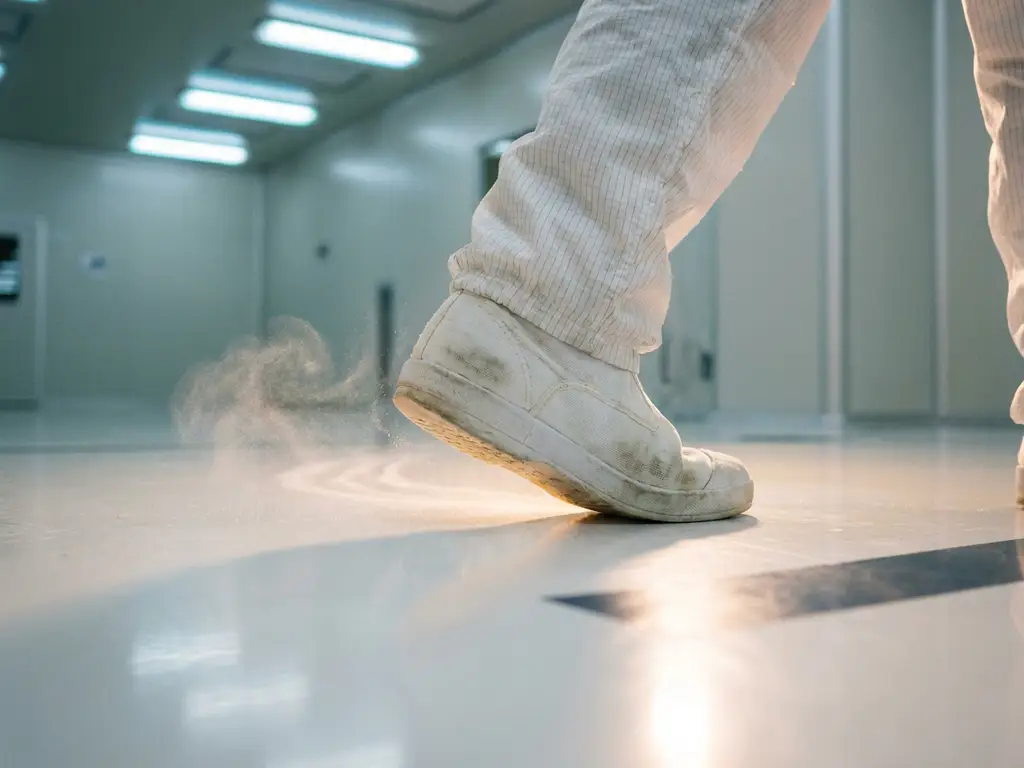
Cleanroom shoes and booties significantly reduce the risk of contamination from foot traffic, but they do not fully prevent floor contamination on their own. The limitation is mechanical: footwear captures particles already on the sole but cannot prevent contaminants from being tracked in while walking through uncontrolled zones before the controlled environment is reached. The sections below address the most common questions facilities teams ask about cleanroom footwear, floor-level contamination, and what a complete contamination control strategy actually requires.
How do contaminants bypass cleanroom footwear?
Contaminants bypass cleanroom shoes and booties primarily because footwear acts as a barrier on the foot, not on the floor. Particles shed from clothing, skin, and equipment settle on the floor regardless of what personnel are wearing. Once on the floor, those particles can be redistributed by foot traffic, airflow, and wheeled equipment, and standard cleanroom footwear does nothing to remove or capture what is already on the ground.
There are several specific pathways through which contamination bypasses footwear controls:
- Particle accumulation during gowning: Personnel put on cleanroom shoes or booties in gowning areas, but the act of gowning itself generates particles from clothing and skin. If the floor beneath them is not controlled, those particles are immediately at risk of being carried forward.
- Transfer at transition points: Entry points between uncontrolled and controlled zones are high-risk areas. Footwear picks up particles from uncontrolled floors and carries them across the threshold before any decontamination step occurs.
- Wheeled traffic: Carts, trolleys, and pallet trucks are not covered by footwear protocols at all. Wheels are among the most efficient carriers of floor-level contamination into controlled environments.
- Sole degradation: Over time, the materials used in cleanroom shoe covers can themselves shed particles, particularly under repeated use or mechanical stress.
The result is that cleanroom footwear addresses one dimension of contamination risk while leaving floor-level particle transfer largely unmanaged.
What percentage of cleanroom contamination enters through the floor?
Industry experience and contamination control research consistently indicate that up to 80% of contaminants entering controlled environments do so at floor level. This figure reflects the combined contribution of foot traffic, wheeled equipment, and airborne particles that settle and are then redistributed across floor surfaces. It is the most significant single contamination pathway in most cleanroom and controlled environment settings.
This proportion is particularly relevant for facilities that invest heavily in air filtration, gowning protocols, and surface cleaning, but apply minimal control at the floor entry point. When 80% of contamination risk is concentrated at floor level, a contamination control strategy that focuses primarily on overhead HEPA filtration or personnel gowning is addressing a minority of the problem. Floor-level intervention is not supplementary – it is foundational.
For quality managers preparing for GMP or ISO audits, this data point is a useful framing tool. Regulators and auditors increasingly expect facilities to demonstrate a layered approach to contamination prevention, and floor-level controls are a visible, documentable part of that approach.
Why do disposable sticky mats fail to solve the problem?
Disposable sticky mats fail to reliably solve floor contamination because their adhesive surface becomes saturated quickly, losing effectiveness long before the mat is replaced. Once the top layer is covered with particles, the mat no longer captures new contamination – it simply becomes another contaminated surface. The peel-off design is intended to address this, but in practice, layer changes are often delayed or inconsistent, particularly in high-traffic facilities.
Beyond performance degradation, sticky mats present several operational and compliance challenges:
- Inconsistent use: Personnel frequently step around or over sticky mats, particularly when carrying equipment or moving quickly. A mat that is bypassed provides no protection.
- Limited coverage for wheeled traffic: Disposable sticky mats are generally not engineered to withstand the weight and repeated pressure of carts, trolleys, or forklifts. Wheeled traffic either avoids them or damages them.
- Recurring cost and waste: Disposable mats generate significant single-use plastic waste and require continuous repurchase. Over a multi-year period, the total cost of ownership is substantially higher than reusable alternatives.
- Audit risk: If a sticky mat is visibly saturated or has not been refreshed, it can raise questions during regulatory inspections about the rigour of contamination control procedures.
For facilities under GMP, FDA, or ISO compliance requirements, the unreliability of disposable sticky mats introduces a risk that is difficult to document away.
What’s the difference between sticky mats and reusable contamination control mats?
The key difference between sticky mats and reusable contamination control mats is the mechanism of capture and the durability of that mechanism over time. Sticky mats rely on an adhesive layer that degrades with each footstep and must be replaced. Reusable contamination control mats use a polymeric surface engineered to capture and retain particles through a combination of surface texture and material properties, and that surface can be cleaned and restored to full performance repeatedly.
The practical differences extend across several dimensions:
- Performance consistency: A reusable polymer mat maintains its contamination capture properties after cleaning. A sticky mat’s performance declines from the first footstep and cannot be restored.
- Lifespan: High-quality reusable mats are designed to last three to five years or more. Disposable sticky mats are consumed continuously, with layers peeled away throughout the day in active facilities.
- Antimicrobial protection: Reusable contamination control mats from manufacturers like Dycem incorporate built-in antimicrobial technology, inhibiting microbial growth on the mat surface between cleaning cycles. Sticky mats offer no equivalent protection.
- Suitability for wheeled traffic: Engineered reusable mats can be specified for heavy wheeled traffic, including forklifts and pallet trucks. Disposable sticky mats cannot.
- Sustainability: Reusable mats generate a fraction of the waste produced by disposable alternatives, making them a more sustainable option for facilities with ESG commitments.
How does a contamination control mat system work at entry points?
A contamination control mat system works at entry points by creating a defined decontamination zone that personnel and equipment must pass through before entering a controlled environment. As shoes, boots, or wheels make contact with the mat surface, the polymeric material captures and retains particles from the sole or tyre, physically removing them before they can cross into the clean zone. The mat is then cleaned at regular intervals to maintain capture efficiency.
Effective mat placement follows the logic of the contamination pathway. Entry points – gowning rooms, airlocks, cleanroom entrances, and critical corridors – are the highest-risk transition zones because this is where uncontrolled and controlled environments meet. Positioning a mat at these thresholds intercepts contamination at the moment it is most likely to transfer.
For facilities with multiple entry types, the system can be configured to match the specific traffic at each point. Pedestrian entrances benefit from mats optimised for foot traffic, while loading bays or production areas with heavy wheeled equipment require mats engineered for greater mechanical load. The full range of contamination control mats available from Dycem covers both pedestrian and heavy-traffic applications, ensuring the right specification for each zone.
Cleaning protocols are a critical part of system performance. Reusable mats are typically cleaned with water and a mild detergent, restoring the surface to its original capture efficiency. This predictable maintenance cycle makes it straightforward to document and validate as part of a facility’s contamination control records.
When should facilities combine footwear protocols with floor-level controls?
Facilities should combine cleanroom footwear protocols with floor-level contamination controls whenever they operate in a regulated or precision-sensitive environment where contamination poses a compliance or product quality risk. The two controls are complementary, not interchangeable. Cleanroom shoes and booties manage what is on the foot; floor-level mats manage what is on the floor. A complete strategy requires both.
The case for combining both controls is strongest in the following scenarios:
- High-traffic entry points: Where large numbers of personnel enter a controlled zone repeatedly throughout a shift, floor-level mats provide consistent passive decontamination without relying on individual compliance with footwear protocols.
- Mixed traffic environments: Facilities where both personnel and wheeled equipment share entry points cannot rely on footwear protocols alone. Floor-level mats address both traffic types simultaneously.
- Regulatory audit preparation: Demonstrating a layered contamination control strategy – footwear, floor mats, gowning, and air filtration – provides stronger documented evidence of due diligence than any single control measure.
- Post-incident remediation: If a contamination event has been traced to floor-level transfer, adding mat controls at entry points is a documented corrective action that addresses the identified root cause.
In practice, the most effective contamination control programmes treat cleanroom footwear and floor-level controls as complementary layers within a broader strategy, not competing alternatives. Each layer closes a gap that the other cannot fully address.
How Dycem helps with cleanroom floor contamination control
Dycem’s reusable contamination control mat systems are designed specifically to address the floor-level contamination gap that cleanroom shoes and booties leave unmanaged. Where footwear protocols protect the foot, Dycem mats protect the floor, capturing up to 99.9% of shoe and wheel contaminants at the point of entry before they can reach the controlled environment.
Dycem’s product range covers every type of entry point and traffic condition:
- Dycem CleanZone: Engineered for pedestrian and light-wheeled traffic zones, including cleanroom entrances, gowning rooms, and airlocks. Delivers high-performance particulate capture at the most sensitive transition points.
- Dycem WorkZone: Built for heavy-wheeled traffic including forklifts, pallet trucks, and large carts. Provides consistent contamination control in demanding industrial and logistics environments, with a lifespan exceeding three years.
- Dycem Floating Mats: Flexible, repositionable mats for facilities that need non-fixed contamination control across variable or temporary zones.
All Dycem mats share core attributes: reusable polymer construction, built-in Biomaster antimicrobial protection, ISO-certified manufacturing, and a three-to-five-year lifespan that makes them a more sustainable and cost-effective alternative to disposable sticky mats. Mats are customisable in size, format, and colour to suit any facility layout, and Dycem’s contamination control specialists are available worldwide to support site assessment and system design.
To find out which solution is right for your facility, contact Dycem’s team to arrange a free site survey and consultation.