

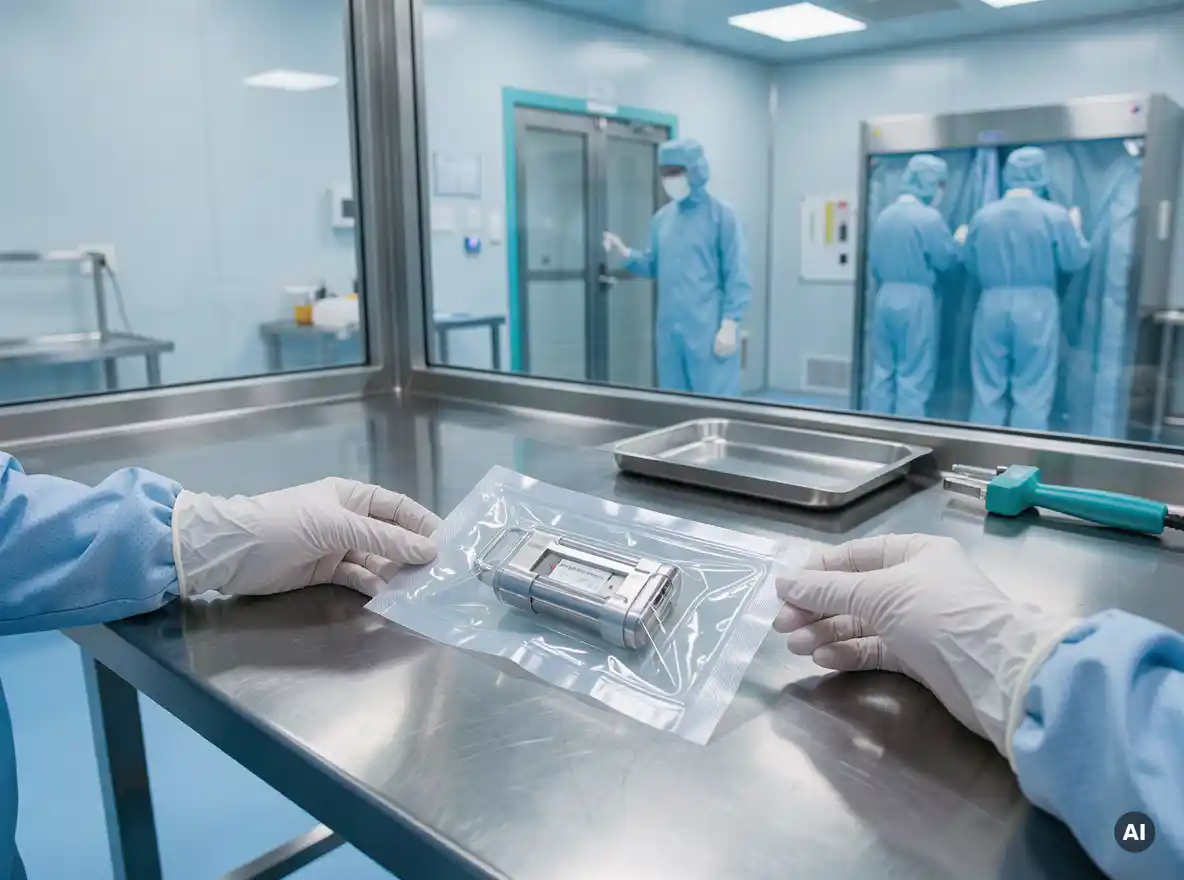
Medical device manufacturers limit particle transfer into sterile packaging areas by layering controls: defined gowning and material transfer procedures, validated cleaning, appropriate airflow and pressure management, and floor-level contamination control at every entry point. Footwear and wheels carry particles continuously, so capturing them at thresholds is a practical priority. The sections below cover where particles enter, which controls help, and how to verify results.
Where do particles enter sterile packaging areas most often?
Particles enter sterile packaging areas most often through personnel entrances, material transfer points, and wheeled equipment crossing from less controlled zones. Each doorway, airlock, and pass-through is a boundary where contamination from adjacent areas can follow people, carts, and products into the packaging environment.
The most common entry routes include:
- Gowning rooms and changing areas, where footwear, garments, and hands transition between zones.
- Corridors and airlocks connecting general manufacturing or warehouse space to controlled rooms.
- Material pass-throughs, where cartons, trays, and components arrive carrying surface particulates.
- Trolleys and carts that roll between zones and deposit debris from their wheels.
Dycem’s industry experience indicates that around 80% of contaminants reach controlled environments at floor level, which is why thresholds deserve as much attention as air handling.
How do shoes and wheels carry particles into controlled zones?
Shoes and wheels carry particles by picking up dust, fibres, and debris from uncontrolled floors and releasing them on contact with the next surface. Treads and wheel contact patches hold fine particulates, which then dislodge through footsteps, vibration, and rolling, becoming resuspended and spreading across the room.
Because people and equipment cross thresholds many times per shift, small amounts of transferred material accumulate quickly. Hard-wheeled carts are a particular concern, as they run over contaminated floors and then travel directly towards packaging lines. Once particles settle on a clean floor, ordinary activity can lift them into the air and onto products, packaging materials, and sterile barrier surfaces.
This is a particulate and cross-contamination pathway, distinct from microbial control, although particles can also act as carriers for microorganisms. Understanding the difference between contamination and cross-contamination helps teams map which transfer routes matter most in their facility.
What controls reduce particle transfer at entry points?
Effective control combines several layers rather than relying on a single measure. Gowning procedures, validated cleaning, airflow and pressure strategy, controlled material transfer, and floor-level particle capture each address a different part of the pathway, and they work best when designed together.
- Gowning and behaviour: Defined garment sequences, hand hygiene, and limits on movement reduce personnel-generated particles. Specific practices should follow the facility’s risk assessment and applicable requirements.
- Airflow and pressure strategy: Filtered air and pressure differentials help direct particles away from critical areas. The appropriate strategy depends on the facility’s contamination control and containment needs rather than a single universal setting. Airborne particle cleanliness classification is defined in ISO 14644-1, while ISO 14644-2 covers monitoring and periodic testing.
- Material transfer discipline: Wipe-down, depackaging, or transfer hatches limit what enters on cartons and tools.
- Cleaning and disinfection: Scheduled, validated cleaning removes what accumulates between controls, with frequencies and agents set by the facility’s own risk assessment.
- Floor-level capture: Contamination control mats at thresholds remove particles from soles and wheels before they travel further.
Floor-level capture does not replace HVAC, HEPA filtration, or gowning, but it reduces the particle load those systems must handle. Facilities that also manufacture sterile medicinal products can review what a contamination control strategy involves under EU GMP Annex 1. Annex 1 applies specifically to sterile medicinal products, not to medical devices, but it offers useful principles for wider sterile manufacturing. Note that EU GMP Grades A–D and ISO cleanroom classes are separate systems and are not automatically interchangeable.
Are reusable polymeric mats better than sticky mats?
For most sterile packaging entry points, reusable polymeric mats are a strong option. They maintain consistent particle capture without peeling layers, can be washed and reused, and avoid the disposal waste and layer-change errors associated with sticky mats. Suitability still depends on traffic type and site conditions.
Key points of comparison:
- Consistency: Sticky mats lose effectiveness as sheets fill and must be peeled on schedule. A missed or incomplete peel leaves a saturated surface, and loose peeled sheets can themselves become a debris source.
- Cleaning approach: Polymeric mats are cleaned in place and reused, so capture performance does not depend on removing a sheet at the right moment.
- Waste and sustainability: Reusable mats are a more sustainable option, as they avoid the continual disposal of peel-off sheets and packaging.
- Lifecycle: Dycem designs its mats to perform for 3 to 5 years, subject to application and care.
Dycem mats also incorporate Biomaster silver-ion technology, which inhibits microbial growth on the mat surface. This supports hygiene but does not replace cleaning, disinfection, or environmental monitoring.
How should mats be placed and maintained for best results?
Mats should be placed where all foot and wheel traffic must cross them, directly at the point of transition into the controlled area, and maintained with regular cleaning to keep the surface effective. Coverage and contact are the two decisive factors: a mat that can be walked around or is too short will miss contamination.
For medical device packaging areas, the entry points described earlier are the priority:
- Map traffic flows to identify every route people and wheeled equipment use between zones.
- Place mats at gowning room exits, cleanroom entrances, airlocks, and critical corridors, sized so both feet and every wheel make contact.
- Match the product to the traffic. Dycem CleanZone is engineered for pedestrian and light-wheeled traffic, while heavy-wheeled industrial traffic calls for a different solution, such as Dycem WorkZone.
- Set a documented cleaning routine following the manufacturer’s guidance, as outlined in Dycem’s cleaning instructions.
- Inspect surfaces for wear, damage, or build-up as part of routine checks.
Medical device facilities with varied layouts can see how this applies in practice on Dycem’s medical device industry page.
How can manufacturers verify that particle control is working?
Manufacturers verify particle control through environmental monitoring, surface and mat inspection, and, where appropriate, measured particle collection testing. Verification should combine trend data from the cleanroom with direct evidence that entry-point controls are capturing particles as intended.
Practical verification methods include:
- Non-viable particle monitoring in line with the facility’s classification and monitoring plan. The difference between viable and non-viable monitoring clarifies what each method detects.
- Surface and settle monitoring near entry points to confirm trends are stable. Settle plates and active air sampling play complementary roles: settle plates show what deposits over a set exposure time, while active air sampling measures microorganisms in a known volume of air.
- Routine mat inspection and cleaning records to show the control is maintained.
- Trend review after changes, such as new traffic patterns, equipment, or layout adjustments.
Results should be interpreted against the facility’s own risk assessment and monitoring limits. No single product guarantees compliance, so mat performance is best judged as one control within the wider contamination control strategy.
For teams planning new packaging areas or reviewing entry points, Dycem offers a complimentary site survey to identify where floor-level contamination control will have the greatest effect.
Frequently Asked Questions
Where should I start if I want to improve particle control at our sterile packaging entry points?
Start by mapping every route that people, carts, and materials take into the packaging area, then rank each entry point by traffic volume and the cleanliness gap between the zones it connects. Review existing environmental monitoring trends near those doors to find where particle counts are highest. Priority points are usually gowning room exits, airlocks, and corridor transitions, and a site survey can help confirm where floor-level controls will have the greatest impact.
What are the most common mistakes when installing entry-point mats?
The most frequent errors are mats that are too small, so people or wheels can bypass them, and placing them away from the actual point of transition. Other mistakes include using a product that does not suit the traffic type (for example, heavy wheeled equipment on a mat designed for pedestrians), letting edges curl or lift, and skipping documented cleaning and inspection. Walk the route yourself to confirm that both feet and every wheel contact the mat.
What should I do if particle counts rise near an entry point after a layout or process change?
Treat it as a trend that needs investigation: review recent changes to traffic patterns, equipment, cleaning schedules, and gowning practice. Check that mats are intact, clean, and positioned where traffic now flows, and confirm that airflow and pressure differentials are still within specification. Document the findings and corrective actions, and continue monitoring to verify the trend returns to normal.