

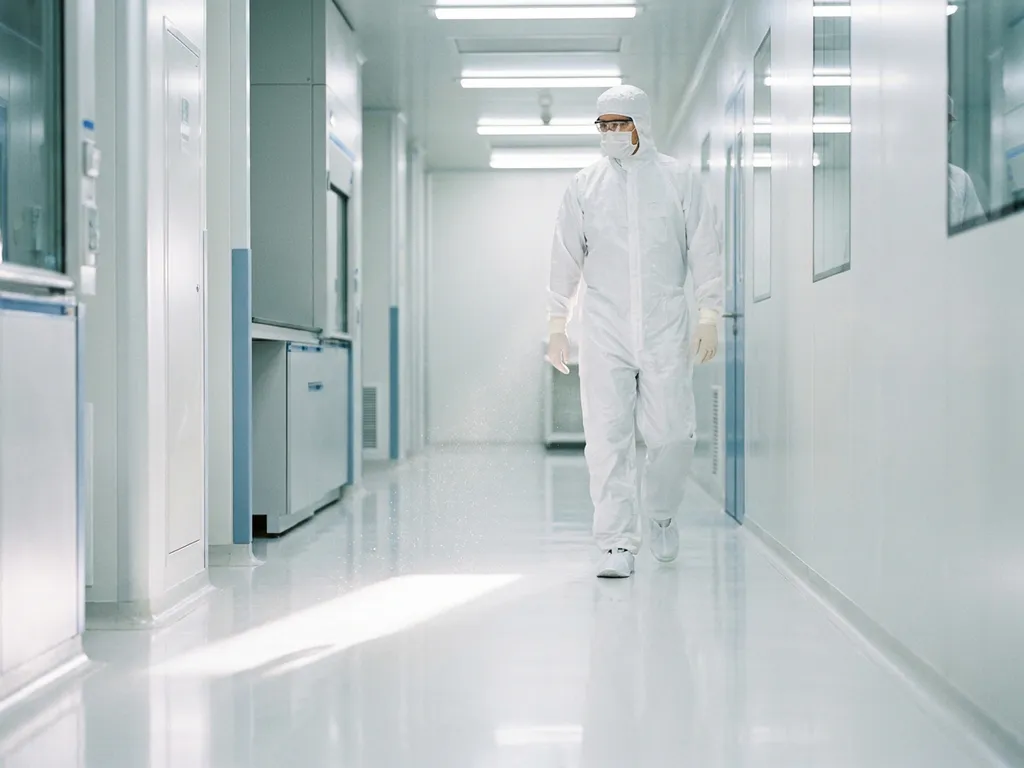
The most commonly transferred floor particles include fibres, skin cells, dust, microorganisms, and chemical residues. These contaminants are introduced primarily by foot traffic and wheeled equipment, with human activity being the dominant transfer mechanism in most controlled environments. The sections below examine where these particles originate, how they move, and which industries face the greatest exposure risk.
Where do floor-level particles originally come from?
Floor-level particles originate from three primary sources: the external environment brought in through entry points, human activity inside the facility, and the facility itself. Outdoor contaminants such as soil, pollen, and airborne debris attach to footwear and wheel surfaces and are carried directly into controlled spaces. Once inside, personnel shed skin cells, fibres from clothing, and hair continuously as they move through the facility. Surfaces, equipment, and even building materials contribute additional particulate matter over time.
The breakdown of particle origins matters because different sources require different control strategies. Externally sourced particles tend to be larger and more irregular, making them easier to capture at entry points. Internally generated particles, particularly those shed by personnel, are often finer and more persistent. Process-generated particles, such as those produced by manufacturing equipment or chemical reactions, are typically the most hazardous in terms of product contamination risk.
Understanding the origin of floor contaminants is the first step toward building a layered contamination control strategy that addresses each source systematically rather than reactively.
What are the most common particle types found on cleanroom floors?
The most common particle types found on cleanroom floors are fibres, skin flakes, dust, microorganisms such as bacteria and fungal spores, chemical residues, and inorganic particles including metal fragments and mineral dust. Each type presents a distinct contamination risk depending on the industry and the sensitivity of the processes taking place within the controlled environment.
Fibres are among the most prevalent contaminants and come primarily from clothing, including garments worn beneath cleanroom gowning. Even with full gowning protocols in place, fibres can escape through gaps at cuffs, collars, and zippers. Skin cells are generated constantly by every person present in the facility and can carry viable microorganisms on their surface, compounding the biological contamination risk.
Inorganic particles such as silica dust, metal shavings, and mineral residues are particularly relevant in electronics, aerospace, and precision engineering environments. These particles can cause physical damage to components at a microscopic level. Chemical residues, meanwhile, are a concern in pharmaceutical and food processing environments where cross-contamination between substances could compromise product integrity or patient safety.
How do particles transfer from floors into controlled environments?
Particles transfer from floors into controlled environments primarily through mechanical transport, which occurs when footwear and wheeled equipment pick up contaminants from one surface and deposit them in another zone. Secondary transfer mechanisms include air disturbance caused by foot traffic, which resuspends settled particles and allows them to migrate to higher surfaces, equipment, and exposed product.
The transfer process is largely invisible and continuous. Every step taken by a person walking through a facility lifts particles from the floor surface and redistributes them. Wheeled equipment such as trolleys, pallet trucks, and carts are particularly efficient at transferring contaminants because their wheels maintain consistent contact with the floor over long distances, collecting particles across multiple zones before depositing them in sensitive areas.
Industry data consistently shows that around 80% of contaminants entering controlled environments arrive at floor level. This statistic underscores why floor-level contamination control is a foundational element of any cleanroom protocol, not an optional supplementary measure. Without an effective barrier at entry points, even the most rigorous air filtration and gowning procedures are undermined by what enters underfoot.
Which industries face the highest risk from floor-transferred particles?
Pharmaceuticals, medical devices, electronics, aerospace, and food and beverage manufacturing face the highest risk from floor-transferred particles. In these industries, even trace levels of contamination can result in product failure, regulatory non-compliance, patient harm, or costly batch losses. The sensitivity of the processes involved means that contamination control is a compliance requirement rather than an operational preference.
In pharmaceutical and medical device manufacturing, floor-transferred particles can introduce microbial or chemical contamination into sterile products. Regulatory frameworks including GMP, FDA, and ISO 14644 set strict particulate limits for cleanroom environments, and failure to meet these standards can result in facility shutdowns, product recalls, and significant financial penalties.
Electronics and semiconductor manufacturing present a different but equally serious risk. Particles as small as a fraction of a micron can cause defects in microchips and circuit boards, resulting in component failure and yield losses. In aerospace and precision engineering, metallic particles and fibres can compromise the integrity of safety-critical components. Food and beverage facilities face contamination risks that directly affect consumer safety, with regulatory bodies enforcing strict standards around allergen and microbial control.
What particle sizes are most difficult to control at the floor level?
Sub-micron particles, those smaller than 1 micrometre in diameter, are the most difficult to control at the floor level. These particles are too small to settle reliably under gravity, meaning they remain airborne for extended periods and are easily resuspended by any air movement or foot traffic. Standard mechanical capture methods are less effective at this scale, and their small mass means they travel further once disturbed.
Particles in the range of 0.1 to 1 micrometre present a particular challenge because they fall into a size range where neither gravitational settling nor simple filtration is fully effective. This range is sometimes referred to as the most penetrating particle size in filtration science. In cleanrooms classified to ISO 5 or above, controlling particles at this scale requires a combination of HEPA filtration, positive pressure management, and rigorous entry-point contamination control working in concert.
Larger particles, while easier to capture individually, pose a different problem: they act as carriers for smaller contaminants including bacteria and chemical residues. A single fibre or skin flake can transport dozens of microbial cells into a controlled environment, making the capture of macro-particles at entry points an important secondary defence even when the primary concern is sub-micron contamination.
How can floor contamination be measured and monitored effectively?
Floor contamination in controlled environments is most effectively measured through a combination of surface particle counts, microbial contact sampling, and visual inspection protocols carried out at defined intervals. These methods provide both quantitative data on particulate levels and qualitative insight into contamination patterns across the facility.
Surface particle counting involves collecting samples from floor surfaces using validated swabbing or contact plate techniques. Results are compared against baseline measurements and regulatory limits to identify whether contamination levels are within acceptable ranges. In pharmaceutical and medical device facilities, this data forms part of the environmental monitoring programme required under GMP regulations.
Microbial contact sampling uses settle plates or contact plates to detect viable organisms on floor surfaces and at entry points. This is particularly important in sterile manufacturing environments where even low levels of microbial contamination can trigger a batch failure investigation. Trend analysis over time is as valuable as individual readings, as it reveals whether contamination control measures are maintaining consistent performance or deteriorating.
Regular visual inspection of entry points, gowning areas, and high-traffic corridors provides a practical first-line indicator of contamination load. Visible soiling, discolouration, or debris accumulation at these locations signals that the contamination barrier is being challenged and that intervention is needed. Combining visual checks with scheduled quantitative sampling gives facilities the most complete picture of their floor contamination status.
How Dycem helps control floor-level contamination
Dycem’s reusable contamination control mats are engineered to address floor-level particle transfer at its source, capturing contaminants from footwear and wheeled equipment before they can enter controlled zones. The system works by using a high-tack polymeric surface that physically removes particles from the undersides of shoes and wheels with each pass, providing a consistent and measurable barrier at every entry point.
- Up to 99.9% capture rate of shoe and wheel contaminants, validated across a range of particle types and sizes
- Built-in Biomaster antimicrobial protection that inhibits the growth of bacteria and other microorganisms on the mat surface
- Reusable and washable construction with a lifespan exceeding three years, eliminating the recurring cost and waste of disposable sticky mats
- ISO-certified manufacturing aligned with EN ISO 9001 and 14001, supporting compliance with GMP, FDA, and ISO cleanroom standards
- Product range designed for every zone, from pedestrian entry points with CleanZone mats to heavy-wheeled traffic areas with WorkZone, and flexible temporary zones with Floating Mats
Whether you are managing a pharmaceutical cleanroom, a food processing facility, or a precision electronics environment, Dycem’s contamination control specialists can assess your specific entry points and contamination risks through a free site survey. Contact Dycem to arrange a consultation and find out how the right floor-level solution can strengthen your contamination control programme.