

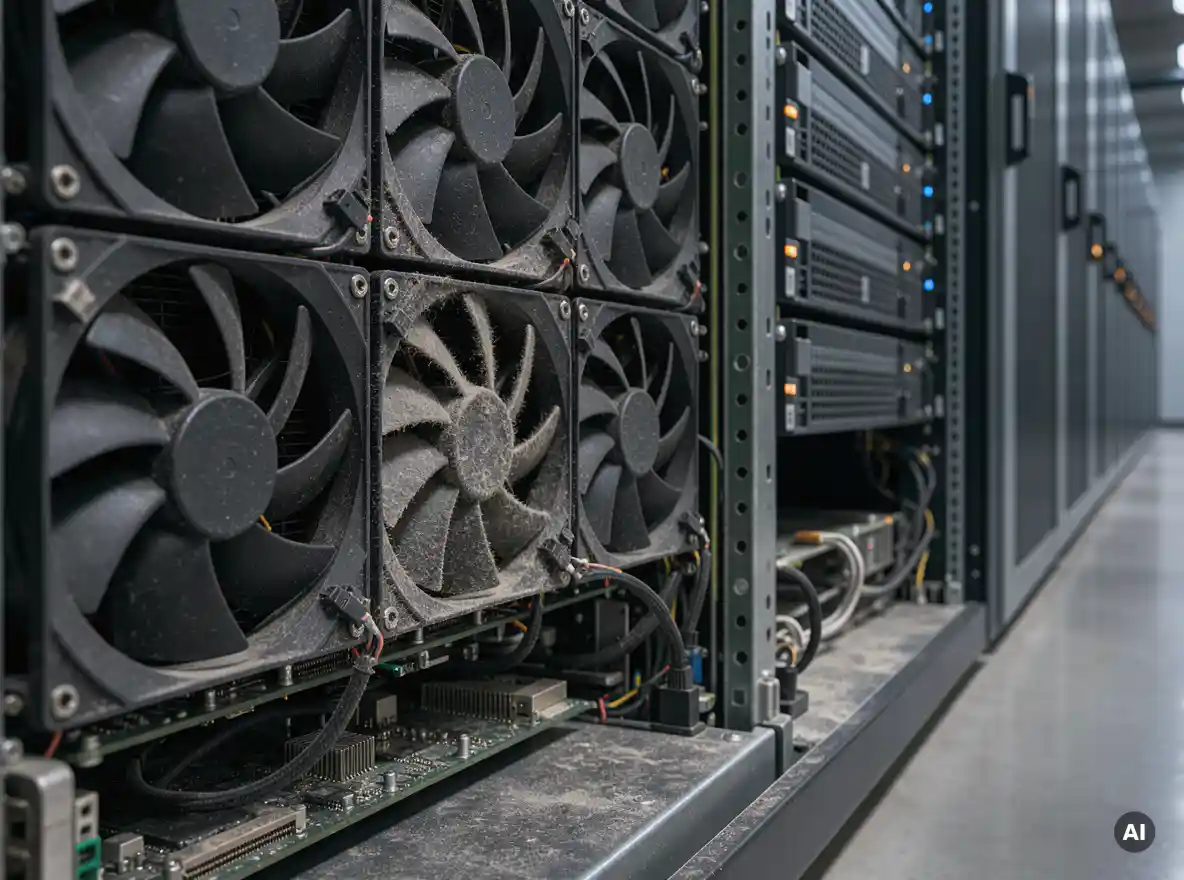
Particulate contamination is a problem in data center server rooms because airborne and surface dust settles on hardware, restricts cooling airflow, and can cause overheating, electrical faults, and premature component failure. Much of it is carried in on footwear, wheels, and packaging. Effective data center contamination control therefore combines clean air management, disciplined cleaning, and floor-level entry controls.
The sections below explain where particles originate, how they damage equipment, which standards apply, how to detect contamination, and how to reduce it.
Where do server room particles come from?
Server room particles come from two broad groups of sources: those carried in from outside the room and those generated inside it. External sources include outdoor air, footwear, equipment wheels, and unpacked hardware. Internal sources include cardboard and packaging debris, degrading materials, and the movement of people and equipment.
Understanding the pathway matters because each source calls for a different control. The most common origins include:
- Foot traffic: Shoes carry soil, grit, fibres, and fine dust from corridors, loading areas, and outdoor surfaces into white space.
- Wheeled equipment: Trolleys, carts, and rack delivery equipment transfer particles from dirtier zones to cleaner ones.
- Packaging and unboxing: Cardboard, wood pallets, and shrink wrap shed fibres and fragments when hardware is unpacked near live equipment.
- Construction and maintenance work: Drilling, cutting, and cable work release dust that can spread quickly through a facility.
- Air intake and ventilation: Outdoor air that is inadequately filtered can introduce fine particulate.
- Room materials: Deteriorating ceiling tiles, unsealed concrete, and worn surfaces can shed particles over time.
Floor-level transfer from footwear and wheels is widely recognised as a major route for contamination entering controlled environments, which is why entrances and transition points deserve particular attention.
How does dust damage servers and networking equipment?
Dust damages servers by insulating components, blocking airflow, and creating conditions for electrical faults. Accumulated particles act as a thermal blanket on heat sinks and fans, raising operating temperatures. Over time this can shorten component life, trigger thermal throttling, and increase the risk of unplanned downtime.
The main damage mechanisms are:
- Restricted cooling: Dust clogs filters, fan blades, and heat sink fins, forcing fans to work harder and reducing cooling efficiency.
- Heat retention: A layer of dust on circuit boards traps heat, which can accelerate the ageing of components.
- Electrical faults: Conductive or hygroscopic particles can bridge closely spaced contacts, leading to short circuits or intermittent errors, particularly in humid conditions.
- Corrosion: Certain particles, including those containing salts or sulphur compounds, can corrode connectors and contacts over time.
- Mechanical wear: Abrasive particles can affect moving parts such as fan bearings and disk drive components.
The practical outcome can be higher energy use for cooling, more frequent hardware replacement, and a greater likelihood of outages. These are exactly the operational risks data center operators work to avoid.
What cleanliness standards apply to data center particulates?
The principal reference for data center particulate cleanliness is ISO 14644-1, which classifies air cleanliness by airborne particle concentration. ASHRAE guidance for data processing environments commonly points to ISO Class 8 as the recommended airborne cleanliness level. These are industry guidance and design references rather than universal legal requirements.
Several points are worth distinguishing:
- ISO 14644-1: Defines cleanliness classes based on the number of particles per cubic metre at specified particle sizes. Data centers typically reference ISO Class 8 as a practical target.
- ISO 14644-2: Covers monitoring and periodic testing to demonstrate that a classified area continues to meet its class. It is a separate requirement from classification itself.
- ASHRAE guidance: Technical committee publications for data processing environments recommend limits on airborne particulates and also address gaseous contamination and surface cleanliness.
- Manufacturer requirements: Equipment vendors often set their own environmental conditions as a condition of warranty, so operators should check hardware documentation.
- Contractual and customer requirements: Colocation and enterprise agreements may impose cleanliness conditions that go beyond general guidance.
Facilities should confirm which of these actually apply to their site, jurisdiction, and contracts rather than assuming a single standard governs every data center. For a deeper explanation of how particle monitoring approaches differ, see this guide to viable and non-viable particle monitoring.
How can you tell if a server room is contaminated?
You can tell a server room is contaminated through a combination of visual inspection, airborne particle counting, and surface sampling. Visible dust on racks, floors, or vents is an early warning, but particle counters and surface tests provide measurable evidence of whether conditions meet the target cleanliness level.
Practical indicators and verification methods include:
- Visual inspection: Look for dust on rack tops, under raised floors, on fan intakes, and around air supply points.
- Airborne particle counting: Use a calibrated particle counter to measure concentrations against the chosen ISO class.
- Surface cleanliness testing: Sample surfaces such as floors and equipment tops, using methods like tape lift or surface particle counting.
- Equipment symptoms: Rising inlet temperatures, increased fan speeds, clogged filters, or recurring unexplained hardware faults can point to contamination.
- Cleaning frequency review: If surfaces need cleaning far more often than expected, the source of ingress is worth investigating.
Trends are more useful than single readings. Regular monitoring at consistent locations helps identify whether contamination is rising and where it is entering.
How do you reduce particulate contamination in a data center?
You reduce particulate contamination in a data center by layering controls that stop particles at their source, remove them from the air, and keep surfaces clean. No single measure is sufficient. Effective programmes address people, materials, air, and floors together, and verify results through monitoring.
Key measures include:
- Control entry points: Establish defined transition zones before the white space where footwear and wheels are addressed.
- Manage materials: Unpack hardware in a staging area away from live equipment and remove cardboard and wood from the server hall.
- Maintain air filtration: Keep HVAC filters correctly rated and replaced on schedule, and consider positive pressure relative to adjacent dirtier areas where the facility design allows.
- Clean consistently: Use a documented cleaning schedule with appropriate tools such as HEPA-filtered vacuums, and avoid methods that resuspend dust.
- Restrict access and set rules: Limit unnecessary traffic and communicate expectations to contractors and visitors.
- Monitor and review: Track particle counts and cleaning findings to confirm controls are working.
A structured approach to planning these measures is outlined in this overview of a contamination control strategy. Although that guidance originates in sterile pharmaceutical manufacturing, where EU GMP Annex 1 applies, the underlying principle of identifying and controlling contamination pathways translates well to other critical environments such as data centers.
Do contamination control mats work at data center entrances?
Yes, contamination control mats can reduce the particles that footwear and wheels carry into a data center when they are placed at entrances and transition points. They address one specific pathway, floor-level contamination, and work best as part of a layered strategy alongside filtration, cleaning, and access discipline.
Dycem reusable polymeric mats are designed to attract, capture, and retain particles from shoe soles and wheels as people and equipment pass over them. According to Dycem, its mats can capture up to 99.9% of particles under the conditions tested, and results in a given facility will depend on factors such as traffic levels, cleaning routine, and installation. Dycem also notes that most contaminants enter controlled environments at floor level, which is why entry points are a logical place to intervene.
For pedestrian and light-wheeled traffic at data hall entrances, airlocks, and corridors, Dycem CleanZone is the relevant product. Unlike disposable peel-off options, reusable mats are a more sustainable choice because they are washed and reused rather than discarded. Facilities comparing approaches may find it useful to review how reusable mats differ from sticky mats.
Mats do not replace HVAC filtration, validated cleaning, or equipment monitoring. They reduce the amount of particulate that has to be managed by those other controls. Regular cleaning of the mat surface, following Dycem’s cleaning guidance, is what maintains its performance.
Particulate contamination in server rooms is a manageable risk when its sources are understood and controlled in layers. Starting at the entrance, where footwear and wheels introduce much of the dust, is often the most practical first step. Facilities assessing their entry points can arrange a complimentary site survey with a Dycem contamination control specialist to identify where floor-level ingress is occurring and which controls fit the layout.
Frequently Asked Questions
How often should a data center be cleaned to control particulates?
There is no single schedule that fits every facility. Frequency depends on traffic levels, room design, and monitoring results. Many operators set a routine schedule for floors and equipment tops, then adjust it based on particle counts and how quickly dust builds up. If surfaces need cleaning far more often than expected, investigate the source of ingress rather than simply increasing cleaning.
What cleaning methods should be avoided in a server room?
Avoid dry sweeping, feather dusters, and standard vacuums without HEPA filtration, because they can resuspend fine particles into the air where they can settle on or be drawn into equipment. Use HEPA-filtered vacuums and lint-free, damp or purpose-designed cleanroom wipes, and follow equipment manufacturers’ guidance. Only trained staff should clean around live hardware or under raised floors.
What if my cleanliness readings exceed the target ISO class?
First confirm the result by repeating measurements at consistent locations and times, and check that the particle counter is calibrated. Then trace the source by reviewing HVAC filter condition, recent construction or hardware deliveries, door and entry practices, and floor-level traffic. Address the most likely pathways, such as unpacking in the white space or unfiltered air, and re-test to confirm improvement.