

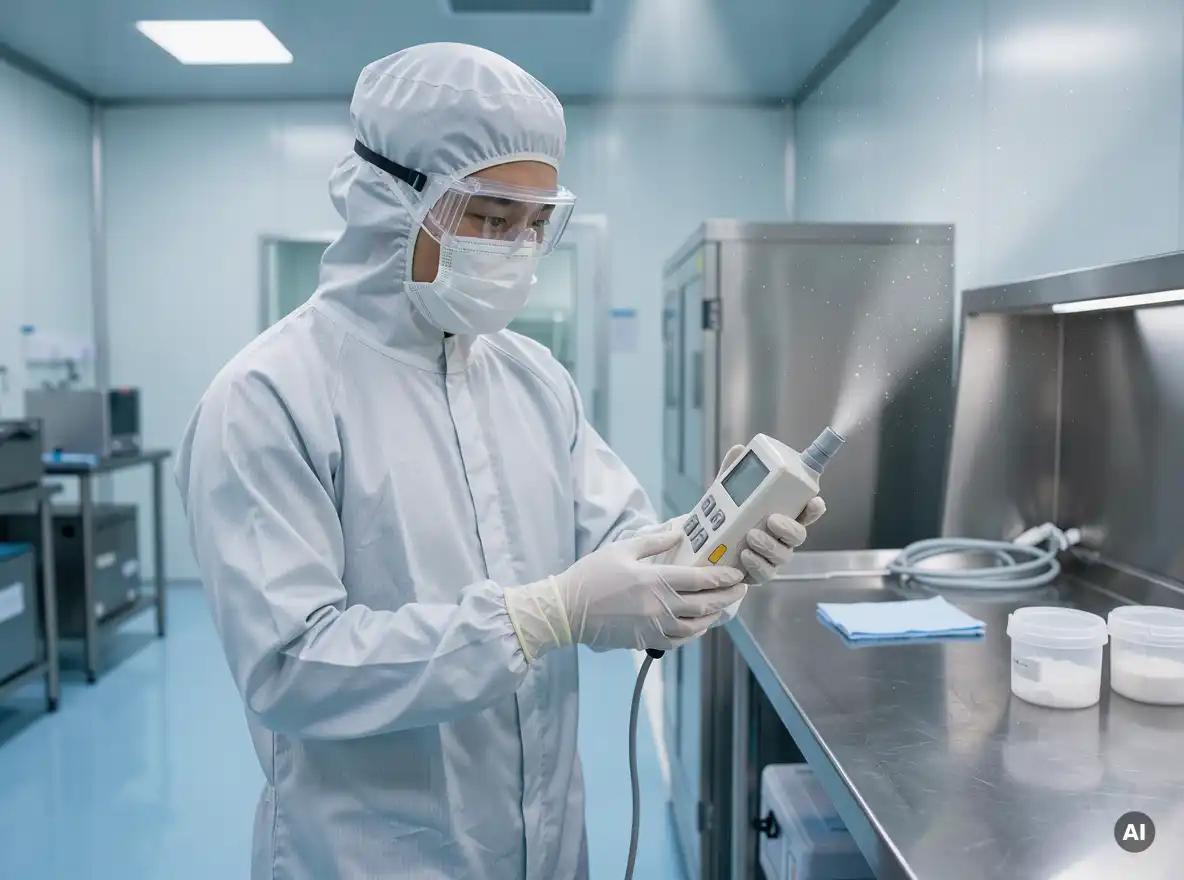
A one-off spike and a recurring excursion have different root causes, so the response must differ too. This article explains how to read the pattern, which sources to check first, how floor-level contamination and airflow contribute, and how to investigate and prevent repeat excursions in line with non-viable particle monitoring principles.
How can you tell why excursions keep recurring?
You can tell by analyzing the pattern: when excursions happen, where the particle counter sits, which particle sizes rise, and what activity coincides with them. Recurring excursions that cluster around shift changes, material deliveries, or specific locations point to a repeatable source, not random noise.
Start by overlaying monitoring data with operational records. Useful questions include:
- Timing: Do excursions follow shift handovers, breaks, cleaning cycles, or deliveries?
- Location: Is one sampling point responsible for most alerts, or do several points rise together?
- Particle size: Do 0.5 µm counts rise, or mainly 5.0 µm and larger? Larger particles typically settle quickly and often indicate local, mechanical, or personnel sources, while a broad rise across sizes can suggest filtration or airflow issues.
- Duration: Do counts recover in minutes (activity-linked) or stay elevated (system-linked)?
A trend review across weeks, not individual alarms, is what separates a systemic cause from an isolated event. Results are assessed against the limits relevant to your facility. ISO 14644-1 defines cleanroom classification by airborne particle concentration, while ISO 14644-2 covers monitoring and periodic testing. For sterile medicinal product manufacturing, EU GMP Annex 1 sets Grade A–D limits and monitoring expectations. ISO classes and EU GMP grades are related but not interchangeable, and alert and action levels should be set according to your own quality system and risk assessment.
What are the most common sources of recurring excursions?
The most common sources are people, incoming materials and equipment, floor-level traffic, inadequate or inconsistent cleaning, and environmental control faults. Personnel are generally the largest contributor inside an operating cleanroom, while the floor and entry points are major routes for contamination arriving from outside.
Each source leaves a recognizable signature:
- Personnel: Counts rise with movement, gowning breaches, or high headcount. Poor gowning technique and rapid movement shed skin and fibers.
- Material and equipment transfer: Spikes align with deliveries, trolleys, packaging, or cardboard entering the space.
- Cleaning practices: Inconsistent technique, unsuitable wipes, or residue from poorly managed cleaning cycles can generate rather than remove particles.
- Process activity: Some operations generate particles directly, such as mechanical wear, cutting, or powder handling.
- Entry-point contamination: Soil carried on shoe soles and wheels bypasses upstream controls if it is not captured at the threshold.
Understanding the difference between general contamination and its spread is also valuable. Our guide to contamination and cross-contamination explains how a single entry route can feed multiple downstream areas.
Why does floor-level contamination keep raising particle counts?
Floor-level contamination keeps raising particle counts because footwear and wheels continually carry fine particulate into controlled areas, where foot traffic and wheeled movement can then resuspend it. Dycem estimates that around 80% of contaminants enter controlled environments at floor level, so an uncontrolled threshold keeps re-supplying the same problem.
Cleaning alone often cannot keep pace. Particles deposited on the floor are disturbed every time someone walks across it or a cart rolls through, and some are returned to the airborne zone. If the entry route is not controlled, the room is cleaned and re-contaminated repeatedly, which can produce the stop-start excursion pattern many facilities see.
Floor-level control targets this at the point of entry. Reusable polymeric flooring such as Dycem CleanZone is designed for pedestrian and light-wheeled traffic at gowning rooms, cleanroom entrances, corridors, and airlocks, where it attracts and retains particles from footwear and wheels before they travel further. According to Dycem, its mats can capture up to 99.9% of shoe and wheel contaminants under defined test conditions; actual performance depends on the installation, traffic, and cleaning regime. Floor-level control is one layer of a wider strategy. It does not replace gowning, cleaning, environmental monitoring, or HEPA filtration, and it does not on its own ensure regulatory compliance.
Can HVAC or airflow problems cause repeated excursions?
Yes. HVAC and airflow problems can cause repeated excursions when filtration, air change rates, or pressure cascades are compromised. A degraded or poorly seated HEPA filter, imbalanced pressure differentials, or disrupted airflow patterns can let particles accumulate or migrate between zones.
Signs that point toward the air system rather than activity include:
- Elevated counts that persist regardless of personnel or process activity
- Simultaneous rises across multiple sampling points
- Counts that worsen during door openings, suggesting a weak pressure differential
- Slow recovery times after a disturbance
Airflow can also be disrupted by physical changes inside the room. Equipment placement, added furniture, or new obstructions can create turbulence or dead zones that trap particles near the critical area. Checking recovery time, differential pressures, filter integrity, and air visualization (smoke studies) helps confirm or rule out airflow as the cause. Appropriate pressure strategies depend on the contamination control and containment requirements of each facility, so assess them against your own design intent rather than a generic target. Mats and cleaning cannot compensate for a failing air system, so these checks should run alongside any floor-level measures.
How should a recurring excursion be investigated?
A recurring excursion should be investigated systematically: confirm the data, characterize the pattern, map potential sources, test hypotheses one at a time, and document the findings. Treat it as a root cause investigation under your quality system rather than a repeated cleaning exercise.
- Verify the measurement. Confirm the particle counter’s calibration, sampling location, and sample volume, and rule out false counts from counter faults or poor tubing practice.
- Characterize the pattern. Review timing, location, particle size distribution, and recovery behavior across a meaningful trend period.
- Map the contamination pathways. Trace routes for people, materials, equipment, air, and the floor from entry to the affected area.
- Check engineering controls. Review HEPA integrity, air change rates, differential pressures, and any recent maintenance or layout changes.
- Review behavior and procedures. Observe gowning, movement, material transfer, and cleaning technique against the written procedures.
- Test one change at a time. Introduce corrective actions individually so the effect on counts can be attributed correctly.
- Document and trend. Record the root cause, actions, and verification results, and keep trending afterward to confirm the fix holds.
For sterile manufacturing, investigations should also feed into the site’s contamination control strategy. See our overview of a contamination control strategy under EU GMP Annex 1 for how monitoring data and corrective actions connect. Which standards and requirements apply depends on your industry and jurisdiction.
What prevents particle count excursions from returning?
Excursions stay away when the confirmed root cause is removed and a layered contamination control approach is maintained. Prevention combines controlled entry points, disciplined gowning and material transfer, validated cleaning, well-maintained air systems, and continuing trend monitoring so drift is caught before limits are breached.
Practical measures that support lasting control include:
- Control the threshold. Capture contamination from footwear and wheels at entrances, gowning areas, and airlocks, and keep that control properly maintained.
- Standardize behavior. Reinforce gowning technique, movement discipline, and material transfer procedures with training and periodic observation.
- Maintain cleaning discipline. Use appropriate tools, validated agents, and consistent frequency. Reusable floor surfaces need regular cleaning to keep performing, as covered in Dycem’s cleaning guidance.
- Service the air system. Schedule filter integrity testing, pressure monitoring, and airflow checks.
- Keep trending. Set alert levels below action limits and review data regularly to detect early drift.
Where excursions trace back to floor-level contamination, reusable polymeric flooring offers a more sustainable option than disposable peel-off mats, which generate repeated waste and need frequent replacement. Dycem’s mats are designed for a service life of several years, though the right product and layout depend on the traffic type in each area.
Recurring excursions rarely resolve through cleaning alone. They resolve when the repeating source is identified, controlled, and verified through data. If your investigation points to floor-level contamination at entry points, a complimentary Dycem site survey can help you assess traffic flows, identify where contamination is entering, and determine where floor-level control fits within your existing strategy.
Frequently Asked Questions
Where should I start if I have no idea what is causing our recurring excursions?
Start with the data you already have. Export several weeks of particle count results and overlay them with shift schedules, delivery times, cleaning logs, and maintenance records. Look for clusters by time, location, and particle size, then verify the particle counter’s calibration and sampling setup before investing in corrective actions. This usually narrows the list of suspects quickly and prevents you from chasing a measurement fault.
How do I know whether an excursion is a genuine contamination event or a false count from the instrument?
Check the counter’s calibration status, sample tubing (length, bends, and cleanliness), isokinetic probe setup, and sample volume. Look at whether counts are implausibly high with no corresponding activity, appear in a single channel only, or disappear when you swap in a verified counter at the same location. A repeat measurement with a second calibrated instrument is a simple way to confirm or rule out an instrument issue.
What if the excursions only occur at one sampling point?
A single problem location usually indicates a local source rather than a system-wide fault. Inspect what is nearby: door openings, personnel traffic paths, equipment that generates particles, damaged surfaces, or a nearby entry point such as an airlock or material hatch. Also check for local airflow disruption, such as new equipment or furniture that creates turbulence or dead zones around the sampling point.